Scammers tricked me with fake podcast offer

When dog groomer and social media star Caroline Donoghue was invited onto an exciting American podcast, she was over the moon.
Known online as Love Mud Dog Lady, with many thousands of followers on social media, Caroline is used to media appearances.
So when a well-known American podcast, WHOA That's Good, emailed her agent offering an appearance payment of $3,000, it seemed like a fantastic opportunity.
But, as she told Radio 4’s Scam Secrets, not everything was as it seemed...

A flattering offer
The email, sent from guest coordinator Calista Wren, was very flattering.
“We’re reaching out because we truly admire your work as an award-winning dog groomer and educator," it read.
“Your passion for canine welfare, along with your impactful social media presence, has created a space that educates and inspires dog owners around the world."
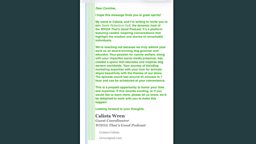
The email continued, adding a generous financial incentive:
“We’re reaching out because we truly admire your work as an award-winning dog groomer and educator'Email from 'Calista'
“This is a prepaid opportunity to honour your time and expertise. If this sounds exciting or you'd like to learn more, please let us know. We'd be delighted to work with you to make this happen.”
Caroline and her agent had no reason to believe that the message wasn’t genuine, so they decided to take "Calista" up on the offer.
Setting up the call

The video interview was to take place the next day using Facebook’s Meta Business Suite.
Caroline then got a call from the podcast’s IT technician, explaining what needed to happen to accommodate the recording.
All she had to do was add the email of the person from the podcast to her Meta Business suite profile to facilitate the call.
“I had to input this certain email address,” Caroline told Scam Secrets.
“They didn't ask me for passwords. It wasn't asking for me for any security information. Just add this email onto your events page and it'll make everything work perfectly.”
Caroline did this, then waited patiently for the podcast interview to begin. But it never happened.
“I was sat there ready for my podcast, so excited,” Caroline explained. “I'd been promoting it on my socials. And no one appeared.”
‘Very concerned’

Fearing something was wrong, Caroline contacted the WOAH That’s Good team and was told the interview request had not come from them. In fact, they had never heard of her.
And when Caroline next logged into her Facebook account, she realised that the email she had inputted, from the purported podcaster, now had full control of her Meta Business Suite account.
“My access is now at a basic level, so obviously I'm very concerned,” Caroline says.
“Now I can't control my page and I think, ‘Am I still going to have access this morning? Is the page still going to be there?’”
As a large amount of her income relies on her social media interactions, it was a worrying time for Caroline.
“The income that I get from working on these platforms and working with these different brands that I've built up over four years really does help us live.”
Scammers strike again

It wasn’t long until the scammers struck a second time, with a different animal organisation.
The British Hen Welfare Trust, a charity set up to rehome chickens used in the egg-laying industry, were also contacted by someone purporting to be from WOAH That’s Good, offering a fee for an interview.
Luckily for them, before they added any emails to their Meta Business Suite account, one of the charity’s founders grew suspicious.

They immediately alerted David, who looks after the IT for the British Hen Welfare Trust.
"They'll target anybody. We were completely drawn in and we wanted the opportunity."Fran, British Hen Welfare Trust
“I'm just thankful that we didn't add any external email addresses to that Facebook account,” David told the show.
“It would've been so easy to do because you're caught up in the moment of trying to make this all work.”
Fran, who received the original email from the scammers, was asked if she was surprised that they would target a charitable organisation like theirs.
“I suppose it's not shocking really,” she told Scam Secrets. “They'll target anybody. We were completely drawn in and we wanted the opportunity.
“It could have had millions of eyes on our charity and helped spread our message and potentially rehome thousands more hens. But it could've been potentially catastrophic for us.”
What are the scammers after?

While many scammers are simply seeking out money, these fraudsters are after something with a different type of value: access to social media followers.
For Caroline, the fraudsters had not only gained access to her Facebook account, they could now reach the hundreds of thousands of people who follow her page and trust her content.
They could target Caroline’s fans with any messaging they want: Crypto scams, fake advertising, phishing schemes or malware could be spread, using the account as bait.
The payments that Facebook made to Caroline for legitimate advertising on her page also stopped when her account was compromised.
It is unclear why the platform stopped these payments and the Scam Secrets team, despite correspondence with the company, couldn’t get a specific response concerning this.
After many months of negotiation, and worry, these payments did start up again and Caroline regained control of her account. But it was not an easy process.
Warning signs to look out for

If you have a social media account with a healthy following and are suddenly approached to appear on a podcast, what are the tell-tale signs that a scam might be occurring?
- Unofficial emails: In Caroline’s case, the original email came from a Gmail account, rather than an email associated with the podcast. Messaging from a third-party email address should be a cause for concern.
- Flattery: The tone used in the original email sent to Caroline was highly flattering. Although it might seem nice, it could also have been devised by AI as a manipulation technique.
- Unprofessional platform: Remote interviews for podcasts will likely take place on professional recording software, designed to capture audio at high quality. If the call is somewhere else, such as Facebook, maybe check the credentials again.
- Money offers: Some podcasts do offer appearance fees, but not all. Most assume that guests will appreciate the exposure a podcast can offer, especially one with millions of listeners. If large amounts of cash are suddenly being offered, proceed with caution.
- ‘Admin’ requests: Once the scammer’s email had been added to Caroline’s account, they were in full control. Being asked to add anything to the ‘admin’ section of your social media account by a third party should ring alarm bells. In general, if the instructions seem needlessly convoluted, it could be a scam.
The Scam Secrets team are here to help

As with many scams, if something seems too good to be true, it probably is.
This particular scam is effective as it appears to be so legitimate. A flattering approach from a hit podcast, a chance to gain a wider audience, a cash incentive and no sharing of sensitive information.
Facebook told Scam Secrets that it was closely working with law enforcement to help keep the scammers off its platforms.
You can listen to the full episode of Scam Secrets: ‘The Podcast Scam’ on BBC Sounds.
![]()
Booking a holiday? Watch out for this hard-to-spot scam
Holiday planning can be stressful - but for two Booking.com users, it became a nightmare when they were left hundreds of pounds out of pocket by a sophisticated scam.
![]()
'I was a scammer, now I fight fraud'
Former scammer turned Scam Secrets expert, Alex Wood, explains why he turned his back on crime and now fights fraud.
![]()
Is this the worst ‘what I ordered vs what I got’ ever?
It was supposed to be a lovely purple cardigan. What arrived was anything but...
![]()
Listen to Scam Secrets
Dissecting the techniques criminals use to steal your money - with fraud investigator Shari Vahl, criminologist Dr Elisabeth Carter and ex-criminal Alex Wood.