Why does British food have such a bad reputation?
Former French President, Jacques Chirac, reportedly said of the Brits, “You can't trust people who cook as badly as that. After Finland, it’s the country with the worst food.”
Is British cooking really a crime against food? Or is this a foreign plot to do down Britain?
In Here for the History on BBC Sounds, Alice Loxton and Ben Henderson investigate the influential moments behind Britain’s culinary reputation.
They explore how British aristocrats turned towards French food while our peasant cuisine was crushed by the Industrial Revolution and land enclosures.
They do a deep dive into parsnip sandwiches and carrot fudge as they examine the enduring legacy of World War II rationing and, finally, explore how gastropub grub is helping turn things around.

Listen to the full episode
![]()
Why does British food have such a bad reputation?
Ben Henderson and Alice Loxton investigate the history behind Britain’s culinary reputation. They explore how British aristocrats turned towards French food from the 1600s, while Britain’s peasant cuisine was crushed by the industrial revolution and land enclosures. Finally, they examine the enduring legacy of World War Two rationing.
Historically, English food was on a par with the French
In the 1500s, British fare was regarded as pretty good, even by our European neighbours.
The average Brit lived in a rural village and ate pottage, a vegetable stew, thickened with grains and, if times were good, embellished with a little meat or fish. Bread was a staple. Dairy produce came from a communal cow, and villagers would have kept chickens. At certain times of the year, starvation would have been a genuine concern, and so they ate every bit of the animal, intestines and all.
“One of the characteristics of food at the time is it's no worse than how peasants are eating in France or Spain,” states Ben.
At the top of Tudor society, Henry VIII was known for his hugely elaborate feasts. The food of the elite was heavily spiced and they added a lot of sugar, even to meat. “It wasn't bland in the slightest,” says Ben.
In the wake of the Norman conquest of 1066, English and French cuisine had a lot in common.
French cuisine began to dominate
In the wake of the Norman conquest of 1066, English and French cuisine had a lot in common.
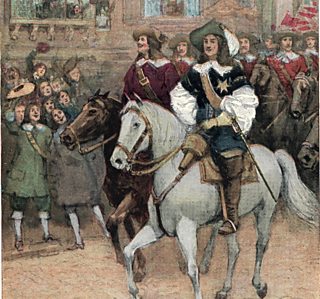
But in the 17th century, things would start to change.
“France is slowly becoming one of the dominant powers in Europe and what this instigates is a competition among much of the nobility in France to outdo each other,” says Ben. “It becomes a sort of kind of culinary arms race.”
“They use cooking as a way to show their status and their prestige and what emerges from this is a new, more refined French cooking.”
They moved away from medieval-style spiced meats and began to rely on aromatic, seasonal herbs. They used thickening agents and started making France’s iconic sauces, still with us to this day. They started treating vegetables as a delicacy in their own right.
People began writing down the rules. In 1651 came a seminal book: Le Cuisinier François by François Pierre de la Varenne. This is seen as the founding text of modern French cooking.
Meanwhile, in England, there was civil war. When the King was overthrown, his son went into exile in France. It is there that the future King Charles II developed a taste for French flavours. When the monarchy is restored in 1660, the “Merry Monarch” (so called due to his love of a good party) brings French cuisine back with him.
The elite circles start serving French cuisine at their elaborate dinner parties, and it slowly percolates through British society. British food has been knocked off its perch.
Hannah Glasse, a great influential cookery writer of the 18th century (the Delia Smith of her day), wrote, “So much is the blind folly of this age that they would rather be imposed on by a French booby than give encouragement to a good English cook.”
Peasant cuisine came under attack
In Medieval Britain, a lot of land was Common Land. Members of the local community were entitled to use it to graze their animals, grow their own food and collect firewood, which was essential for baking.
But, big landowners began to kick the peasants off, a process which accelerated in the 1700s. They petitioned Parliament for “enclosure” and put fences up. For the poor, their food lifeline was taken away.
A peasant from Bedfordshire described his situation: “I kept four cows before the parish was enclosed, and now I don't keep so much as a goose.”
Between 1604 and 1914, there were more than 5,000 enclosure bills, encompassing over a fifth of the area of England. It was an “earth-shattering” change for the peasantry, cutting off their supply of fresh meat and veg.
“It undermines that peasant cuisine, which I think if you look abroad in any culture is so important to developing a rich food culture,” says Ben. “It's a big reason why Britain is so lacking in that department.”
The Industrial Revolution meant no time for cooking
Between roughly 1750 and 1850, the Industrial Revolution transformed the nation.
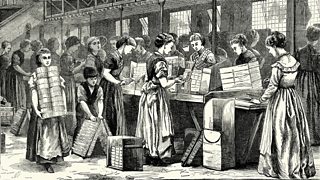
“Britain shifts its focus from being an agrarian society, people working from the land, and towards cities and an industrial society,” explains Alice.This had a huge impact on the way people ate.
A Manchester cotton factory worker’s diet was documented by the physician James Kay-Shuttleworth in the 1830s. Breakfast consisted of tea or coffee with a little bread, and occasional porridge. For lunch, it was boiled potatoes with melted lard, butter, and a smattering of fried bacon fat. And dinner? “A meal of the coarsest food is prepared with heedless haste, and devoured with equal precipitation.”
Women, who had been the backbone of household cooking for centuries, were increasingly going to work outside the home, with the children. Food knowledge was no longer being passed down the generations.
With the move to urban living, and no refrigeration, tinned food was on the up.
There were some positives: the popularisation of the sandwich, the pasty, the sausage roll and fish and chips. However, these examples of rugged, working-class fare rarely regarded as great delicacies abroad
Second World War rationing
Perhaps the biggest factor in our terrible food reputation is Second World War rationing.
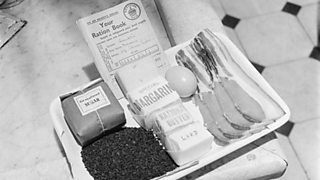
With Hitler’s U-boats sinking ships bringing food to Britain, the government decided food had to be rationed. Everyone was given a ration book with coupons for specific foods like bacon, ham, butter and sugar.
Imported fruit was limited so cooks had to become more inventive. Root vegetables were used as a replacement for sugar. This led to strange concoctions like carrot fudge and “banana” sandwiches, made with parsnips and food colouring! Turning to British produce did create some iconic innovations, like the classic crumble.
Rationing continued for nine years after the war ended – getting worse before it got better.
“For such a huge period of time, British people just don't have access to the products to make good cuisine,” states Ben. “A whole generation of Brits were raised without the ingredients to cook in a really nice way.”
A British Renaissance
In the 20th century, things started to improve. There was a post-war economic boom. Great food writers, like Elizabeth David, started to look abroad and reopen our eyes to the glories of Mediterranean food. There was a normalisation of foods like pasta in middle class households.
In the 60s and 70s, there were new waves of immigration, flooding the country with now beloved foods like curry and Chinese.
The reputation of traditional British food, however, was still struggling.
In 1984, a New York Times journalist wrote, “Go to an English pub and you are in danger of finding nothing more appetizing than a Scotch egg, which consists of a hard-cooked egg rolled in sausage meat, usually served stale.”
The gastropub revolution
In 1991, there came the start of a revolution: the gastropub. Restauranteurs Michael Belbin and David Eyre took over a London pub called The Eagle, extended the kitchen and started producing decent food.
“The gastropub has definitely improved the quality of British food over the last 35 years,” says Ben.
There is an emphasis on British produce, seasonality and localism, which is all part of something bigger – the Modern British movement. One pioneer, Fergus Henderson, set up a restaurant in the mid-90s called St. John. They became known for “nose to tail” cooking – a no-waste strategy that the average Tudor peasant would endorse!
A whole infrastructure of artisan cheesemakers, bakeries, foragers and market gardens has been built up to supply our restaurants with quality British ingredients.
“I think this has done a lot to undo the damage,” says Ben, “where the peasant cuisine was destroyed by industrialisation and the enclosures.”
“Things are looking up,” says Alice. “We're maybe becoming rivals once more with our French neighbours.”
Stats prove this.
“There are nearly 70 Michelin-starred restaurants serving predominantly British cuisine,” says Ben. “More than the number serving American and Spanish food combined.”