
The Indian Ocean - Argo float

Locations
The Indian Ocean
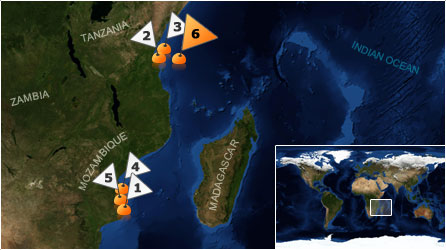
Location map
Introduction
The Indian Ocean is the third largest body of water on Earth at more than 6,000 miles wide and covering 13% of the world's surface. It is home to 5,000 species of fish, many of which only exist in the Indian Ocean. But it is also an ocean under threat from global issues such as over-fishing and climate change, which make this an ocean on the edge.
Argo float
Overview
The British Met Office is involved in an international project to investigate the complex process of heat transfer in the world's oceans and its effect on climate. In the tropics, the heating effect of the sun can have a major impact on weather and trigger dramatic storms so additional measurements from the Indian Ocean are very valuable.
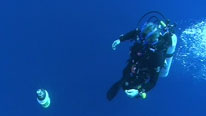
An un-manned Argo float will join a network of more than 3,000 similar data-collection devices around the globe. The float descends up to 2,000 metres to gather information on temperature salinity and depth. It then ascends and contacts a satellite to log its position and periodically to download the data before sinking again. Each float can work autonomously for up to 4 years.
| Importance: | The information collected by the Argo float will help scientists who are studying the relationship between the Indian Ocean monsoon and sea temperatures. |
| Dive category: | This is a deep dive made to assist in the float's deployment. |
| Access: | This dive was made for scientific purposes and is not available to the general public. |
Interesting for
- Argo floats
- Full information about the Argo project, how the floats work and what the scientists hope to achieve.
- Official Argo website
- Predicting the Earth's temperature
- Wikipedia discusses the techniques used in computer based climate prediction and their accuracy.
- Global climate model
BBC related content
- Oceans presenter biography: Paul Rose
- BBC Weather: Climate change
- BBC Science & Nature: Climate change experiment results
Episode region
BBC iD
BBC iDBBC navigation
BBC links

BBC © 2014The BBC is not responsible for the content of external sites. Read more.
This page is best viewed in an up-to-date web browser with style sheets (CSS) enabled. While you will be able to view the content of this page in your current browser, you will not be able to get the full visual experience. Please consider upgrading your browser software or enabling style sheets (CSS) if you are able to do so.
