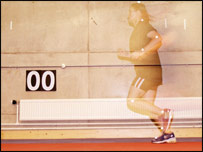
The term 'keep fit fanatic' is often said in jest – but exercise addiction is on the up and causing untold destruction to many people's health, careers and private lives. Now experts at Nottingham Trent University have created the world's quickest and easiest test to spot problem exercisers before their obsession spirals out of control. 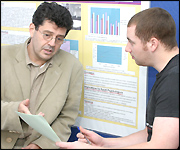 | | Dr Zsabo (on the left) |
Dr Attila Szabo, an international expert on exercise addiction, and Professor Mark Griffiths, an expert on addictive behaviour, have come up with the Exercise Assessment Inventory (EAI) a simple but accurate six point questionnaire which aims to seek out the growing number of exercise addicts, estimated at almost 3% of the population. Previous attempts to create exercise addiction models have resulted in lengthy questionnaires, followed by a complicated scoring method which has to be analysed by an expert. This is not the case with the EAI which takes seconds to complete and is easily scored by the user. The participant answers the questions and rates each one on a five point scale of strongly disagree (1) disagree (2) uncertain (3) agree (4) strongly agree (5). Those most at risk of exercise addiction would score 24 or more out of 30, a potential risk 13 to 23, and very unlikely risk zero to 12. Dr Szabo says: "There is a misconception that being addicted to exercise is healthy but this is certainly not the case. These people not only risk doing themselves serious harm physically, but are so obsessed with exercise that they will put it before their family, friends and career. It's not just about the amount of time these people spend exercising, but how much they think about it. To them, exercise is the most important thing in the world." He added: "People can test themselves if they think they have a problem but the EAI could also be referred by GPs, physiotherapists and occupational therapists who suspect a patient of exercise addiction. It is an essential tool that would enable measures to be put in place before the problem gets out of hand causing a great deal of physical and social damage." Professor Griffiths said: "Nobody really knows what causes exercise addiction but individuals probably turn to exercise as a form of escapism from another problem. Once identified, it can only really be cured by a mental health professional." So, here's your chance to test yourself and your partner. Questions for the Exercise Addiction Inventory: - Exercise is the most important thing in my life.
- Conflicts have arisen between me and my partner about the amount of exercise I do.
- I use exercise as a way of changing my mood (e.g. to get a buzz/to escape).
- Over time I have increased the amount of exercise I do in a day.
- If I have to miss an exercise session I feel moody and irritable.
- If I cut down the amount of exercise I do and then start again, I always end up exercising as often as I did before.
|