They say tragedy plus time equals comedy. But sometimes the relationship between the two concepts can be a lot closer. With Trainspotting, it's almost incestuous. Irvine Welsh's subversive cult novel takes us on a drug-fuelled roller-coaster ride through the darkest recesses of Edinburgh low-life. It seems an unlikely basis for a commercially successful film, but experiencing the stage adaptation helps to explain the journey that Trainspotting has taken. After all, it was the stage adaptation of Trainspotting by Harry Gibson which tempted film-maker Danny Boyle to turn his efforts towards putting it to celluloid. Horror and humour It's clear this is a work which time has not tamed. Its midnight-black humour and caustic satire still have allure - while its central themes retain their nightmarish qualities and still echo tabloid headlines. Welsh's wit is translated perfectly to the stage - opening with a healthy flow of irony as Renton and Tommy's initiative and ingenuity help them dodge employment and usurp benefits. As the play continues, the growing blend of horror and humour reaches an almost schizophrenic level. A characteristic of the cinematic adaptation of Trainspotting was in how it propelled the character of everyman junkie Mark Renton to centre stage - using his monologues to navigate an unwholesome world. However, the danger of concentrating on a central protagonist is that other characters are dismissed or forgotten, and the play solves this perfectly. By featuring monologues from a variety of characters it pulls us into a private tour of their personal hell. 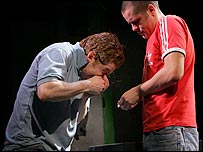 | | Ruaraidh Murray (left) and Peter Milne |
The self-denial and delusion of Ruaraidh Murray's Tommy makes his decline even more harrowing. Brian Alexander thrusts the thoughts of psychopathic Begbie into the audience with the velocity of a well hurled bottle and Renton's smutty sexual anecdotes, as offered by Peter Milne, are punctuated with viewers' laughter. The multifaceted performance of Laura Harvey deserves special mention. She shows a fantastic understanding of each of the characters between which she scurries. This voyeuristic kinship between audience and actors is a powerful tool, injecting a degree of sincerity that makes their downfalls all the more painful to observe. Character connections Trainspotting is a compelling vision of a frustrated community - betrayed by government and shunned by society. Neglected though this underworld may be, the poignancy of the play makes it impossible to ignore. As far as the journey is concerned, this play would have no doubt kick-started the novel. But as a performance it deserves respect for being much more than a stepping stone in the rise of Irvine Welsh's writing. It’s a performance of distinction. Like the heroin Renton romanticises, it's pure, honest and loaded with character. But like the comedown which stalks him, its unapologetic, unflinching and totally unforgettable. Trainspotting runs at the Norwich Playhouse until Saturday 25 March, 2006. For ticket details call 01603 598598. Trainspotting is on national tour until 27 May, 2006. |