 | 24 September 2014 |

| |
| BBC Homepage BBC Northern Ireland | | |
| |||
| » | Newsline Meet The Team In Pictures NI News Online Politics Show Let's Talk Hearts and Minds Good Morning Ulster Talkback Evening Extra Titanic Journey | | |
| Contact Us | | |
BBC NewslineYou are in: BBC Newsline > Robert Kelly Pollin biography 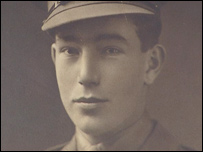 Robert Kelly Pollin biographyRobert Kelly Pollin was born in Meadow Street north Belfast on 16th June 1897. He was the eldest son of James Moore Pollin, and his wife Martha (nee Corbett). In the years that followed the couple had two more children, Emma Sara Pollin, born around 1899 and John Pollin, born around 1902. 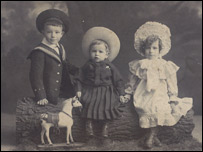 Robert Kelly, John and Emma Sarah By 1911, census records show the young family were living in Ravenhill Avenue in east Belfast, before later moving back to the north of the city, settling in Taunton Avenue. Their father, James Moore Pollin worked in the offices of Robert Kelly and Son Solicitors in Belfast city centre. The young Robert, who was named after his father’s colleague, was educated at Belfast Royal Academy. On leaving school he followed his father into the legal profession and joined the same firm as a solicitor's apprentice. Signing up to fightIn January 1916, in the middle of the First World War, Robert enlisted in the British army. He was 18 years old when he signed up at Belfast City Hall. Initially, he joined the 19th Battalion of the Royal Irish Regiment, a cadet training unit, and was billeted to Newcastle, Co Down where he trained under Colonel R H Wallace. From his obituaries, we understand Robert completed his preliminary training in Fermoy County Cork and in September 1916, he was commissioned into the 4th Battalion of the RIR, (Royal County Downs) a special reserve unit. He was sent to France in the spring of 1917, but shortly after arriving, he was taken ill and was admitted to hospital in Le Havre. He spent two months recovering before being sent on to the front. Preparing for PasschendaeleIn the summer of 1917, the Allied forces were preparing for a last, final push against the German army in Flanders. Such was the ferocity of the bombardment of German positions in advance of the offensive, the explosions could be heard as far away as Kent in England. 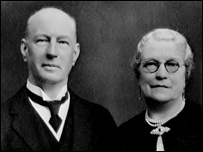 Robert's parents Knowing the danger that lay ahead, Robert wrote his will on the battlefield on the 27th July 1917, just four days before his death. Back home in Belfast, his family were celebrating the birth of a new baby boy. Records show they registered the birth of their forth and final child, Ivan Stuart Pollin on the very same day. His final hoursBefore dawn on 31st July, the offensive now known as the Battle of Passchendaele began. By now, Robert was attached to the 1st Battalion of the RIR, which was fighting within the 8th division of the British army. From the regimental war diary, and other documentation, we believe Robert fell in the fields close to Westhoek Ridge. 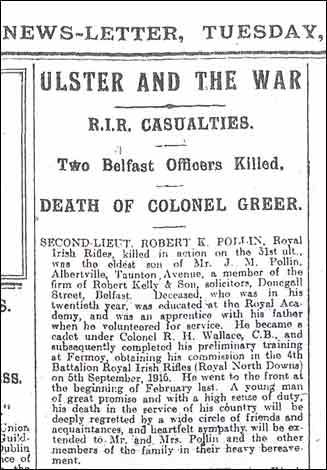 Belfast Newsletter obituary 7th Aug 1917 The regimental diary states that he was one of 20 officers and 620 men who went into the attack. The casualty rate for officers was high. 13 of them (two thirds) were either killed or wounded in the first day of the battle. Among other ranks, there were 30 deaths and less than one third were either killed, wounded or missing on that same day. Robert's body was never recovered and his name is listed on the Menin Gate memorial to the missing in Ypres (now Ieper), Belgium. All in all, he survived only a matter of weeks on the Western Front, and his experience was probably no more or less remarkable than that of the thousands of other servicemen who gave their lives in the First World War. However, it is for exactly that reason that his story is poignantly representative of a generation sacrificed, where so many young men "of great promise" were lost. last updated: 29/07/2009 at 09:39 You are in: BBC Newsline > Robert Kelly Pollin biography
Latest Bulletins |
| | About the BBC | Help | Terms of Use | Privacy & Cookies Policy |

