

EXPLORE EPISODE EIGHT - 12 to 9
Local Navigation

Bringing to life spectacles of natural wonder on our doorstep
No.12
Rutting Deer
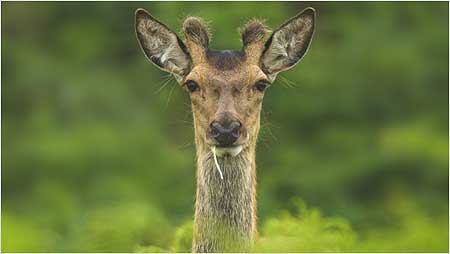
There are five main types of deer in the British Isles - Red Deer, Roe, Fallow, Sika and Muntjac.
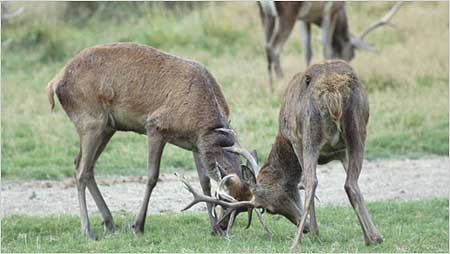
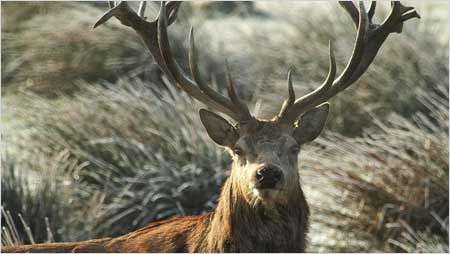
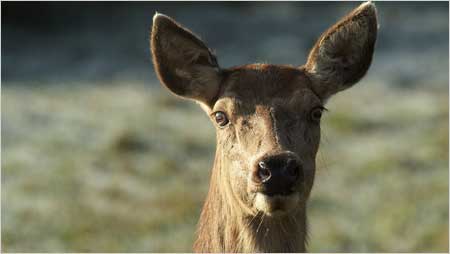
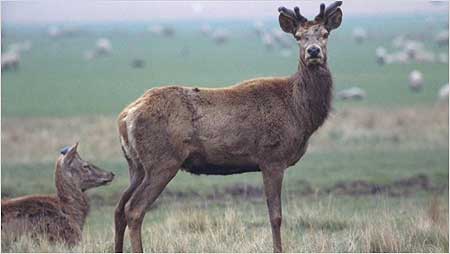
The Red Deer (Cervus elaphus) is Britain's largest deer measuring around 1.37 metres at shoulder height. The adult deer is characterised by its reddish-brown coat. The male's antlers are usually branched and his rump is creamy in colour.
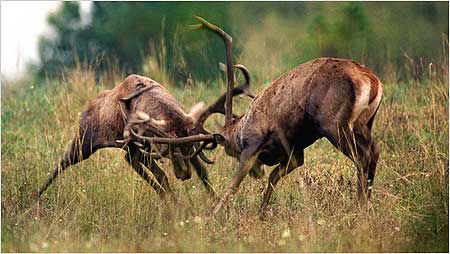
One of nature's great spectacles is deer rutting. Red Deer mate between late September and November when the mature stags seek out female hinds. During the rut, stags lock antlers in a sometimes bloody contest to establish the dominant Alpha male.
After the rut, stags and hinds once again become segregated with males and females usually remaining in separate groups for much of the year.
Male Red Deer are larger than females and have branched antlers which are shed every year in the spring.
The numbers and range of Red Deer have decreased dramatically since the late 18th Century in most of England, Wales and the Scottish Lowlands due to hunting and culling. Today numbers are healthier and have increased to around 315,000. In some areas of Scotland, the high density of the deer population means that culling is the only way to ensure the animals do not cause damage to woodland habitats.
Fallow Deer are smaller than Red Deer and have four distinct colour variations. 'Common' Fallows have a brown coat with white mottles whilst the 'menil' and 'melanistic' deer are darker, the latter are almost black. The 'albinistic' is the palest Fallow and is virtually white. It is common for the various Fallow Deer groups to interbreed.
Sika and Muntjac Deer are of Far Eastern origin and were imported into Britain.
The Muntjac is the smallest British deer, barely the size of a large dog, with a reddish brown coat. The male has short antlers and tusk-like canines.
Web links
The BBC is not responsible for the content of external internet sites.
Photo credits
BBC, RSPB Images and Jaybee at North East Wildlife.
Photo gallery
Watch and Listen
Watch the annual autumn deer rut at Lyme Park in Cheshire with presenter Chris Packham:
Help playing audio/video
Tips
Tips for viewing this species:
- Check soft ground for evidence of deer tracks - look for cloven hooved prints with two digits. Red Deer prints are larger at around 70mm wide and 90mm in length. The smallest and hardest to identify deer prints are those of the Muntjac at 20mm by 30-40mm.
- During the winter Red Deer are more likely to be found on sheltered lower ground whilst in summer they tend to move to higher feeding areas.
- Check the ground for deer droppings - these vary in size depending on the species. They are pointed at one end, relatively odourless and are black in colour when fresh.
- Look up at the browse line of trees which can be a giveaway - look for damaged or nibbled bark.
- Listen carefully - the male Sika Deer is identifiable by its noisy whistling sound.
- The best time to watch deer is just after dawn and dusk.
- Once you've located a herd of deer, keep camouflaged next to a tree or bush and stay quiet - be patient and keep quiet!
- The best time to watch deer rutting is between late September and November. Listen out for the bellowing that goes on as a precursor to a clash.
- Good months for watching deer calves are mid-May and early June.
- Great places to go deer stalking include Tatton Park, Studley Park, Grizedale Forest, Exmoor, The Quantocks, Woburn Abbey, Fountains Abbey,
Bowland Forest, Galloway Forest and the New Forest. - The Muntjac Deer is mostly seen in southern and central England.
- The Forestry Commission Scotland runs an annual deer rutting event at Galloway Forest Park which is stage managed and almost guarantees that two stags will fight. The National Trust also organises deer walks during the rut at Lyme Park.
- Keep your distance during the autumn rut!
Habitat
Red Deer are widely distributed across Europe mainly in woodlands, uplands, moorland and country estates.
The majority of British Red Deer are found on the moors of the Scottish Highlands, although there are smaller populations in North West England, Exmoor, East Anglia, and Ireland.
The Red Deer is a species of the woodland fringe but in recent years its range has extended to coniferous forests and country estates. It feeds on grasses and rushes in summer whilst in winter its diet changes to small shrubs, heather and blaeberry.
In moorland habitats, hinds are often organised into groups of up to 40 animals, with a dominant hind, her offspring, and other mature female family members.
Fallow Deer prefer mixed woodland and open grassland whilst Sika and Muntjac Deer are very secretive, with a preference for dense woods. Roe Deer are mainly found in mixed woodlands but can also be seen in open farmland and parks.
Lyme Park in Cheshire is a medieval deer park and National Trust property which is great for deer watching. There are about 330 free-roaming Red Deer which were brought to the park in 1398, plus a smaller number of Fallows.
Although only a few miles from London, Richmond Park boasts a population of around 300 Red and 350 Fallow Deer which have been kept in the park since 1637 when King Charles I enclosed the area for hunting.
No. 11 - Flocks of Geese
Flocks of geese are one of the most spectacular sights in the animal kingdom due to their sheer numbers and swooping patterns in the skies above.
Best place to see - Snettisham (North Norfolk).
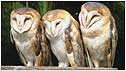
No. 10 - Barn owls hunting
The Barn Owl is one of the UK’s most popular birds with its stunning heart-shaped white face and gold-beige plumage. Look out for them hunting.
Best places to see - Norfolk, Great Ouse (The Wash) and farming areas.
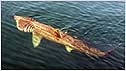
No. 9 - Basking Sharks
The Basking Shark is distantly related to the Great White Shark and can be spotted all around the British Isles coast.
Best place to see - Hebrides (Scotland).


Also on Nature's Top 40
BBC Nature & Wildlife
More from bbc.co.uk nature

BBC iD
BBC iDBBC navigation
BBC links

BBC © 2014The BBC is not responsible for the content of external sites. Read more.
This page is best viewed in an up-to-date web browser with style sheets (CSS) enabled. While you will be able to view the content of this page in your current browser, you will not be able to get the full visual experience. Please consider upgrading your browser software or enabling style sheets (CSS) if you are able to do so.
