

EXPLORE EPISODE SIX - 20 to 17
Local Navigation

Bringing to life spectacles of natural wonder on our doorstep
No.20
Puffins
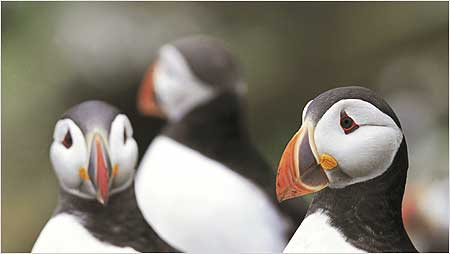
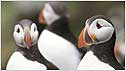
Puffins are often described as comical looking birds - they've been nicknamed 'sea parrots' and 'the clown of seabirds'.
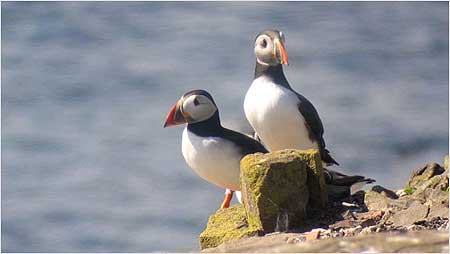
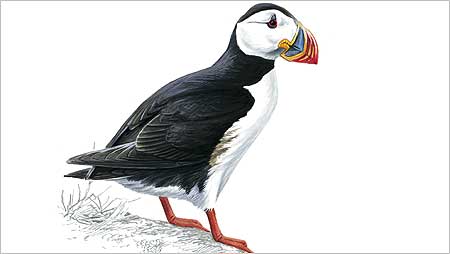
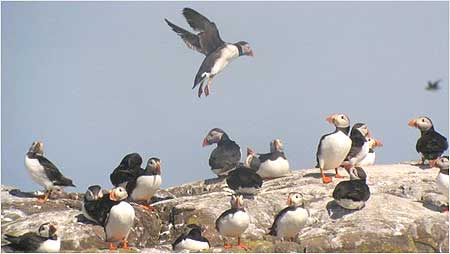
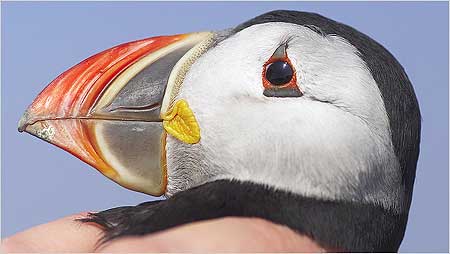
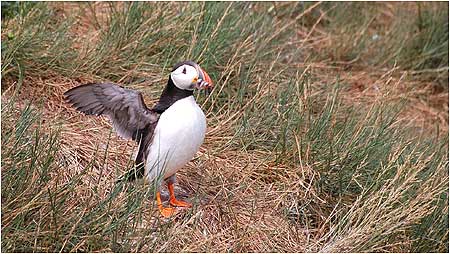
The Puffin's black upper plumage contrasts with its white face and belly. The bird's most distinctive feature is its beak with its rainbow of yellow, red and blue colours. In the winter they lose their bold bill colours and eye markings - and take on a duller look.
With their slightly doleful look and awkward landing technique, this is the one seabird that the British public have taken to their hearts. As a result there are numerous boat trips around the British Isles for Puffin watchers during the summer.
The bird is long lived and can survive for up to 30 years. They are mainly silent but can make a growling noise. Puffins use their beaks to make gestures to others in the colony.
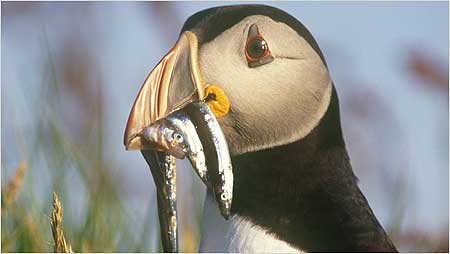
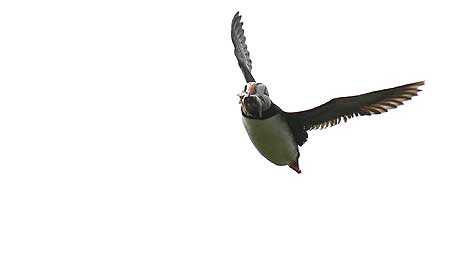
The Puffin's favourite food is the sand eel which they catch by diving underwater using their feet and truncated wings as paddles as they swim. It's amazing how many fish these birds can catch without losing them!
The Puffins use their serrated beaks and tongues to hold their catch. On average they can catch about 10 eels but the record is said to be an astonishing 62!
Photo credits
Photos courtesy of RSPB Images and Jaybee/North East Wildlife.
Web links
The BBC is not responsible for the content of external internet sites.
Photo gallery
Watch and Listen
Watch Puffins nesting in their burrows and catching sand eels with presenter Chris Packham on the Isle of May in Scotland:
Listen to the sound of Puffins on the RSPB website:
Listen to audio and video clips
Help playing audio/video
Tips
Tips for viewing this species:
- Watching puffins is incredibly easy – but you have to get your timing right. The Puffin spotting season runs from April to August when you'll see thousands of birds as they return to their breeding colonies. After this the birds disappear and spend the winter at sea on their way back to the Atlantic Ocean.
- June and July are the best months when Puffins are most active and raising their young.
- The best places to watch Puffins are Shetland, Skomer and Skokholm Islands, the Farne Islands, the Isle of May, the Treshnish Islands (near Mull) and Lundy.
- Take to the seas! One of the best ways of seeing Puffins during the summer is to take a boat to the Farne Islands where thousands of the birds can be seen on sea and land. Visitors can disembark on Inner Farne, run by the National Trust, where a pathway takes wildlife watchers close to the Puffins and their nests.
- Ferries run to the Isle of May from Anstruther and North Berwick between April through to September.
- The best place to see Puffins on Skomer Island is the Wick where you can get within a few feet of them by following marked pathways.
- Sea watching can be productive in April - watch for the Puffins a short distance out at sea - many of them can be seen bobbing around and coming briefly inland to check for good places to nest. A pair of binoculars and a scope are helpful if watching from the coastline.
- Don't forget your camera - Puffins are incredibly photogenic!
Habitat
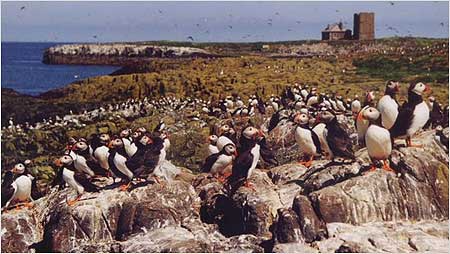
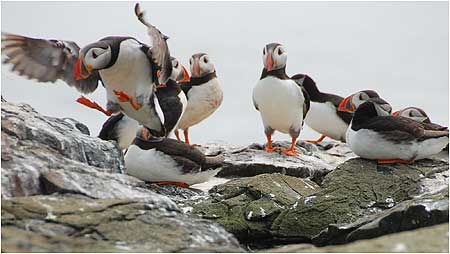
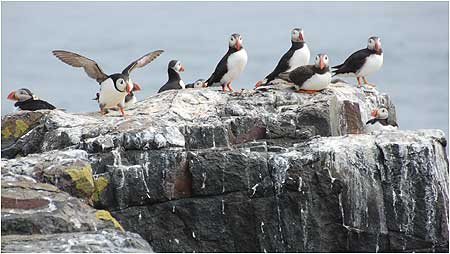
Puffins spend much of the year at sea and only come ashore during the breeding season between May and August when they can be seen on rocky islands around the British Isles. They live in large colonies where there's safety in numbers from predators such as Black-backed Gulls.
The Puffins nest in burrows on grassy cliffs, in holes in the ground or in rocky crevices. If a suitable burrow doesn't exist, they dig their own holes using their feet as shovels.
The Puffin raises just one chick or puffling every season. It takes six weeks to fledge and then sneaks out of its burrow under the cover of darkness and hurls itself into the sea. The young bird will return about five years later when it's ready to breed.
There are large colonies of Puffins on Shetland (at Noss and Hermaness), Skomer and Skokholm (Pembrokeshire), the Farne Islands (Northumberland) and the Isle of May (Scotland).
Back in 1955 there were just seven pairs of Puffins on the Isle of May in the Firth of Forth. Today the island is home to the single largest Puffin colony in Britain with a staggering 100,000 of these little beauties. The birds are attracted by the isolation and the safety the island provides as well as an abundance of their favourite food, sand eels.
Lundy Island is another place to see these sea birds - in fact Lundy is Norse for "Puffin". Sadly there are nowhere near as many Puffins as there once were on Lundy and only 10 breeding pairs remain. This is mainly because of the introduction of rats to the island, which were brought over by humans several centuries ago. Rats and other scavenging vermin are bad news for Puffins and other birds which nest on the ground, because they feed on bird eggs and chicks.
No. 19 - Autumn colours
Autumn is the season of stunning tree colours with spectacular russets, oranges, yellows and browns.
Best places to see - Thorp Perrow (North Yorks), Westonbirt (Glos), Longhaw (Sheffield).
No. 18 - Wild Orchids
Orchids are arguably the most glamorous and mysterious of Britain's wild plant families. Summer is a great time to see wild orchids in proliferation.
Best places to see - Kenfig (South Wales), Kent Downs.
No. 17 - Minke Whales
Go whale watching and read our top tips on how to see one of Britain's largest mammals in the waters around our coasts.
Best places to see - Mallaig (West Scotland).


Also on Nature's Top 40
BBC Nature & Wildlife
More from bbc.co.uk nature

BBC iD
BBC iDBBC navigation
BBC links

BBC © 2014The BBC is not responsible for the content of external sites. Read more.
This page is best viewed in an up-to-date web browser with style sheets (CSS) enabled. While you will be able to view the content of this page in your current browser, you will not be able to get the full visual experience. Please consider upgrading your browser software or enabling style sheets (CSS) if you are able to do so.
