Ludwig’s David Mitchell, Anna Maxwell Martin, Mark Bonnar and Sian Clifford promise a puzzling second series - “more murder, more mystery and more shocking revelations”
Missing detectives, multiple murders and high-ranking cover-ups. It can mean only one thing... Ludwig is back!
Missing detectives, multiple murders and high-ranking cover-ups. It can mean only one thing... Ludwig is back!
Master puzzle-setter John ‘Ludwig’ Taylor (David Mitchell) is now a crime scene consultant, working alongside DCI Russell Carter (Dipo Ola) on ‘impossible’ crimes for the Cambridge Police Authority. But with his identical twin brother still missing, John and his sister-in-law Lucy (Anna Maxwell Martin) won't stop – there’s a puzzle to solve and a husband and father to bring home. One masquerade may have ended, but a new one has just begun.
JN
Interview with the cast and creatives
David Mitchell (John ‘Ludwig’ Taylor)
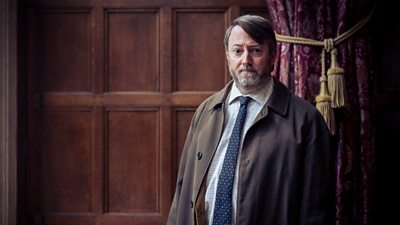
Where do we find Ludwig at the start of this series?
At the start of this series, he's discovered all this evidence and potential clues to the terrible thing that's been going on that made his brother disappear. But it's boxes and boxes. He's quite happily pottering his way through them, trying to work out which of the conspiracy theories are absolute nonsense and which of them might have a kernel of truth. It's like a big jumbo crossword that you can luxuriate over for a whole Sunday afternoon but, in this case, a Sunday afternoon might turn into months.
Meanwhile, Lucy has more of a sense of urgency. John can’t go into the police station very much, because there haven't been any murders for him to be called in as a consultant on, which frustrates Lucy. She thinks the answer to the mystery is more likely to lie there than in these sterile boxes. But then, fortunately for the show, if not for the fictional characters involved, a spate of murders begins.
What’s John’s relationship with Lucy (played by Anna Maxwell Martin) like now?
Their relationship is a bit warmer than it was. There's more trust in each other and their childhood closeness has returned. But there's also a lot of sniping. The phase when Lucy was just incredibly grateful to John for putting his own life on hold and doing this has passed. Now she's just frustrated by his timidity, his plodding approach, and his propensity to get distracted by murders.
What is it like working with Anna?
Anna is brilliant. She's a wonderful actress, but also very funny and fun on set. She takes a similar view to filming as me, which is that it's important to keep it light and have a nice time. Neither of us obsessively descend into our characters between shots. We just turn up and say the lines as best we can and try and have a laugh in between.
Can you tell us who Joanne Kemper (played by Sian Clifford) is?
Joanne Kemper is the MP for Cambridge, and various lines of inquiry that John and Lucy are following appear to lead to her. She's obviously a very important person, with a lot of links to senior members of the police force. Her father was also the MP for Cambridge. She's a senior person in her political party, so she's powerful and connected, and intimidating. When John first meets her, he has a strong impression that she's met James before. Something that, as a twin, he's used to picking up on. Initially, we meet her because she just happens to be a witness to a murder. It's a great bit of intriguing plotting by Mark Brotherhood, the writer.
What part does Cambridge play in Ludwig?
I went to university there, and I love it. You want people to enjoy slipping into this world like a pair of slippers, but with a dead body in them. Cambridge is obviously a great candidate for that. Inspector Morse is one of my favourite shows, but that was set in Oxford. That's where people want to escape to in this kind of program. I think you've got to have a beautiful setting to juxtapose with the nature of the crimes.
What will audiences love about the new series?
The overarching plot thickens, but I think our main aim is to give people the same satisfaction, the same intriguing entertainment as we did the first time, and not to let that slip. I think Mark, the writer, has done a brilliant job and it draws you in even further.
Why do you think audiences love ‘cosy crime’ as a genre?
The truth is that we live in troubled times. The golden age of crime, as they call it, was the 1930s, and that's when people disappeared into their Dorothy L. Sayers novels, and Agatha Christie. That was also an extremely troubled era. Let's hope that this cosy crime boom ends more happily than the 1930s one did.
Who is your favourite amateur sleuth?
I'm probably going to go old school and say Sherlock Holmes, although he would dispute being an amateur. He goes about it quite professionally, but he's not the police. I like the feeling of his impossible brilliance. There are moments in the Ludwig script that are like that, where you don't really think it's plausible that a brain could do that.
If you had to solve a crime, who in the cast would you want to partner with?
I would hate the responsibility of having to solve a crime. I'm absolutely a carper from the sidelines, a sort of commenter, and a moaner. I'm very happy pretending to solve crimes. I think Anna would be pretty good at solving a crime, so I might choose her, and then she would basically get on with it. I think Dipo is very analytical so either of them would be pretty good.
How do you find the balance between humour and drama?
The balance between mystery and humour was something, particularly in the first series, that we were quite worried about getting right. It's a comedy drama, not a straight drama. Although, my view is that any drama with no comic element is flawed. The main thrust is caring about the plot and the characters and then the comedy is decorative to that. The risk in Ludwig was putting too many jokes in, so the plot is undermined and becomes silly and a spoof. You need it to be broadly straight, but then to have funny elements that are believable for the characters.
Anna Maxwell Martin (Lucy Betts-Taylor)
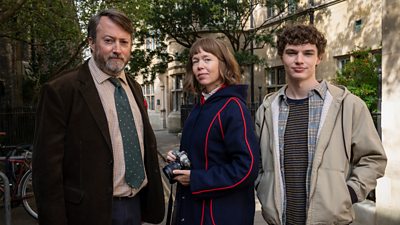
Where do we find Lucy at the start of this series?
We find Lucy, John and Henry pretty much straight off the back of series one. They're still embroiled in the same investigation, which is trying to find out where James is. John has been revealed as not being James, and so they're trying to work out how to get all the information they need when he is no longer in disguise as James. It’s a bit less domesticated and Lucy is now working for the local advertiser paper. She thinks she's a crime reporter, but that role doesn't even exist, and they don't really cover anything consequential.
What’s John’s relationship with Lucy like now?
John and Lucy are more partners in crime now, rather than Lucy just being a cipher for information. They're in it together and on the mission together, which is good. Lucy is sparky, energetic, and perpetually positive. She is the Tigger to his Eeyore. He is thinking it through, and she wants to grasp life. It's wonderful to play someone so positive.
What is Lucy’s relationship with Gareth (Mark Bonnar)?
Gareth is utterly exhausted by Lucy, her energy and positivity. He wants a quiet life eating biscuits. He doesn't have any interest in Lucy getting up in his grill and demanding that they do more work, so he's a bit exasperated with her.
What is the difference between series one and two?
This series is bigger and better, brighter and bolder. It builds on the success of the first and it's got even better. We all really enjoy being here and creating the show. Mark Brotherhood, our writer, is so responsive. He doesn't block you; he really wants to show everyone off and that's really exciting.
How do you find the balance between humour and drama?
That is definitely Mark Brotherhood. You step into a role and make of it what you can, but Mark has given me comedy and pathos in Lucy. We see more depth of character alongside the comedy and I'm very grateful to Mark for giving me both.
Who is your favourite amateur sleuth?
I'm going to have to say, because I've watched every single episode, Silent Witness is one of my top favourite programmes of all time. You could say they're not amateur sleuths, they're pathologists, but they do always seem to crack the case. If I'm going back to my childhood, I'm going to say Dempsey and Makepeace.
What will audiences love about the new series?
I hope that they go on the journey with Lucy and John. It's funny, sweet, and light-hearted but some moments are painful. I hope that they just enjoy the show, rather than thinking too deeply about its meaning.
Mark Bonnar (Gareth Fisher)
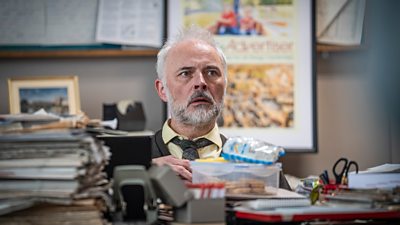
Tell us about your character, Gareth.
He doesn't enjoy people. He's been on his own for a long time in this office. He's curmudgeonly. He eats a lot of rubbish. He’s his own boss, and that's the way he likes it.
What’s his role in the story?
Gareth's role is to provide an alternative police station where they can carry on the investigation without any prying eyes. But it turns out, because he loves Ludwig and he's a lifelong puzzle fan, he's also quite good at solving stuff. Gareth's relationship with Lucy is abrasive but he is also intrigued by her. She comes into the office like a whirlwind and he never knows how she gets in. She just appears.
What drew you to this role?
The thing that always draws any actor to any role is the words that they've got to speak. When I read Mark Brotherhood's scripts, I was blown away by the balancing act that he performs, because it's not easy to do. It's not easy to make something dramatic, intriguing, and funny. It all starts with Mark's scripts but in combination with the brilliant cast.
What was it like walking onto set?
What always blows me away anytime I step onto any set is what geniuses the art department are. They create a world that makes you forget yourself.
What is the East Anglia Advertiser?
It's one of those old-fashioned papers that used to be like the Edinburgh Advertiser when I was growing up. It was reams and reams of car adverts, lonely hearts, and the odd story about cats being pulled out of trees. It's a provincial paper.
How do you find the balance between humour and drama?
When you're doing straight down the line drama, you don't have to worry about whether it's funny or not so it's an added layer of jeopardy doing comedy. This is not outright comedy, which is even scarier, because you must be able to flip between the two. It’s the brilliant thing about Mark's scripts. You might have quite a funny little moment, and then a serious, heartfelt moment. It’s a real balancing act.
If you had to solve a crime, who in the cast would you want to partner with?
If it were something that required a lot of evidence gathering, I’d choose Anna but if it was something that required you to sit back and think and ponder about then I’d choose David.
How would you describe the tone of the series?
Ludwig's tone is witty, heartfelt, and slightly curmudgeonly.
Sian Clifford (Joanne Kemper)
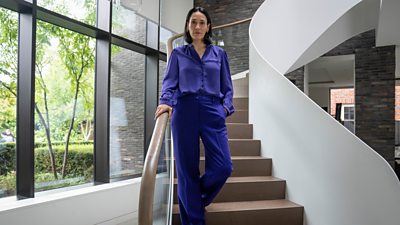
What's Joanne's relationship to the Cambridge police?
Joanne has a police aide who takes care of her security and Ziegler is a confidant of hers. I run into a spot of bother at the beginning of episode one and he's the person I call. They're a team of people that I feel I can rely on.
Joanne's connected to many of the deaths that James was investigating before he disappeared. How do you approach playing an antagonist or a baddie like that?
I approach playing an antagonist as I would any other character. I'm fed by the script and the people around me and their brilliant performances. I don't think you can really play a concept or an idea of a person. You must get to the root of what motivates them and what is driving them and then believe that is for the good. Whether it's for the good of all or for themselves, that is another thing. So, when the scripts came to me, it was certainly an exciting prospect. It's a nice challenge to take on, particularly because she is mysterious and a bit of an enigma and hiding so much.
You play the local MP in Cambridge, whose dad held the role before her. Tell us about the job.
Joanne's family have been in power within Cambridge for quite a long time, her father was an MP before her. There's a real level of trust with them as a family and as representatives of that community. I've tried to play her as someone who's trying to bring politics into the 21st century. She's modern and approachable but she also has the gravitas of that ancestral history with her role as an MP.
What is it that drew you to this role?
The second I started watching it, I was hooked. I just thought it was wonderful, such an amazing team of people. I was chomping at the bit to be a part of it. The scripts and the character were just too good an opportunity to say no to.
What was it about the scripts that jumped out at you?
They're just so clever. When I was reading them, I started to get a little confused as to what I'd seen or was remembering from series one, because it was so vivid to me what was happening in series two. The scenes that I'd read in the script were so evocative and so real to me that I could picture them exactly. The writing is just so clever, it's wry and funny. It's got something which I think a lot of other crime drama hasn't, which is warmth. There's a silliness to it, which is joyful. As joyful as doing a puzzle. It's Anna and David's performances at the centre of that which create that feeling as much as anything.
What was it like stepping onto the set?
It was amazing. I've only been to the police station but that was amazing. It was like stepping into my TV set. I asked to have a tour of the rooms that they've built for the house, just so I could have a little snoop around. I love it. It feels magical. It's the best part of the job.
What will audiences love about the new series?
It's just as clever and the plot thickens. It gets much darker in a lot of ways. It's surprising, particularly episode six, but it's still got all the charm and all those incredible ingredients from series one. It has everything and more. More crime solving, more puzzles and more murders.
If you had to solve a crime, who in the cast would you want to partner with?
David Mitchell. No question.
Georgie Fallon (Producer)
Can you tell us a little bit about where we left our characters at the end of series one?
At the end of series one, John had to basically confess that he'd been impersonating his brother to get Lucy off the murder charge of Holly. So, it was revealed to Carol and his colleagues that he wasn't who he said he was, but to protect all the murders that he had solved, they decided to maintain the pretence that he was James so that he could hand in his resignation and then James could disappear, and then John could kind of step forward. The team sort of pulled together to protect him, and by the end of series one, the only person who didn't know who he was, was Ziegler.
Where does that leave John at the beginning of series two?
At the end of series one, they finally cracked the cypher that James had left them and found a storage unit which was full of material that James had stolen from somebody who'd been murdered before the series, which was all the evidence of this conspiracy that they'd been investigating. They've basically taken on the task of: we've got to find out what has happened. That carries into series two. They've got all these files; they need to find out where James is, what the conspiracy is, who knows about it, but also at the same time, John's been employed as a crime scene consultant by the police because he's pretty good at solving murders, so they want to keep him around.
How has John changed now that he's a crime scene consultant?
John is no longer having to conceal his identity, so, he's able to have a bit more confidence. We get to enjoy him not really minding that he doesn't know what a police detective does and embracing his own approach. He's a bit more comfortable in that sense, but he’s also still got to conceal his identity from Ziegler. Chief Constable Ziegler, who's played by Ralph Inneson, who's the big boss in Cambridge and someone that we know, slash suspect, has got some ulterior motives. He's the only person who doesn't know that John was pretending to be James. They've got to pretend that John has just suddenly arrived as James has departed, which is quite funny to witness.
What new role does Lucy take on this season?
Lucy in series two is on fire. She is basically running the conspiracy side of their investigation. So, while John's faffing around solving murders, she's really focused on how to find out what has happened to James and why. We get to see her investigate on her own a lot more. She's always been very proactive.
How has John and Lucy's relationship evolved in series two?
They're an interesting mixture of good friends, almost like brother and sister, but also there's this sort of deep history between them. It's nice seeing John take on that family role because it's not comfortable for him, but he's also stepping in where his brother isn't there for Henry and Lucy. Lucy can just understand him quickly and isn't hesitant to tell him so. There's a familiarity about the two of them together, which is fun. It's intriguing.
Can you tell us about Gareth and the introduction of the East Anglia Advertiser?
The East Anglia Advertiser is a local paper. I think it was once quite an important publication in Cambridge, but I'm sure budget cuts have meant it's sort of a one-man band and they focus mainly on advertising. Lucy taps them to get access. She wants the backing as a journalist so that she can get access to people and speak to them in her investigation.
Could you tell us about the relationship between Lucy and Gareth?
They have a fun repartee, and he doesn't really take any of her rubbish, which is quite fun to watch because she obviously gives John quite a lot of rubbish, and John doesn't really know how to respond. She needs him for access. He doesn't really want the hassle, but he gradually finds himself getting increasingly involved in what she's doing, so as the series develops, we see him get more interested and he comes physically closer in the office as the episodes go.
Is Cambridge as a setting important to the show?
Cambridge, as a setting, is important to the show. We didn't want to set it in London because so much is set in London, but Cambridge feels like a big enough, cosmopolitan enough city to justify the horrendous number of murders that they have there. It's also beautiful on camera and feels recognisable to viewers, but it hasn't been seen loads. I think Cambridge has a nice mix of the beautiful old architecture, but also this really modern side with the science parks and all the research and that's very interesting for us to set our world in.
Tell us about the introduction of Joanne Kemper. How has her character impacted this larger mystery that's going on?
The introduction of Joanne Kemper in this series, which is played by Sian Clifford, speaks to the conspiracy escalating, and it's that classic thing of it goes all the way to the top. I think this series is about realising that there's someone even above Ziegler who knows what's going on and pulling John and Lucy further into this world of power and politics that's not accessible and quite scary. She comes from a lineage. Her father was an MP. He knew Ziegler, so you start to realise there's all these connections and that increases the stakes for Lucy and John because they realise they're dealing with some quite powerful people, and she represents that.
Why is Ludwig an unmissable show?
Ludwig is an unmissable show because you can watch it with your whole family. The crimes are so cleverly plotted, and the way that they relate to different puzzles, I think, is enjoyable to figure out.
Do you have a favourite puzzle in the show?
I think my favourite puzzle in the show is maybe the episode five puzzle. I won't reveal too much, but it's quite satisfying to see because it's a puzzle that's created by the murderer.
What was the thinking behind some of the costumes for Ludwig?
In series one of Ludwig, we first meet John at home, and he's in his knitwear. When he must pretend to be James, he borrows his suit, which is a nice corduroy suit and he basically wears that for the whole series. We knew we wanted quite a strong look for John that would become that iconic look that you're used to seeing with television detectives.
Kenton Allen (Executive Producer/ Chief Executive of Big Talk Studios)
How has John changed now that he's officially a crime scene consultant?
One of his big secrets is out. He is not his brother. He is John, a puzzle setter who is quite good at solving crimes, given the way his brain works and his ability to look at things in a slightly obscure, obtuse way. It's starting all over again, I guess, in that he's having to pretend to various members of Cambridgeshire Police that he is a newly recruited to the police department and hasn't been working there impersonating his brother for the last six weeks.
What new role does Lucy take on in this season?
I think Lucy is much more engaged in the mystery of her husband's disappearance. She's got much more agency. She gets herself a job as a reporter for a useless newspaper, which is basically an advertorial that doesn't really do news. But she's much more engaged in trying to find out what is going on, what might have happened to her husband and what this supposed conspiracy is that they think they are onto.
Could you tell us a bit about John and Lucy's relationship?
I think John and Lucy's relationship has matured. They've been on quite a journey together in series one, and I think in series two their relationship is a bit more consolidated. I think they like each other more. The love that dares not speak its name, perhaps. I think that they are working together with a greater kind of purpose to find out what is going on with Joanne Kemper.
Who is Joanne Kemper?
Joanne Kemper is the local MP. High-flying, high-profile, front-footed, perspicacious, quite beady, slightly scary, who witnesses a murder in episode one and exits the scene of the supposed crime as soon as she smells trouble. That leads John to interview her, and then we learn over the course of the episode and the series that there is more to Joanne Kemper than meets the eye.
What's it like having Sian join the cast?
When we were trying to cast Joanne Kemper, we wanted somebody who had a brilliant ability with wit and irreverence but also a steely exterior and slightly intimidating, and Sian leapt into our brains. We're obviously huge fans of Sian from her work on Fleabag. Sian brings a steeliness and a directness and a playfulness to Joanne Kempner that we think is delicious. Is she a baddie or is she a goodie?
What was it like working with Mark Bonnar?
Mark Bonnar is an absolute delight and working with him is a joy. He brings another dimension to Ludwig, which is a dishevelled brilliance.
So, what will audiences love about this new season?
If you liked Ludwig series one, strap in for Ludwig series two, because it just got more real. There's more murder, there's more mystery, and there's more shocking revelations.
How important is the setting for Ludwig, do you think?
I think the setting is critical for any crime drama. When you think of Inspector Morse, you think of Oxford. When you think of Broadchurch, you think of the Dorset coast and the beach and cliff setting. I think Cambridge gives us another layer of specificity and a visual language. I think the more specific you can be about where you are, the stronger flavour your show can have. It's a lot of period shows that feature Cambridge, but there's not that much contemporary drama that's been shot there. I think it feels fresh to a British audience.
How would you describe the look of Ludwig?
It's something that Robbie McKillop, who set the style on the first series, and everybody have improved on since his excellent first episodes. I think it's a mix of ancient and modern, really, both in terms of what you see on screen and how the costumes are designed. The choice of Lucy's house is sort of 70s. It's not your traditional terrace house. It's got quite a Scandinavian feel to it. I think Cambridge gives you a mix of ancient and modern. The university part of the town is very ancient, but the police station is very contemporary, quite high-tech.
We went for an elevated aesthetic, so it hopefully feels slightly elevated and ambitious in its cinematography. It's more cinematic than televisual, the way it's framed, the way we shoot it, the way it's lit, so it feels like an elevated visual treat as well as a kind of story treat. There are lots of things in the design that echo the puzzle world of Ludwig that are in there for viewers to spot and enjoy in terms of the way shots are composed and clues to puzzles are presented to the audience. I would like to think it is a sort of elevated mainstream detective show with a twist.
Do you have a favourite puzzle from the show?
My favourite puzzle in Ludwig is whether Lucy and Ludwig will ever kiss.
What has the BBC ever done for me?
Follow For More
Latest from the Media Centre
All newsSearch by Tag:
- Tagged with Latest NewsLatest News
- Tagged with Media PackMedia Pack
- Tagged with ComedyComedy
- Tagged with DramaDrama
