BBC Eye investigation uncovers the secret networks smuggling endangered European glass eels from rivers in Europe to Asia, coordinated by Hong Kong gangs
BBC Eye: Billion Dollar Babies is available to stream on iPlayer and the World Service YouTube channel
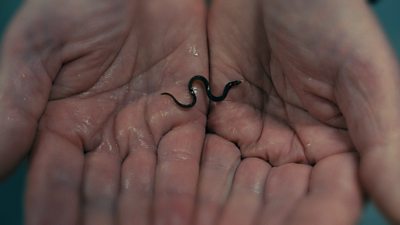
A new investigation from BBC Eye shines a light on one of the world’s most lucrative yet largely overlooked wildlife crimes: the illegal trafficking of European glass eels.
BBC Eye: Billion Dollar Babies explores how smuggling eels offers “high profits and low risks”, making it an attractive business for gangs looking to profit from the soaring demand in Asia.
This multi-billion-dollar global criminal network profits from smuggling a commodity that can be worth more than the trade of illegal drugs – referred to by gangs as “cocaine of the sea”.
BBC Eye, from the BBC World Service, gains exclusive access to a Hong Kong triad as they conduct their smuggling operations and uncovers the secretive networks moving juvenile glass eels - worth thousands per kilogram - from Europe to Asia.
Once abundant in rivers across Europe and a staple of traditional dishes, the European eel is now critically endangered. Since the 1980s its population has collapsed by ninety-five percent. Yet demand for the species has never been higher, particularly in Asia where eel is a prized delicacy and a cornerstone of a vast aquaculture industry.
It’s impossible to breed eels in captivity so the eel trade relies on glass eels caught in the wild.
Eels have a mysterious life cycle, with all European eels believed to be born in the Sargasso Sea. The eels then travel thousands of miles to Europe, where they mature, later migrating back to the Sargasso Sea to reproduce then die, leaving a new generation to drift back to Europe.
In the UK, the River Severn is one of the places where glass eels can still be found in large numbers.
There used to be a legal market for British glass eels in China. The Asian eel had become scarce, so demand for European eels exploded. Almost twenty years ago, to protect the species, a European-wide ban was put on exports outside of Europe. This has driven an illegal trade.
In Billion Dollar Babies, BBC Eye speaks to a Hong Kong triad member involved in the smuggling of glass eels.
“My nickname is Little Di, and everyone calls me Elder Brother”
“The areas of activity of all Hong Kong's gangs are very similar: sex industry, gambling, drugs. The more profitable, the more people will do it, such as drugs. In terms of scale, we are the largest, and we are mainly involved in smuggling.”
“Smuggling eels offers high profits and low risks. As for drug smuggling: if you get caught, you'll be sentenced for life, if not executed.”
“With eels you are just smuggling food, it's not a serious crime. It's a few years [in jail] and your goods confiscated.”
“After a few years you're out and can start doing it again.”
Another triad member tells BBC Eye: “Just one small glass eel is worth around 2 to 3 dollars.”
“We smuggle 500 to 200 kilos a time.”
“During peak season we usually make around 2 or 3 deliveries a week. At 9 or 10 pm a brother from Mainland China tells us when to begin.”
“No mobile phones allowed. We normally wait for the tide to rise in the early morning.”
“Big ships are waiting, with facilities to keep the eels alive. They transport them to China. We use speedboats or other small boats.”
“With the neighbouring gang we have six teams which is enough to run the entire European eel smuggling operation.”
The European eel is so endangered that it has come under international wildlife protection laws. Regulations in Europe allow trading, but the majority of glass eels must be used in conservation projects which help restock their numbers.
BBC Eye also speaks to the key players in the eel trading business including Peter Wood, a British eel trader who has been exporting baby eels all over the world for more than 50 years.
Peter Wood buys glass eels from a network of local fishermen.
In 2021, Peter Wood made a controversial deal with Russia. The trade of glass eels with key markets in Asia had long been prohibited, and after Brexit, the EU would no longer buy eels from the UK. However, Russia remained a promising market.
For three years, the UK government granted Peter Wood an export licence for up to 3 million glass eels to be used in a Russian conservation project, despite most trade with Russia facing sanctions.
One of Peter Wood’s customers, in Kaliningrad, Russia, is a company called Goodfish. They receive a grant from the Russian government to manage their eel project.
When investigating Goodfish it was found that one of Goodfish’s owners might have commercial interests in the eel.
The owner of Goodfish has companies directly related with the fish industry, selling various eel products for consumption.
Goodfish told BBC Eye that all the eels purchased from Peter Wood were strictly for conservation, and that the consumable eel products were non-European eels.
They say there is no conflict of interest with the eel conservation project.
In 2025 the UK government changed its position on exporting glass eels to Russia, revoking Peter’s export licence.
Peter Wood says: “The UK government has stopped all our exports to Kaliningrad because of the Russian war against Ukraine. This had huge negative consequences. This fishery we’ve been running here for 50 years will be closed and staff will lose their jobs. If we don’t survive, the eel becomes a sort of museum piece.”
“We continue to do stocking in Europe. The key markets are Poland and Lithuania. It’s a really bizarre situation that Poland can stock but Kaliningrad is unable to stock.”
“It’s too early to give up the fight. Too early to close the business.”
Peter Wood told BBC Eye his eels were not helping fund Russia’s war with Ukraine; he says Kaliningrad was purely a state conservation project, and that his trades with Russia had always caused controversy.
Peter Wood says he denies all allegations of illegal trade, stating his staff has never broken national or international laws.
He says his priority is and has always been the recovery of the European eel.
BBC Eye: Billion Dollar Babies is now available to stream on BBC iPlayer and the BBC World Service’s YouTube channel. It is a co-production with Arte and ZDF.
The one-part World Service podcast The Documentary Podcast: Billion Dollar Babies is available on BBC Sounds or wherever you get your BBC podcasts.
RD
Follow for more
Latest from the Media Centre
All newsSearch by Tag:
- Tagged with BBC World ServiceBBC World Service
- Tagged with Latest NewsLatest News
