| 24 September 2014 |

| |
| BBC Homepage | | |
| |||
| Contact Us | | |
History featuresYou are in: Manchester > History > History features > Mussolini and Manchester 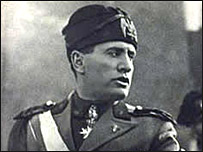 Il Duce: Benito Mussolini Mussolini and ManchesterIn 1931, a football team from Manchester’s 'Little Italy' travelled to Rome to play a match in front of Benito Mussolini who later presented each Mancunian with a medal. We want your memories of Little Italy and this unusual fixture. A medal from Mussolini is surely one of the more bizarre sporting mementos and one of them now forms part of a new exhibition about Manchester’s Italian community at the Museum of Science & Industry (from 8 Feb). 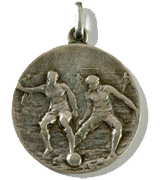 One of Mussolini's medals Italians first started settling in Ancoats, just north of Manchester city centre, from the mid-1800s due to economic problems in Italy. The area soon became known as ‘Manchester’s Little Italy’ and was famous for Italian specialities including ice cream, barrel pianos, mosaic and terrazzo tiling, and the manufacture of scientific instruments. Eventually, Ancoats itself began to suffer the consequences of declining industry in the 1960s, and Manchester’s vibrant Italian community was relocated by Manchester City Council to other parts of the city. However, back in its heyday, the Ancoats community was passionate about football and the invitation to play against an unnamed Italian team in Rome put them on a big political stage. 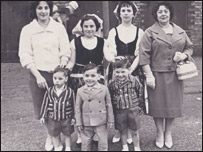 Family from Manchester's Little Italy Few official details are known, but according to legend, ‘Little Italy’ were winning the game. However, conscious that 'Il Duce' was watching, the referee wisely recorded the final score as a draw! PropagandaBenito Mussolini was a huge football fan but, like other Fascist dictators, saw it as a tool for propaganda. It's even alleged that he fixed the outcome of the 1934 World Cup Final! Elsewhere, Real Madrid inspired national pride for Franco and Hitler saw the 1938 World Cup as a key moment to assert the dominance of the Third Reich. 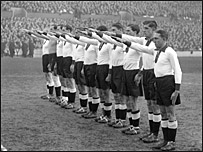 Football was used for Fascist propaganda It could have been worse for the Ancoats team in 1931. Three years later Italy – then world champions - played England at Highbury. The run up to the match was almost like a countdown to battle, with both sides using racist and inflammatory language. England eventually won 3-2, but five players sustained serious injuries during the match. Some claim it was one of the most violent football matches ever played. 'Manchester’s Little Italy' runs from 8 February to 31 August at the Museum of Science and Industry.Whatever the legends, we’d like to find out more Little Italy and their match in Rome in 1931. Do you have one of these medals? Or do you know more about this match? Tony Rea, ManchesterA team did travel to Italy but it would be wrong to think they were chosen specially by Mussolini to play before him. At this time there was a very popular youth movement promoted by Mussolini and his government called the 'Balilla'. A kind of political Boy Scouts & Girl Guide movement, it promoted Italian patriotism and Fascist values. It was popular in Italy and abroad in Italian communities. Every year families would send their children with Italian teachers sponsored by the Italian Consul over to Rome to participate in sporting activities. There was everything from football and swimming to track and field events. Those who excelled were presented medals or got to shake the hand of 'Il Duce'. Basically this was a propaganda exercise to promote Mussolini's regime and ensure that even Italians abroad remained loyal to Italy. last updated: 19/03/2008 at 15:19 SEE ALSOYou are in: Manchester > History > History features > Mussolini and Manchester   |
| | About the BBC | Help | Terms of Use | Privacy & Cookies Policy |