 | 27 November 2014 |

| |
| BBC Homepage | | |
| |||
| Contact Us | | |
PlacesYou are in: Manchester > Features > Places > Danger: OBE 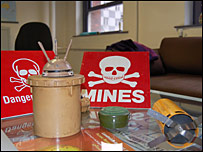 Hazard: landmines in MAG office Danger: OBEFrom a back street in Manchester city centre, a small charity is busy making the world a safer place. The Mines Advisory Group (MAG) is in the business of saving thousands of lives from the hidden menace of landmines. Find out more: MAG is actively involved in the clearance of landmines and other weapons in 35 current and former conflict zones around the world including Angola, Cambodia, Lebanon and Iraq. 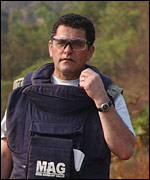 Lou McGrath OBE It's highly dangerous work. Yet the charity has arguably saved more lives and livelihoods than any other organisation on the planet. Now, MAG’s unique humanitarian effort has been officially recognised. Its chief executive, Lou McGrath, received an OBE in the 2008 New Year’s Honours’ list. CiviliansSince it was established in 1989, MAG has trained thousands of field workers who, under the charity’s close guidance, have destroyed millions of landmines, bombs, missiles and other tools of armed conflict.
Their work has spared countless numbers of innocent people from death, amputation or serious disfigurement. Yet this global effort is co-ordinated by just 40 people from an office on Newton Street. "The vast majority of casualties take place after war, and usually these are civilians," explains MAG’s Director of Policy Tim Carstairs. "Landmines and unexploded bombs restrict people’s access to education, healthcare facilities and water. If these are cleared, people can return to their lives safely and start again." Nobel PrizeLou McGrath’s OBE is just the latest honour bestowed on the charity. In 1997, MAG became co-laureate of the Nobel Peace Prize for its humanitarian work with the International Campaign to Ban Landmines. 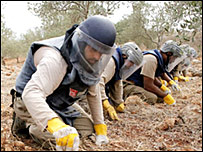 MAG: in the field And Princess Diana and Heather Mills-McCartney both famously supported the organisation. Yet despite this, the charity has a low profile in Manchester and in the UK as a whole. "Not a lot of people know we are here," says Tim. "But MAG employs, trains and educates people all over the world who have been affected by war. What we are doing is making a huge difference." UniqueIn the past six months, 18 MAG Mine Action Teams cleared over 700,000 m2 of land and destroyed almost 20,000 explosives in Iraq alone. And in Laos and Cambodia, MAG’s work is making a real contribution to the community. Around 38% of women, 7% of whom are amputees (caused by mine accidents), are employed by the organisation. 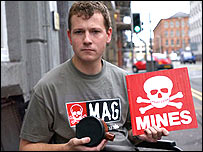 Victim: BBC reporter Stuart Hughes BBC World Affairs Producer Stuart Hughes became a MAG patron in 2003 after losing part of his right leg when he stepped on a landmine in northern Iraq. He says the work MAG carries out is unique: "MAG doesn’t clear barren mine fields, it targets mine fields where people live and builds relationships with communities, works with them and helps them prosper." "It’s quite unique and deeply humanitarian at its core." ChallengeDuring the nineties, much of MAG’s work focused on the clearance of mines. Today it continues this work but new challenges lie ahead. "Over the past decade we have noticed new and different weapons being used, such as cluster bombs in Afghanistan,” Tim explains. "There are a lot of weapons left lying around, which then get into the wrong hands. It is our duty to find these weapons and to destroy them." It's the funding the charity receives through the European Union, foreign governments and to a lesser extent, public donations, that allows MAG to carry on with its work of making the world a safer place. “It doesn’t cost much to cut up a gun or to clear a mine. This is not about war and who is responsible; it is about giving people the chance to start again. Without clearing these mines, people cannot return to their homes safely.” last updated: 07/01/2008 at 17:46 You are in: Manchester > Features > Places > Danger: OBE [an error occurred while processing this directive]  Remembering the Munich air disaster |
| | About the BBC | Help | Terms of Use | Privacy & Cookies Policy |
