| 24 September 2014 |

| |
| BBC Homepage | | |
| |||
| Contact Us | | |
History featuresYou are in: Manchester > History > History features > Exchanging histories 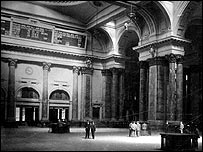 The Royal Exchange in 1921 Exchanging historiesA retired trader has joined the Museum of Science and Industry in appealing to his former colleagues for their stories to bring to life the history of one of Manchester’s best known buildings, the Royal Exchange. These days, the Royal Exchange is more of a centre for culture, housing as it does the theatre, than it is for commerce, but between 1874 and 1968, it was a hive of textile trading activity, with over 11,000 members at the trading peak in 1921. 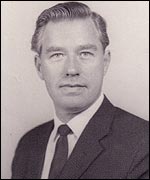 Albert Rowson Albert Rowson, now 79, was one of those traders, regularly taking to the floor for two decades, and he recalls times when there were up to 700 taking part in the day’s commerce. "It was really a hub of activity. By 11 o’clock in the morning, you would get quite a lot of people on. I would be on my stand and people would come along to me to ask for the price of this or that count of cotton. "The great thing was that you did your business on a hand shake; you didn’t have to sign anything as a man’s word was his bond." 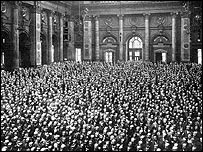 A packed Royal Exchange in 1911 Now Albert has contributed his memories of his time in the Exchange to MOSI’s Histories Revealed project, which aims to collect the oral histories of people who worked in Manchester’s textile industry. He says that recording the past of the building is very important. "The Royal Manchester Exchange was such a great facility, as it meant people could meet there, rather than have to come out to all the factories and mills. "It was such a pity when it had to close. I wanted to contribute my stories of working there, as I think it’s important to perpetuate the memory of such an historic time." 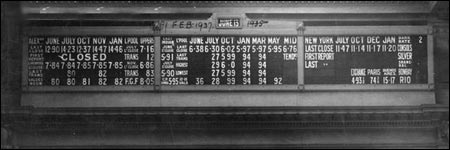 The all important cotton price board in 1937 MOSI’s Susie Elliott, the Histories Revealed Project officer, agrees that telling the story of the Exchange in people’s own words is vital, especially when you consider how significant the building was. "The Royal Manchester Exchange was an incredibly important part of life for thousands of Mancunians and played a key role in the success of the Lancashire textile industry. "It was once the largest trading floor in the country and helped to build on Manchester’s status as the Cottonopolis of the world. 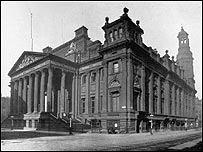 Outside the Royal Exchange in 1900 "We would be interested in hearing from anyone who worked on the trading floor, or in the building dealing or working with textiles, so please do get in touch and tell us your stories." MOSI is interested in talking to anyone who worked at the Royal Manchester Exchange until it ceased trading in 1968, as well as support organisations for textiles which were based in the city centre, such as bleaching and dyeing. The recorded stories will be used in the Museum’s exhibition spaces and in touring exhibitions. There will also be online exhibitions and all full recordings will be available to any researchers. All participants will get to keep a copy of their story on CD.
last updated: 19/03/2008 at 15:50 SEE ALSOYou are in: Manchester > History > History features > Exchanging histories   |
| | About the BBC | Help | Terms of Use | Privacy & Cookies Policy |