| 24 September 2014 |

| |
| BBC Homepage | | |
| |||
| Contact Us | | |
Science featuresYou are in: Manchester > Science > Science features > From Moore to Mars 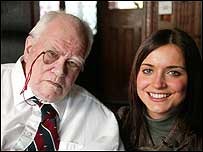 Sir Patrick Moore and Jacey Normand From Moore to MarsAs part of the celebrations to mark 50 years of listening to outer space with the Lovell Telescope at Jodrell Bank, BBC One’s Inside Out has been chatting with Sir Patrick Moore about life on Mars. Alongside his chat with the programme's Jacey Normand, Sir Patrick also took time out to answer some questions that had been emailed in. Below, you can read his answers to your questions about life, the universe and the future of space study. 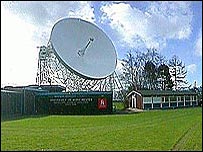 Chris Lyon asks: "Patrick, Do you know when the phase 2 redevelopment of the Jodrell Bank Visitors Centre will next progress? The present facilities are a pale shadow of the previous centre. Does such a national treasure fall between funding stools or do modern astronomers prefer their telescopes to be slightly more ivory than was the case in the halcyon scientific era of the sixties?"Patrick answers: "The Jodrell Bank Visitor centre is now being rebuilt, but I can't say when it will be finished - as soon as possible, I hope. It's all a question of money. Where I live, the South Downs Planetarium and Science Centre is very popular - we finance it ourselves and it just pays for itself. But it's all down to money with Jodrell Bank. "As for your question about ivory towers, I think that the telescope has always been more of a research thing, whilst the planetarium is more of an entertainment thing." 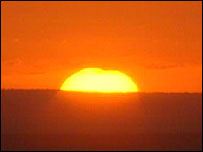 The sun Lee Vernon asks: "I know from your biography, magazine and television programme that your favourite subject is the Moon. If the technology existed and you were physically able to travel to the Moon - would you go, and which part would you most want to visit?"Patrick answers: "I'd love to go to the Moon. I would visit the brilliant crater - the Aristarchus - which is considered to be the brightest crater on the Moon." Bollington's Debating Society asks: "If it was possible to stand on the furthest star I can see from Earth and then look further away from Earth in the same direction, what would I see?? Can you please tell us... a long standing debate could be settled!"Patrick answers: "You'd see much the same as you'd see from here!" 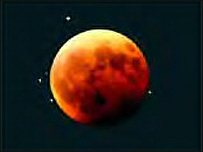 Lunar eclipse Julie Cowburn asks: "Please can you tell me what to look out for whilst viewing a lunar eclipse, and what sort of viewing equipment would I need?"Patrick answers: "A lunar eclipse occurs when part of the Earth's shadow falls upon the Moon. First of all, you'd see the Earth's shadow creeping onto the Moon - and then you'd see some lovely colours. Binoculars will give you a lovely view. A good telescope also helps, of course." John Turner asks: "If a spiral galaxy is 1,000 light years away from Earth then that means that the light from it takes 1,000 years to reach us. If the galaxy itself presents itself to Earth facing away, at say 45%, and it is 350 light years across, then the light from the front end must reach us 350 years earlier than the light from the back edge. If the galaxy is rotating and moving away from us, then why can we still see the spiral instead of just a fuzzy patch of light? I hope you can enlighten me!"Patrick answers: "The answer to your question is - because the spirals are just so far away." 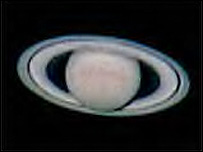 Saturn Damian asks: "Do you think that we will find life on other planets in the next 50 years - as opposed to 100-200 years or longer? And where do you think it's most likely to be?"Patrick answers: "We may find very low type life on Mars, Jupiter's moon, Europa, or Saturn's moon, Enceladus. We're unlikely to find anything advanced - nothing as advanced as a blade of grass, for example. By far the most likely place is Mars, but even if we do find anything, it will be very low level." Terry Hawes asks: "You have you enjoyed your life but if you had a chance, would you have changed anything?"Patrick answers: "I'm lucky - I've enjoyed my life. I've enjoyed my astronomy and my writing. If I had to make the same choices, I'd make the same ones again." 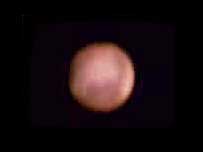 Mars seen through a telescope Paul asks: What do you think the next big scientific discovery will be for the science of astronomy?Patrick answers: "I always expect the unexpected, but it could be the discovery of life on Mars. We now know that Mars was once a wet, watery world... Mars is the only planet near enough to find out quickly whether there's life out there." Roger Bray asks: "What, if anything, do you think can be done to reduce air pollution which is a major problem for amateur astronomers?"Patrick answers: "It's a problem for everybody - not just amateur astronomers. It's also a problem for professionals. The main thing is to persuade local authorities that when illumination has to be replaced, they use street lights that shine down, not up." 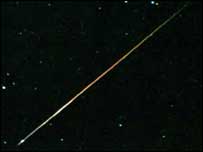 Meteor, photo by NASA Jenny Oldham asks: "Is it possible that the Universe might have started without any energy or mass? And do you think that the Earth will be destroyed within this generation's lifetime by the threat of an asteroid or meteor hit?"Patrick answers: "We think that the Universe began in a very big bang, but how that happened, we just don't know. The chances of being destroyed by an asteroid are very, very slight. The chances in our lifetime are very small indeed - so don't panic!" Monica Hardegger asks: "Is it possible for other planets similar to those in our solar system to be orbiting the Sun on the opposite side to us that we would never see? If so, is it not possible that could be a twin Earth on the other side of the Sun?"Patrick answers: "The question about the twin Earth... The answer is no, because it wouldn't stay there. The pull would destroy the alignment and we'd see it." last updated: 28/03/2008 at 10:33 You are in: Manchester > Science > Science features > From Moore to Mars |
| | About the BBC | Help | Terms of Use | Privacy & Cookies Policy |