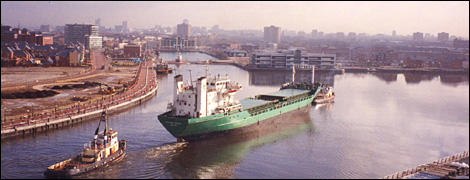
 | | Ship arriving at Manchester Docks |
Before you dismiss it as just another canal, it's worth remembering that the Ship Canal has played a major part in the development of one of the world’s greatest industrial regions - the North West of England. So - with apologies to Monty Python - here's a few reminders: What has the Manchester Ship Canal ever done for us? ![Barton Swing Aquduct [photo: Pennine Waterways]](/staticarchive/1db08f9dd123af8cf3fd785f33b2b67614b6c304.jpg) | | Barton Swing Aquduct [Pennine Waterways] |
"The aqueduct?" What? "The Barton Swing Aqueduct, which carries the Bridgewater Canal across the Manchester Ship Canal – which it has be said, is one of the wonders of the waterways world. Marvellous bit of engineering that…" Oh. Yeah, yeah. It did give us that. Uh, that's true, yeah. "And it revived Manchester’s trade and prosperity…" What? "Well, without the Ship Canal, Manchester would never have been able to build on its cotton trade and the industrial revolution. Without the docks and the deep sea shipping to export from the cotton mills, Manchester would never have prospered in the way that it did." Oh. Yeah, yeah. It did revitalise trade. Uh, that's true. Yeah. "And there’s the railways." What? 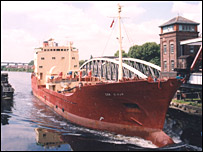 | | A ship passes Barton Bridge on the Canal |
"The Manchester Ship Canal company did actually build the largest private railway in Britain. And with the connection to the national rail network, the Ship Canal was in important factor in the growth of the railways to transport the cargo that was coming into the docks at Salford Quays…" Yeah. All right. I'll grant you - the aqueduct, trade and the railways are three things the Ship Canal has done. "And what about Trafford Park and all those jobs..?" What? "Well, Trafford Park was the first purpose-built industrial estate in the country. The Co-operative Wholesale Society (CWS) had a major food packing factory and a flour mill there; The Ford Motor Company produced the Model T Ford there, The British Westinghouse Electric Company (which later became Metropolitan Vickers) made turbines and generators there, Rank Hovis McDougall built its wooden grain silos there. Then after the War, Brook Bond moved its tea packaging factory at the canal side in Ordsall, Kelloggs started making cornflakes, ICI built its first purpose-built factory for the mass production of penicillin, The Guiness Company began brewing in the Park… And I suppose that without having the Canal for the import of raw materials and export of goods directly to the River Mersey and onto the world beyond, they wouldn’t have stayed and employed all those people." Well, yeah. Obviously Trafford Park. I mean, that goes without saying, doesn't it? But apart from the aqueduct, economic prosperity, the railways, Trafford Park… "There’s the swing bridges and the railway viaducts. Without the Canal we’d have never had Barton Swing Bridge, and the Trafford Swing Bridge near Old Trafford. And of course. And you’ve got five railway bridges." OK, apart from the aqueduct, revitalising trade, making Manchester prosperous, extending the railways, developing Trafford Park, seven swing bridges, five railway viaducts…what did the Ship Canal ever do for us? Well, if you think about it, it has played a major part in the development of one of the world’s greatest industrial regions.. and is still an important economic artery serving not just Manchester but the industrial North West, North Wales, and the Midlands… The Midlands????!!!! Oh shut up! [With apologies to Monty Python and The Life of Brian. And the Romans.] |