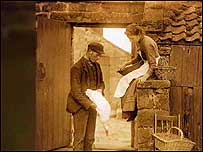
Wartime bomb danger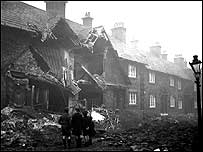 | | Wartime bomb damage c/o Associated Press |
Inside Out investigates how developers are ignoring the risks posed by unexploded wartime bombs in the race to rebuild the North's industrial cities. Experts say piledrivers being used extensively in cities like Hull and Sheffield could set off lost' bombs buried since air raids in the 1940s. In the last decade, more than a dozen of people have died in similar incidents on mainland Europe. Magnetometers or ground penetrating radar can find buried bombs but they are expensive and many developers choose not to use them. Bomb disposal contractor Mike Sainsbury told Inside Out: "We all accept that at some point someone is going to hit a bomb with a drilling rig or a piling rig, and there will be an incident. It is quite possible for a pile to strike a bomb and then cause it to detonate. "Until there is an incident and someone is killed from striking a UXB there won't be any real legislation or any real movement to make this work routine."
Unexploded bomb? Inside Out researchers found documents that suggest an unexploded wartime bomb may be buried beneath a major new redevelopment in Hull. Developers of The Boom - a £100m leisure and housing complex described in promotional literature as "an explosive experience in urban living" - were unaware of the document, which was freely available in the local archives. The company told Inside Out it had been planning a survey to check the site and would carry out underground checks if necessary - but the programme found many developers had not checked the ground before piling. Many sites are being redeveloped for only the second time since the war and most post war building did not involve deep piling. Because of the soft ground on the banks of the Humber Estuary, piles must be driven up to 16 metres to bedrock. Bombs have been found as deep as 8 metres. Compulsory screening Across the North Sea, screening sites in target areas is compulsory. Rotterdam, which was heavily bombed by the Germans as well as the RAF and USAF, checks every site and taxpayers' expense. City engineer Jauko Mutsaers says, "They were designed to kill people and they were designed to do damage
you can't determine if they are still active. "One small shock might set them off. If you go into the ground with piles or you start moving the ground to make room for buildings
you might set off a bomb." The developers of Hull's St Stephens Centre, ING, are based in the Netherlands, but they told Inside Out they had not felt it necessary to carry out ground radar or magnetometer tests. They said a study of databases and historical records found there was a "low to moderate risk" of UXBs being present on the site.
They said workers were being warned of the possibility and were being told what to do if a suspicious object was found. The company said half the piling work on the site - next door to Hull's main railway station, a major wartime target - had already been completed without incident. The Blitz During the Blitz, one in ten German bombs did not go off and in one night bomb disposal crews in Hull had to deal with 400 duds. It's thought many which fell on existing bombsites were never found at the time. Others were "abandoned" as too difficult to recover and left where they lay. There is an official list help by the army but the Ministry of Defence refused to release it to the BBC when Inside Out used the Freedom of Information Act to obtain it. Inside Out was told there was no guarantee it was accurate and its publication may cause public concern. Hull City Council said that as a result of the BBC's findings, it would review its policies on the bomb risk. Councillor Kath Lavery said: "There is a small risk but what you have to understand is that developers these days have to through a process call due diligence processes both for themselves and for their funders
they are in fact well aware of these problems."
Links relating to this story:The BBC is not responsible for the content of external websites | 



 Inside Out - Yorkshire & Lincolnshire: Monday January 16, 2006