BBC HomeExplore the BBC
This page has been archived and is no longer updated. Find out more about page archiving.

28 October 2014
Inside Out: Surprising Stories, Familiar Places

BBC Homepage
England
Inside Out
East
East Midlands
London
North East
North West
South
South East
South West
West
West Midlands
Yorks & Lincs
Go to BBC1 programmes page (image: BBC1 logo)

Contact Us

Inside Out - Yorkshire & Lincolnshire: Monday March 6, 2006

Bradford drugs

Drugs
Tackling the drug problem - at its root

Drugs and crime go together - so how can police stop people taking drugs?

It's a problem which takes more than just smashing down doors.

In some places, drugs are widespread.

In Bradford, working in secret, a police team are gathering evidence on properties occupied by drug users.

They're identifying targets where neighbours have complained of drug abuse and antisocial behaviour.

For more than three months, they've worked with community leaders and housing groups.

In the biggest-ever operation of its kind, raids will be launched across Bradford.

Getting off drugs

Superintendent Oldroyd briefs 100 police officers, as well as 50 housing and drugs workers.

Police are going to smash down doors - but they want to do more than that.

They're using closure orders to force the occupants out of their homes.

But, once they're out, they're offering help to get them off drugs and find somewhere else to live.

The aim is to get as many users as possible into treatment.

Inside Out watches as a man is arrested, suspected of using class A drugs.

His house will be closed down, and he's got to appear in court the next day.

If he agrees to treatment, there's a chance he might stop re-offending.

At a second house, there's a man and a woman.

They'll be offered the same choice: agree to get help or face the consequences.

The cost of drugs

It's expensive being on drugs.

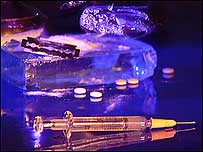
When a bag of heroin costs £10, and a rock of crack £15, addicts commit crime to fund their habit.

The woman and the man are arrested while police search the house.

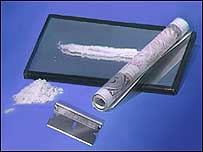
Cocaine
The challenge - keeping users off drugs

Their neighbours will be told that the occupants of this house are not being allowed back.

They've been removed. The next aim is to keep them out of trouble. But will it work?

Back at the police station - the crucial next step - a prisoner is being encouraged to come off drugs.

In central Bradford, the raids continue.

Police find an imitation gun, and there's extensive evidence of drug use.

The flat, in an old people's complex, has been used by prostitutes.

Two women are arrested.

Putting paid to pushers

Hemsworth, near Pontefract, has suffered pit closures and job losses.

Houses were raided here nine months ago. So has it paid off?

In one part of Hemsworth, drug dealers used to drive the streets in blacked-out cars.

There's no doubt things have got better.

Much of the area is due for demolition. Most families have gone - and so have the drug users.

Here, at least, the new strategy seems to be working.

Back in Bradford, two months later, out of 19 people arrested, 15 haven't offended again. That looks like a good result.

It's a good start for a new tactic against drugs.

Links relating to this story:

The BBC is not responsible for the content of external websites

Inside Out Archive

Inside Out: Yorkshire & Lincolnshire
View our story archive to see articles from previous series.

BBC Where I Live

Find local news, entertainment, debate and more ...

Bradford
Humber
Leeds
Lincolnshire
North Yorkshire
South Yorkshire

Meet your
Inside Out
presenter
Jamie Coulson

Jamie Coulson
your local Inside Out presenter.

Contact us
Contact the Yorkshire & Lincolnshire team with the issues that affect you.

Free email updates

Keep in touch and receive your free and informative Inside Out updates.
Subscribe
Unsubscribe

The Peak's missing birds of prey
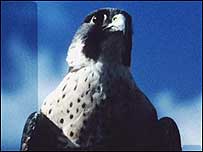
Peregrine Falcon
Peregrine Falcon - king of the skies

Falcons are the toughest, meanest, hardest birds anywhere on the planet.

These are THE birds of prey - a sort of Vinny Jones of the skies.

And the biggest ones will snack on virtually anything.

Amongst the many marvellous looking birds of prey in Derbyshire is the Goshawk, weighing in at a two and with a wingspan of a metre and a half.

The forest is its manor and the birds live off the fat of the land.

So you'd reckon these birds would have absolutely nothing to fear.

Not only do they rule the roost, they're protected by the law.

But the RSPB say in certain areas these birds are taking a hiding - from humans.

Killing protected birds

In a new report the RSPB says that birds of prey are being killed for sport.

The RSPB says that frequently in similar breeding grounds to Peregrine Falcons, there are locations in the Peak where no young have been raised since 2000.

The RSPB claims that in other sections of the Peak District, the number of chicks raised is half that of other areas in Britain

Mark Thomas, a bird specialist, has been investigating.

We join him on the hunt for an elusive pair of Goshawks in the Peak District.

"A lot of people call them 'the phantom of the forest' because it's this incredibly powerful muscular bird that can fly at incredible speeds and dash through the canopies they can eat virtually anything."

But according to the RSPB, in certain parts of the Peak District, these birds of prey have become the prey themselves.

Mark Avery says that since about 1999 numbers of Goshawks in particular, have plummeted.

"They were doing fine here - in fact the Peak District was a great place to see them," he says.

"There are still some here but their numbers have declined in some parts of the Peak District and they've just almost disappeared from some of those places.

"And that's not something we've ever seen before in any part of the country - there's something very odd going on here."

Game shooting?

What the RSPB are alleging is quite simple - that people are deliberately killing birds of prey.

A RSPB says, "Most of the people who've been prosecuted successfully, most of them have been closely associated with game shooting.

"And I'm not saying they're all at it, but that's where I'd look first."

The RSPB reckon its another bird that can explain this trend - the Red Grouse.

People pay thousands of pounds for the privilege of shooting them.

Birds of prey eat grouse so fewer grouse means a worse day for the shooter.

We spoke to a gamekeeper, who isn't based in the Peak District, but he confirmed that keepers were being pushed to 'deal' with birds of prey.

He didn't want to be identified and we've recreated his comments:

"I got to the stage where I was basically told that if I'd done it, I might be able to keep my job.

"But I've never done it - I just refused to do it and after that, well, things started to get nasty, you know.

"One day we were out and a Golden Eagle was flying about, and he went beserk at me.

"He said how embarrassing it was to have all his friends up from London shooting grouse and there was this Golden Eagle flying about.

"He was suggesting keepers weren't doing their job - it was just vermin as far as he was concerned.

"I was told Otters, Badgers, Deer - just get rid of them and don't worry about the legal issues because they could afford the best legal help money can buy."

Bird paradise?

Back in the forest with Mark Thomas, there's still no sign of the Goshawks, but there's evidence of something more sinister.

After a 500 feet climb up from the nearest footpath, we find a bird of prey site which looks like it's been tampered with.

It's difficult to see how anybody could've stumbled across these birds in an isolated location by accident.

A Goshawk was nesting in the tree, but we saw a deep gouge - evidence that someone had climbed up and disturbed the nest.

A mark in the tree trunk bore a close resemblance to climbing spikes belonging to a local keeper, Reg Cripps.

There was enough other evidence for a successful prosecution.

No evidence?

So how many people involved in country sports are really willing to break the law and are turn both barrels on protected birds?

We were keen to speak to someone who regularly deals with shooters, keepers and landowners.

Tim Baines from the Countryside Alliance responds to the allegation that Goshawks are reducing in certain parts of the Peak District and that people involved in country sports are to blame:

"Well I don't know where these figures are coming from.

"I've certainly seen nothing to suggest it, and the last survey suggested that all raptors were doing better than ever in the Peak District.

"And this sort of constant insinuation that people in country sports are involved... there's really very little evidence for it."

So what could be the explanation for the fact that there aren't so many Goshawks around?

Could it be the result of disease, for example?

Mark Thomas has his own views:

"Where populations of birds are disappearing or they're vanishing, where neighbouring populations are fine - those are the mysteries - and that indicates really quite strongly persecution."

Persecution will lead to prosecution say the RSPB - expect a hefty fine and even time in jail if you're caught killing a bird of prey.

Links relating to this story:

The BBC is not responsible for the content of external websites

Lincolnshire's forgotten explorer

Flinders window
A hero down under is now honoured back home

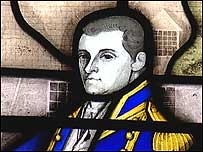
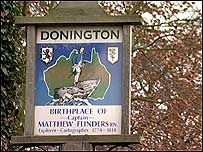
Matthew Flinders was from the Lincolnshire village of Donington.

But few outside the village know that he named Australia and many of the places around its coastline.

He was the first person to circumnavigate the continent, beating the French to it.

He died at 40, unknown and uncelebrated in England.

But in Australia there are more monuments and statues to Flinders than any other person, apart from perhaps Queen Victoria.

There are countless places and streets named after him too including Flinders University in Adelaide and Flinders' station in Melbourne.

Making of statue
Flinders' statue is cast in Lincolnshire

But in his home country he doesn't even have a gravestone.

Euston Station was built on top of the church he was buried in.

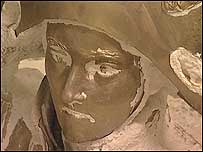
But at last, the first public statue is being built to commemorate him.

It's being put up in Flinders' home village with the help of money raised in Lincolnshire.

The Flinders statue is unveiled on Flinders' birthday on March 16, 2006.

Inside Out watches the statue at every stage of its making from clay to bronze.

Who was Flinders?

Matthew Flinders was born in the village of Donington, near Boston, in 1774.

Donington sign
From Donington to Down Under - Matthew Flinders

His father, also called Matthew Flinders, was the local surgeon and apothecary.

Matthew was educated at home and in Lincolnshire schools, before joining the Royal Navy in 1789.

In 1791 he joined HMS Providence as a midshipman, serving under William Bligh on his second voyage to Tahiti.

After his return to England in 1793 he took part in the Battle of the Glorious on HMS Bellerophon.

The following year he sailed for New South Wales on HMS Reliance.

Voyages of exploration

Shortly after arriving in Sydney, Flinders explored Botany Bay and the Georges River in a small boat named Tom Thumb.

From 1796 onwards Flinders continued his explorations, carrying out valuable survey work among the islands.

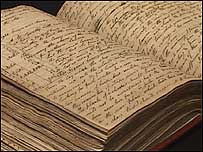
Flinders' journals
Valuable study of Australia and its coast

Flinders' next project was a survey of the entire Australian coastline.

In January 1801, Flinders was given command of HM Sloop Investigator on which he undertook a number of voyages.

He then decided to sail for England to obtain a new boat for his survey work, but war broke out between Britain and France, and Flinders was imprisoned as a suspected spy.

Flinders was incarcerated on the French island of Mauritius for over 6 years, during which time he worked on his journals.

Find out more about Flinders' work in the archive

He was finally released in June 1810 and sailed for England where he settled in London to complete his book, A Voyage to Terra Australia.

Links relating to this story:

The BBC is not responsible for the content of external websites


About the BBC | Help | Terms of Use | Privacy & Cookies Policy