Yoga movement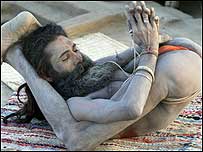 | | Traditional yoga in India |
When you go to yoga class, you expect to tweak a few muscles and work on that Madonna-like physique.
You don't expect to end up devoting the next seven years of your life to an obscure religious movement.
This is what happened to Lyn Dale, a hairdresser and mother-of-two from Hull.
It all started in the 1990s when Lyn was working as a fashion model in London.
She was living the dream, earning lots of money, but started to have panic attacks and so turned to meditation.
Lyn dabbled with several classes, but was most drawn to one advertised as Sahaja Yoga.
She loved the atmosphere and the meditation practice, and was so enamoured of her teacher she fell in love with him, and married him three weeks later. "I felt like I'd known him from somewhere before, it was really strange. "If I'd have felt like I'd only known him for three weeks, I wouldn't have married him so quickly but it just happened and it was part of the Sahaja Yoga thing really I think."
Mediation and spirituality
Sahaja Yoga classes are not exercise classes. They're part of an enormous growth of new religious movements in 70s counter culture, when people discovered meditation and spirituality.
Sahaja Yoga hasn't westernised as much as some of the other ones.
It's interesting because the leader of the religion is a woman.
Shri Mataji Nirmala Devi, is the founder of Sahaja Yoga. She's a wealthy and well connected Indian woman, the childhood protégé of Gandhi, and married to a respected Indian diplomat.
But to the Sahaja Yoga followers, as Lyn discovered, she's a divine being. | YOGA CHECKLIST |
If you are looking for a yoga class, things to check are:
What type of yoga is it? There are many different styles of yoga. Most classes in this country will be in Hatha Yoga, which has elements of bending and stretching, with some breathing and meditation. Iyengar Yoga is similar to Hatha Yoga, but performed according to a method devised by a teacher called Mr BKS Iyengar. Power Yoga, or Astanga Yoga is the form made popular by celebrities such as Madonna and Geri Halliwell. This is a more dynamic and strenuous workout. Is it the right class for you? It is a good idea to have a short discussion with the teacher before you start to practise yoga. Some classes are suitable for beginners, whilst others might suit more advanced students. Also, you should talk to your teacher about your general health, and if there is any health or fitness issue the teacher should be aware of. Always check the teacher's credentials. Most qualified yoga teachers will be certified by the British Wheel of Yoga, the governing body for yoga. Any qualified teacher would be happy to tell you their credentials. Whatever form of yoga class you attend, you should make sure the teacher is fully trained and certified to teach. Most yoga teachers will be certified by the British Wheel of Yoga, by an organisation affiliated to the British Wheel. Any teacher would be happy to tell you their credentials. |
Anti-material girl Whatever Sahaja Yoga asked of Lyn, she went along with it. She turned her back on the world of fashion, and severed ties with friends and family. But she began to have misgivings when she witnessed Shri Mataji accepting lavish gifts, and at the same time encouraging her followers to reject material wealth. Lyn couldn't just walk away. By now she had two children, and feared that rejecting the Sahaja Yoga movement would threaten her marriage and break up her family.
"If you feel like Sahaja yoga is like a family to you and if you've got doubts, you will get thrown out of Sahaja yoga. "So it would be a case of leaving Sahaja yoga and also splitting with my husband and my marriage would break down," says Lyn. Not every form of yoga is like Sahaja Yoga, of course. Laura Bissell of the Yorkshire Yoga Centre points out that, "if you go to a yoga class in the West it's 99% likely to be Hatha yoga. "This is physical exercise with breathing techniques and relaxation. "It's important to check out the qualifications of any yoga teacher, so you know that the teacher's training has covered the precautions necessary for individual problems." No pressure
The Sahaja Yoga organisation know Lyn's history, and have made these comments: "There are no rules forcing an individual to adopt any particular lifestyle. "We function with unpaid volunteers. No money is ever taken from practitioners under any form of duress. "Donations are only accepted to help fund communal activities such as the hiring of halls. "No-one is under pressure to attend meetings, contribute funds or to do anything that they are unhappy with. "Ms Dale's account of her experiences does not correspond with those of other people."
Regrets After seven years, Lyn split from her husband and broke away from Sahaja Yoga, taking her children back home to Hull. She regrets the time she spent in the Sahaja Yoga Movement: "You wouldn't imagine anything like that could happen really to you, but it just shows that it can affect anybody. "There's a lot of regret there and that's why I want as many people to know about it so that they don't make the same mistakes." Links relating to this story:The BBC is not responsible for the content of external websites | 



 Inside Out - Yorkshire & Lincolnshire: Monday February 6, 2006