| 24 September 2014 |

| |
| BBC Homepage England | | | |||||||||||
 | ||||||||||||||
| Contact Us | | ||||||||||||
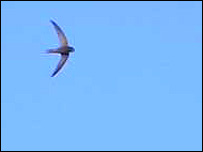
Historically, swifts have been known as "The Devil's Bird" - probably because of their inaccessibility and thus, just like owls, they attract more folklore than good natural history. But of course, it's not their nocturnal nature which keeps them beyond the reach of our early investigations. It's simply that they migrate away for the winter - something that confused observers pretty much until the 20th Century. And when they are in Britain they only land to breed and they do that in inaccessible sites - tiny cracks high in buildings. They feed, drink, and preen in flight and are the only group of birds known who actually mate on the wing. They sleep in flight and in summer you'll see any non-breeding swifts spiralling up towards the stars as darkness falls, their screams fading with the daylight.
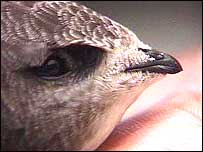
Only recently, we have discovered that these birds fly up to around 10,000ft. It's at this altitude that they shut down half their brain, continually correcting the wind drift so they wake up where they fall asleep. It's cooler up there and of course there are no predators. Some Swedes sussed it out using radar to track individual birds - smart! All of these behaviours have led to the evolution of a highly aerial, sickle winged, big eyed, wide mouthed body form fitted with the shortest of legs. Swift secrets Although they have claws for clinging, once at rest they stumble about on their breast in a truly ungainly fashion. Our European swifts are all dark chocolate brown with forked tails and a pale chin patch - easily distinguished from swallows and martins. And it is these habits which meant that unlike so many equally familiar species their ecology remained an ornithological enigma for years.
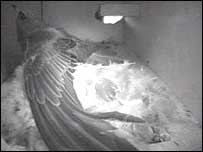
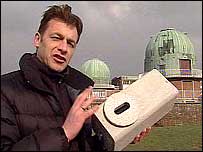
And what is most exciting is all of their secrets are still being discovered. Cue Graham Roberts, our swift man of Hampshire. Over a succession of years Graham has increased and modified a series of swift nesting boxes which he has under the gable of his house. Each is fitted with one or more small black and white infra-red camera which has allowed him a unique insight into the life of these birds. So, between May and August, his adjoining office becomes a mini-studio and it's here that he has recorded some truly amazing sequences of previously unseen behaviour. Coincidentally he has pioneered similar projects to pry into the private lives of peregrines nesting on buildings in Brighton and Chichester. He's that sort of birder, inventive, clever, simply one of the best naturalists I've met. Annual pilgrimage Swifts collect their nesting material on the wing and gather grass which they weld with their saliva into a small cup.
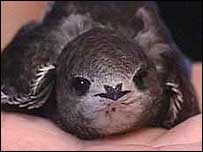
Later, they decorate and insulate the nest with as many feathers as they can catch. They'll return to this nest each year and since they can live more than 20 years, that means a sustained succession of visits. And nest sites are jealously guarded, any intruders being fiercely and noisily ejected. Two or three plain white eggs are laid and the young are fed by both parents who return with frequent meals of insects. These are held by the adults in a food ball in a throat pouch which is successively disgorged to the offspring. One can only imagine the thousands of insects that are packed into these bulging birdburgers! Now all of this was well known, there is a famous monograph by another great birder David Lack, entitled 'Swifts in a Tower' (1954) but Graham's constant and diligent attentions have revealed more details about all sorts of things. Give a swift a home Most extraordinary of all was when a female with eggs lost a mate and after a period of lonely incubation found another male. He promptly came in and threw out her original eggs and she obviously laid another clutch.
Thus he had ensured that it was his offspring that he was going to be rearing, a brilliant example of the evolutionary selfish gene. Another essential part of Graham's passion is the conservation of this species. It is declining, not least as modern buildings have fewer holes for them to nest in. He's come up with a Swift brick, a simple way of neatly incorporating a nest box into any new building. Early trials have been very successful. If you'd like to do your bit you can buy boxes to clip up to your eves and they work too. Go on, get one. Swiftly.
| ||||||||||||||||||||||||||||||||||||||||||||||||
| | About the BBC | Help | Terms of Use | Privacy & Cookies Policy |

 Inside Out - South: Monday March 7, 2005