| 28 October 2014 |

| |
| BBC Homepage England | | | |||||||||||
 | ||||||||||||||
| Contact Us | | ||||||||||||
In this week's nature notes, Chris Packham takes a look at the world of the lovable seals which inhabit our coasts. Seals are one of those animals which seem to draw extremes of human emotion. The tabloid press run regular pictorials damning the Canadian culling of seal pups which elicit instant outrage, whilst similar sentiments are seen from fishermen who blame the localised increases in seal populations for the fall in stocks of fish. Theres controversy in them there seals! And sadly a nasty virus has infected Northern Europes colonies but for the moment that seems to have abated. Seal IDBritain has two resident species: grey and common seals. Very loosely speaking commons are distributed around the Eastern coasts and greys on the North and West.
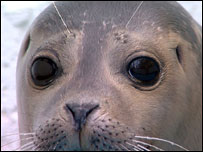
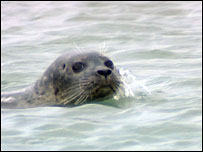
They are easy to tell apart. Greys have long roman noses whilst commons are generally considered the more attractive animal with a big eyed, round face. Their nostril pattern is equally distinct. Commons form a distinct 'V' shape whilst the nostrils of the grey run in vertical parallel. Both have variable coat colours and markings and range from silvery greys through to black, blotched and spotted in various patterns. But in truth go for the nose profile, something youll pick up easily if, as is more than likely, the animal is in the water. Seal spottingThe coast between Ramsgate in Kent and Exeter in Devon is pretty sparsely populated. There are precious few rocky coves and the general boaty-busyness means that in many areas there is simply too much disturbance, something seals are especially sensitive too when they give birth to their young. For greys this is a winter event, the single pup being born between October and December.
Commons produce their young in June or July. Both have phenomenal growth rates and the pups are vulnerable to predation when stuck on the shore. This pressure has exacted the evolution of a specific physiological trait in seals. They practice delayed implantation in that they mate whilst they are ashore feeding their young. The eggs are fertilised and after some initial developments the cell mass stops growing and only implants into the uterus wall some 100 days later. This means the adults come ashore not twice (once to give birth and once to mate) but only once a year, reducing their own exposure to predators. Sight-sealingIf you would like to see seals, there are many sites where specialised seal trips are run around the coast.
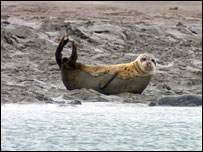
For a few pounds you can take a guided tour of the Farne Island colony in Northumberland where you can find three to four thousand seals basking on the rocks, with 1,000 pups born between in the late autumn. The wonderful seal colony at Blakeney point in Norfolk has mainly common seals, but also some greys and again you can take special ferry trips to see them. Theres another great colony off Margate in Kent. Further West from Hale in Cornwall and Marloes in Pembrokeshire you can explore some Cornish colonies and those around the Skomer/Skokholm island group. You can get more information from the Mammals Trust (UK) which will be featuring seals this Spring.
| ||||||||||||||||||||||||||||||||||||||||||||||
| | About the BBC | Help | Terms of Use | Privacy & Cookies Policy |

 Inside Out - South: Monday February 7, 2005