The project has moved on since the campaign to reopen the line was launched in 2001 by Philip Taylor and George McManus. Development in 2006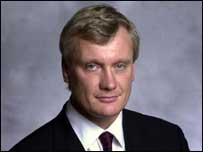 | | Graham Stuart: MP for Beverley and Holderness |
For the first time the idea of reopening the line has been discussed in Parliament. In a Westminster debate in early June 2006 Graham Stuart the MP for Beverley and Holderness said: "Serious attention should be given to the proposed reopening of the Hull to York railway line. "The Hull to Beverley line is still in existence, but the extension from Beverley to York was axed in 1965 as part of the Beeching cuts and has never been reopened. "Recently, however, there has been growing political people pressure, from the ground up-for its return.  | | Paul Belotti - ER Council |
"A point worth making in that context is that transport in the region, particularly at the northern end of the A1079, is about not just reaching York but accessing Leeds and other areas." Gillian Merron, junior transport minister, replied: "[The railway]... would not be financially self-supporting from fare income and would require ongoing public subsidy. "...It would be unfair of me to suggest that consideration of the proposal outlined by the hon. Gentleman is likely to be a realistic priority for the Government in the immediate future." Philip Taylor Vice Chairman of the Minsters' Rail Campaign comments: "The Minister's response was so predictable.  | | Philip Taylor - Minsters' Rail Campaign |
"That's why I recommended the East Riding Council leaders nearly a year ago that the Council should focus on getting the route protected and not hold its breath about getting Government funding any time soon. "It is disappointing the Minister doubted the line's ratio of benefits to costs and the availability of diversions and apparently expected it to be rebuilt and operated without ongoing public subsidy. "Carl Bro, the local authorities' Consultants, satisfactorily addressed these issues in their report. "They indicate that even in the worst case its benefit - cost ratio is more than double the new St Pancras Eurostar Rail Link and that the public subsidy would be well below rail's regional average. "It would be a route of strategic regional importance in the second fastest growing area outside London and I was surprised that the Minister thought it relevant to bracket it with under-performing surviving and re-opened 'branch lines'. 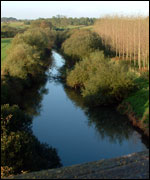 | | Views near Stamford Bridge |
"The main priority must now be to get the route identified by Carl Bro protected through the York, Ryedale and East Riding Councils' Local Development Frameworks." Developments in 2005In June 2005 the Leeds-based engineering consultants Carlbro produced a report looking at whether it was be feasible to reopen the railway. Their economic assessment showed a Benefit - Cost ratio of up to 2.04 over a 60-year period - making it one of the most robust rail reopening proposals in England. The present cost would be £183 million and a further £56 million has been added to cover contingencies.
Currently CarlBro predict up to 800,000 journeys per annum. Carl Bro recommend a half-hourly service so the route should be designed and costed as a double track railway.
David Walford, rail development officer for Community Rail Humber, said that passenger predictions in the report were "conservative". He said the Hull to Beverley to York route could eclipse the Hull to Scarborough line, which takes 1.3m passengers annually and saw patronage increase by 5%, 10% and 8% over the last 3 financial years. 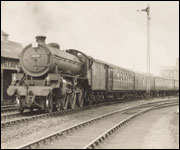 | | Class B1 No 61276. © Tony Ross. |
A new line would follow the original route as much as possible but there would be deviations to the north of Beverley and Market Weighton town centre, to the south of Pocklington, and to the north east of Stamford Bridge.
A new railway bridge would be built across the River Derwent. The line would reconnect into the Scarborough to York line just south of Haxby instead of Bootham Junction.
Only 2 houses would need to be demolished - both in Market Weighton.
What's happening now?Paul Belotti is the forward planning manager at the East Riding of Yorkshire Council based at County Hall.
He told us that during the summer of 2006 people living in the East Riding will be asked whether they think the proposed route of the railway should be protected from further development to stop fresh obstacles being put in the way of reopening the railway.
It is thought there could be considerable opposition to re-opening the line was some people would find their homes would lie close to the railway tracks. BackgroundAfter leaving Hull the line ran through Cottingham and Beverley before veering off westwards, just north of Beverley station. The trains ran through Cherry Burton, Market Weighton, Pocklington, Stamford Bridge, Huntington and York. Today the A1079 road connecting Hull and York is heavily congested with cars. With lengthy queues, some people say it is time to rebuild the railway. This feature looks at the history of the line, why it closed and the campaign to rebuild it. Building the lineThe line was built by the York and North Midland Railway. The first passenger train ran from York to Market Weighton on 3rd October 1847. But the railway stopped there. It was 17 years before the rest of the line, from Market Weighton to Beverley, was completed. 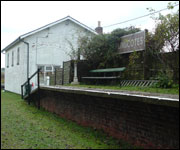 | | Kiplingcotes' disused platform |
Lord Hotham, who owned much of the farmland between Market Weighton and Beverley, was reluctant to have a railway built across his estate on the Yorkshire Wolds. He finally agreed to let the railway through - on the condition that he was provided with his personal station, at Kiplingcotes and that no trains ran on Sundays. The first through train from Hull to York ran on 1st May 1865. Passenger trainsThe line crossed mainly flat farmland, permitting trains to reach 70 mph or more between Market Weighton and York. As early as 1910 an express was introduced connecting the centre of Hull to the centre of York in just 61 minutes. Today, cars take much longer to make this journey. In 1924 the journey time was cut further to just 56 minutes. Diesels were introduced in 1957 and by 1960, there were a record nine passenger trains daily each way. Market Weighton - rail centreUntil 1965, Market Weighton was an important railway junction. The Driffield to Selby and the Hull to York lines both ran through Market Weighton station which boasted its own WH Smith kiosk. In the summertime special trains from the West Riding ran through Market Weighton and Driffield, carrying holiday-makers to Bridlington and Scarborough. 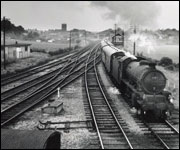 | | Class K1 no. 62007. © Tony Ross. |
In the first picture we see Class K1 no. 62007 passing with an express from Leeds to Bridlington, summer 1964. Market Weighton station is in the centre-right background, the goods shed in centre background. The line to the left went to Beverley. The second picture shows Class B1 4-6-2 no. 61276 passing Market Weighton with a summer excursion from the West Riding to Bridlington in 1959. The station is right background. Freight trainsThe railway carried large amounts of freight. Steel was shipped from Teeside to Hull. Large amounts of timber and cocoa were transported and there was an evening fish train from Hull. The line carried lots of agricultural produce. The Modernisation PlanThe future of the railway looked assured as the 1960's dawned with nine daily passenger trains each way, between Hull and York. Each train carried 57 passengers on average and the line made an annual operating profit of £5,000. That same year it was announced that the line would be modernised. The whole route would be controlled from one signal box and 19 of the 22 level crossings on the line would be converted to automatic half barriers. In May 1961, a contract for the work was placed with the engineering firm Westinghouse and tonnes of equipment were delivered to Pocklington. Then out of the blue, in February 1962, it was announced the modernisation scheme was being suspended for "re-assessment". On the 27th March 1963, Dr. Richard Beeching, a businessman who had been called in by the Government to review Britain's Rail network, published a report, 'The Reshaping of British Railways'. The Beeching ReportDr. Beeching said the line itself made a small operating profit, but when "terminal" costs were taken into account (maintenance of locomotives, administration costs), the line made a £17,000 annual loss. 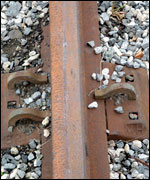 | | Track line |
He said most of the traffic on the line was between Beverley, Hull and York and intermediate stops like Market Weighton and Pocklington generated relatively little income. Dr. Beeching said passengers who wanted to travel between Beverley, Hull and York could do so via Selby and the line was unnecessary. Countdown to closureIn 1964 British Railways announced plans to make the line single-track, further reducing operating costs. It is likely that had this been done and the modernisation plan had been carried out the railway would, by any assessment, have made a clear profit. Local authorities along the route protested about the impending closure and the official rail passenger watchdog, warned that closing the line would cause hardship. Despite the objections Barbara Castle, the Minister of Transport, approved the closure. The last trains ran on a snowy Saturday 27th November 1965. The final train was the 9.42pm train from York to Hull. Tracks rusted, weeds grew, buildings decayed. In January 1969, the British Railways Board agreed to sell off all of the assets on the route. The rails were lifted and the buildings and track-bed were sold off to the highest bidders. Housing was built on parts of the line. In 1991 the East Yorkshire Borough Council announced plans to demolish the Stamford Bridge Viaduct, which carried the railway across the River Derwent. Rail campaigners blocked the demolition and the viaduct was repaired. A railway reborn?The Minsters Rail Campaign is a pressure group that wants to see a direct rail link re-instated between Hull and York. The group was founded in 2002. Moves to re-open the railway received a boost in April 2003 when the Countryside Agency published a report which said that re-opening the line was technically feasible. In 1964, the East Riding of Yorkshire Council had fought to stop the railway being closed. Forty years later, in 2004, the present East Riding Council commissioned a report from the engineering firm, Carl Brothers, investigating whether the railway could be rebuilt. Can it be done?Over the past 40 years many parts of the track-bed have been redeveloped. A housing estate has been built over the route of the line in Beverley. This has also happened in Market Weighton, Pocklington and Stamford Bridge. Even the line's supporters admit that if the railway is rebuilt it will not be able to follow the path of the original line the whole way. Bridges and embankments have been demolished and parts of the track-bed have been ploughed up. Re-opening the railway would be a major civil engineering project. |