

- Contributed by
- TORRANCE Duncan Leitch
- People in story:
- Duncan Torrance
- Location of story:
- Bavaria
- Background to story:
- Army
- Article ID:
- A7646899
- Contributed on:
- 09 December 2005
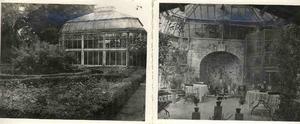
Officer's Mess of the RAF Missing Research and Inquiries Service at SAAL near Regensburg.
CHAPTER XV - Part Two - BACK TO EXHUMATIONS AND CROSSES
On the Wednesday I left with a 15 cwt Fordson truck and travelled down to Saal near Regensberg. The journey was just under 300 miles so took all day. We passed through some very pleasant wooded country, and I enjoyed the driving.
I had started to work once more. My period of enforced idleness was at an end.
Saal itself was a magnificent old place. It must have cost a fortune to build. It had belonged to a very senior Nazi official. Once used by the Americans as an officers club, it had its own ballroom and swimming pool.
It was situated at the bottom of a wooded hill and within half-a-mile of the river Danube.
The first job I did effected me greatly. As the war was closing in on them, the Germans forced marched thousands off prisoners Eastwards. They were running from the advancing allies. I had a mass grave containing nineteen British soldiers. They were prisoners who had been killed by British aircraft as they were being marched across Germany.
It was still easy to see that the men must have been very weak. They had marched a long way. Their boots had no heel left and very little of the soles left. They had been buried with their haversacks, which contained their - toothbrushes, their letters and all the other marks of privation. Judging by their regiments and army numbers, I think they were from Dunkirk, or possibly remnants of the 51st Highland Division which met its end at St Valery.
In Germany we filled in a one page exhumation report on each casuality. These included a tooth chart, showing also the position of any fillings.
One of the excitements was the way people were sometimes identified from information after we had buried them. Unknown burials were then given names. We never knew how. Perhaps tooth checks; perhaps other information we had been able to supply. Incidentally, its wonderful that the term 'Unknown', has been replaced by 'known only to God'. It's o much kinder. Thank you Imperial, now Commonwealth Graves Commission.
Bavaria was an extremely hot Nazi area. It was full of war crimes. Every now and then we came across stories of airman shot in cold blood. There were large numbers whose end we never knew. Some Germans were following a policy of removing the means of identity from bodies Papers, and even badges of rank were taken before the bodies were handed over to civilians for burial.
It was amazing how many identities of airmen we were able to get. If we could identify the aircraft, or one person on it, The Missing Research and Inquiries could do the rest. From their clothing and equipment, our MRES team knew which position each person on the plane had occupied. This could then be matched up with information supplied by the Air Ministry. Collars were a very good source of
names. Good indicators, but not entirely reliable. People, especially air crews, sometimes got their shirt collars mixed with other people?s
We were issued with big thick rubber gauntlet gloves. I did once hear that one of our officers had died of blood poisoning due to a scratch on his hand becoming infected in a grave.
I used the glove on my left hand, but always kept the right hand bare so that my finger tips would never miss a useful clue.
Some of the items we recovered from graves were carefully examined over the week-end. Anything engraved was cleaned. Then we poured a little petrol on it. The petrol evaporated last from the indentations of engraving. Sometimes we could read initials, rarely even names, on a watch or cigarette case.
One of the officers in the unit was getting married. If he was to have a honeymoon, it was essential that he completed his area for various reasons. He had worked extremely hard but it became apparent that he would not finish in time. It was decided that I should go up there for two days and move fifty bodies. This does not sound a great deal but there was a two day journey to Kassel, and my own work still waiting. The bodies were spread out. On both days we covered 250 miles in collecting them. These were sixteen hour days.
On the day we left, we drove to Nuremburg, on the Northern boundary of my area, ready for more exhumations the next day. This was an eight hour day. We seemed to spend half of it waiting for German labour to open graves or reopen some that fell in.
The RAF at Saal had very little to do. I was ashamed of their conduct as occupiers of enemy territory. Probably the worst behaved was the Squadron Leader in charge. He lay himself open daily to serious charges.
He was entertaining German women on the mess rations, using WD vehicles to transport them, and holding drunken orgies in the mess which lasted until between eight and ten the next morning.
He used to break his own speed limit with his jeep coming down the drive to the mess. One Sunday afternoon he took a jeep into the town at two o'clock. He was wearing pyjamas, the officer with him was wearing civies. They brought two German girls, back to the mess.
Another night I caught him in my headlamps, sitting on a bridge in the town, with a German girl and a bottle of gin. Many of these women slept regularly in the mess.
He met his deserts a day or two before his release. He had an accident in his jeep. He was uninjured. Another of his officers also completely smashed a jeep. He also was uninjured. Both managed to avoid disciplinary action or financial responsibility. I don't think they had authority to drive RAF vehicles.
Those are the words I wrote in 1947. They are true. They are absolutely true. That's why I feel I must not now expunge them. But I must intrude my judgement of to-day.
These were wonderfully brave men. Over 50,000 Bomber Command Aircrew were killed. Many of the survivors were decorated. They came from all walks of life. Some were young intellectuals. Some were from Cambridge and Oxford.
They were like the ?Pathfinder Crews' we had to re-bury.
These were graves of special aircrews. One, which particularly stays in my mind, all but one airman had the distinguished Flying Cross or The Distinguished Service Medal.
These pathfinder crews were the spearhead of attack. They flew out and faced all the flak, fighters and searchlights, but marked the targets with flares. So that the hundreds, sometimes a thousand bombers, who followed could find the target.
Bad weather, mist and low cloud, had meant that until the 'pathfinder' system, many bombs were wasted, some even dropped in open country.
Now, of the MRES officers I served amongst, and the few who behaved badly. The years convert initial emotion to a more balanced judgement.
In the American Zone we had twenty or so MRES, ex aircrew. Many may have been suffering from post traumatic stress syndrome, a condition unrecognised then.
Twenty of them spread across two units with little to do. Is it any wonder some of them behaved badly. If there was nothing for them to do, they should have been demobilised.
But I must be honest. I had wonderful times too. We shouldn't have done it. But one day two of us went out for a jaunt.
Great ride round. It included a visit to Berchtesgarden, Hitler's Eyrie up in the Alps. The road was a one-in-four hill. Next stage was a lift, a lift cage the size of a room, and lavishly fitted.
The view at the top was colossal. The building was opulent.
A beautiful table. A vast heavy table. A table with heavy legs. And the leg that saved Hitler from the brief case bomb that could have ended the War.
What a wonderful day. It felt as though we were with history as it was being made.
Germany was somehow a lawless country. We were the Army of occupation. If something went wrong, we had to put it right. The law didn't matter. There was an American military police force, a very showy arrogant force, and a German police force. But they didn't seem to matter. To get anything done meant the black market.
Our central heating broke down. The CO turned to me and said 'get it mended'. I did. He had to come to terms with the fact that German Marks wouldn't do. The deal was 40 gallons of petrol. I cooked the books. He remained honest. That was that. Dishonest, yes. Immoral, yes. Effective, yes, the only way.
Another incident of a different kind. We were out working one day. I led the way to the cemetery, a three tonner followed ,some distance behind.
A big German lorry came the other way and forced me off the road. The three tonner saw what happened. He stopped his truck in the middle of the road. The German had to stop. Admit I was shaken. We made the German driver turn his truck round. He had to go to the cemetery with us.
Then we jammed him in and kept him waiting. After a bit he came up to the graveside where I was working. He said he was Deutsch Reichpost. We were keeping him waiting.
The remains were always parcelled up in old blankets then tied up with old signal wire. When the German addressed me, I happened to have a pair of wire cutters in my hand. I made to smash them into his face. Suppose that was bad. But I didn't want him to get into the habit of thinking he could push British staff cars off the road.
We kept him waiting another half-hour 'till we'd finished. Then we had to let him go.
In a broken, lawless environment, you've got to respond assertively, but justly and honestly.
They were hard times.
That's what we lived amongst.
© Copyright of content contributed to this Archive rests with the author. Find out how you can use this.


 Recommended story
 Story with photo