

- Contributed by
- TORRANCE Duncan Leitch
- People in story:
- Duncan Torrance
- Location of story:
- Lybian Desert
- Background to story:
- Army
- Article ID:
- A7566799
- Contributed on:
- 06 December 2005
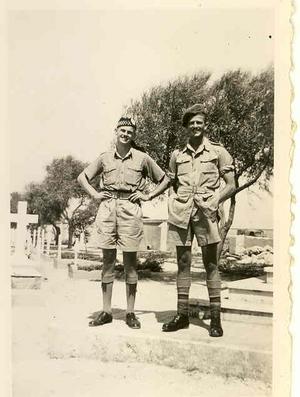
Tom Bowles with the writer in Benghazi Civilian Cemetery
CHAPTER X11 - WINDING UP
Disbanding a good unit is a rotten, thankless task. All one's stores dissappear. All those little extras, which have been won for the unit have to go. One applies for authorities and signatures for
various things, and then sit' back and wait. till they arrive. And last, but by no means least, a nominal role of all ranks has to be submitted.
We had to disband the two units separately. 29's instructions came through first. 28 was to remain in being, pending a War Office decision about further work in the Dodecanese. I was now given the job of handling 29's stores, and returning them complete at the expense 28's. In the end we had to burn 28's ledgers and compile new ones. We had to do this to have on ledger all the stuff we had to get rid of.
To make matters worse, Capt Carter, OC 29 GRU, who should have gone on early special release, was not allowed to go. He stayed with us for another month, with nothing to do. Then he was finally allowed to take his demobilisation.
By this time, my own OC, Capt Bowles returned. He also brought the firm news that we were also to disband.
That evening, Tom Bowles started to tell me of his experieneces in Iraq. The average temperature was. 115? Fahrenfteit in the shade.He had lost ten pounds weight in six weeks. His first three weeks was spent in waiting for a Dakota, which was to take him round and carry his forty odd current burials (i.e. recent as opposed to War). Once he started he had a hectic time. He flew by night and dug by day.
His exhumation parties were all laid on by units close to the cemeteries. In all cases, help consisted of native labour. On one or two odd occaisions even the natives could not stand the smell. They refused to work, vomiting by the graves, leaving Tom to get the bodies out on his own.
Amongst the cemeteries he visited, was one sponsered and maintained by the Americans. The cemetery was by the sea, and the water level only four feet below the ground. This meant the bodies were under the water. Imagine the state of one only four months buried. It was our usual custom not to disturb any coffin. In this case the only practicable course was to remove the limbs and more solid parts of the body. Even this was a struggle. Imagine Tom's surprise, when the American lady in charge, asked him if he had taken the coffins out and cleaned the grave up properley as she hoped to use it again in the near future.
It was on August 23rd, my twentieth birthday, that I took Tom Bowles up to Benina air strip, Benghazi's airport. We had got on together very well indeed. We were both extremely sorry to leave each other.
Whilst waiting in Benghazi, I received a posting order as Quartermaster to a Jewish detainee camp built for 2,500 illegal immigrants. I objected immediately on the grounds that with infantry training and graves experience, I was totally unsuited to the job. It was no use protesting. But, by a stroke of good fortune, the camp was disbanded be ore my posting was confirmed.
I started my journey back to the Delta, by travelling on the two day road convoy to Tobruk. I had a German driver who spoke a little English. He was very much against Hitler, and started to tell me of some of his activities. At first I felt a little sympathetic. Then I asked him when he joined.
He was a regular soldier. I presumed he was one of Hitler's volunteers. On reflection, this may have been unfair. He might have been a conscript.
I sat in the cab beside this German, under strict instructions that I must under no account drive. I kept waiting for it. It was inevitable. Either the clutch or the transmision must go. The vehicle could not strain and jump at every change like this. It was worst of all climbing the passes. His first change was from '4' to '3'. He then was afraid of the next change. He would grasp hold of the transfer gear lever, and with an almighty heave, a jerk and a shudder, we were in low ratio. Just before the engine stalled, he would make the supreme sacrifice. Without touching the throttle, he would change from '3' to '2'.
I must remember that I am a British Officer. It will take me all my time to buy a motor-cycle with my gratuities (?25) and my leave pay (?35). In the meantime our enemy prisoners ride our motor-bikes and drive our trucks, which we are not allowed to touch. On one particularly exasperating day, three officers, all of whom could drive, had to ride in misery in a jeep, while a German drove them. In a jeep, two passengers have room for their legs, three are definitely cramped.
At Tobruk there was a hold up. Passengers were dispatched in an Indian 'native' coach, that could shift eighty at a squeeze. It was attached to the goods train that ran three times a week. I was one of the people delayed. That lead to the surpeise and pleasure of meeting my old friend Tom Bowles again. He'd just been made Welfare Officer for Tobruk.
On my last night, we all went to see a film show in the RAF cinema at El Adem, Tobruk's airport, some thirty miles away. On our return we were swept into the sergeants mess where an unholy consumption of alcohol was in progress. All drink was consumed from beer bottles, to which was added whisky, sherry gin and port, all at the same time.
In the morning I had a walk down the wadi at the rear of the camp. I knew where all the minefields lay and was not unduly worried when I saw a lot of live shells lying about. I already knew of the pye dogs, which were a source of annoyance and danger to Arabs and Army alike, so armed myself with a steel sjake and trusted to luck. After I had walked for about an hourand-a-half in this fascinating wadi, I sat down on a rock, had a smoke, then started to return.
Before I had gone far, I met an Arab. I exhanged the customary greeting 'saihida', paid the normal couple of goodwill cigarettes, and passed on my way. After ten minutes, the wadi shook, and I heard something going up. Its just possible the poor fellow may have bought it. I should have gone back.
At four o'clock, we clambered off the sand by the Railway Transport Offcier's petrol tin hut, into the coach. The only other officer booked to travel on the train was a rather boring 'old school tie'
major. I was agreeably surprised when a captain boarded in overalls, closely followed by a sergeant. I began to chat with the pair of them. At the first block-post I found I was on a good thing, tea had been organised.
It was nine o'clock when we reached the border post of Capuzzo. This was both the Egyptian border and the boundary between the Indian and British Railway Operating company. The officer and sergeant were from the British Operating Company, and had been to Tobruk for the week-end. They had offered to take one of the engines down to save sending up two crews. But the captain needed a firemen, and invited me to join him in the cab for the night's ride. I seized, the opportunity with enthusiasm.
There were two large diesel electric trains. Each train had two separate units developing 395 horsepower each. They were all five years old and had been scrapped by the Yanks. We could get no lease lend spares. No Dollars.
The weight of the train was 400 tons. When I first saw these engines they greatly impressed me with their powerful appearance. Like a lot of American products, they were not as good as they looked. In point of fact, they'd only been built to last two years.
The interior was amazing. Sorbo rubber seats for the fireman and driver. A complicated mass of dials, which, on explanation, proved to be quite simple. Half of them were duplicated because of the two units. We took up a position in the rear train, armed with tea and cheese sandwiches. After some delay, we moved off.
I found that every twenty to forty miles was a block post, through which the train was checked. Each block post was run by an NCO. He had a telephone, thirty Germans, and a truck with railway wheels, instead of the normal road wheels. The party was resonsib1e for repairing and maintaining their section of the track.
As the night wore on, we started turning our cab light off. Theothe leading engine turned its cab light out. Eventually the headlight dissappeared. We thundered through the night at 40 miles an hour, without a single light, and most of us dozing.
We suddenly came to, to find one of the exhausts red hot and the unit firing irregularly. We went outside on the gangway running up the side of the engine. We got covered in diesel oil. One of the fuel pipes had burst. We stopped that unit. With the second unit, and both units on the other engine, we got in alright.
Like most passengers, I had always found the engine's rather annoying, through the night. Now they sounded quite different. I knew what they meant, and which engine was whistling. Three blasts was tea ready in the front engine.
Shortly after one of those magnificent dawns, so characteristic of the desert, we arrived at Simmi11a. At six o'clock, I got out of the cab, unshaven and besmeared with diesel oil. We had breakfast, a shave, then waited for the next train.
Now we had to start travelling with the Egyptian State Railway. I felt quite humiliated, sitting in a carriage. But now I had to watch my kit like a hawk as we entered the land of the 'clefty wal1ah'.
It Was six o'clock before we got into Alexandria. A truck took us up to the transit camp. After a bitter struggle, we succeded in getting a meal. Although we had waited four days in Tobruk, it seemed to be so important that we reach Cairo quickly, that we were made to travel up that night.
In many ways it was pleasant arriving in Cairo during the early morning. We were able to get to the transit camp in comparative peace and quiet. We were not pestered by porters, each trying to steal one's kit, or carry it a little way so they could all crowd round and demand fantastic tips.
I began to make investigations about my interview. After all the recent tear and rush, I still had to wait four days. Eventually I got my interview with AG3. He told me they had absolutley nothing for me to do. I could go to a POW cage at Suez, as duty officer. I could have a week in Cairo before taking up my duties. At this time the Middle East was supposed to be desparately short of officers.
During my weeks stay, I met the British Military Government Officer whom I'd known in Benghazi. He was anxious to fill a vacancy for a staff/lieut vehicle inspector. He asked me a few questions and offered me the job. I seized the opportunity. He telephoned AG3 to get authority for the move. Naturally, we expected no difficulty.
Imagine our surprise when he was told that I could not be spared. I was wanted on a priority posting as ships adjutant. I went back the following day when the posting was confirmed.
© Copyright of content contributed to this Archive rests with the author. Find out how you can use this.


 Recommended story
 Story with photo