

- Contributed by
- Ted Lewis
- People in story:
- Edward Terence Lewis
- Location of story:
- Freetown, Sierra Leone.
- Background to story:
- Royal Navy
- Article ID:
- A6398599
- Contributed on:
- 25 October 2005
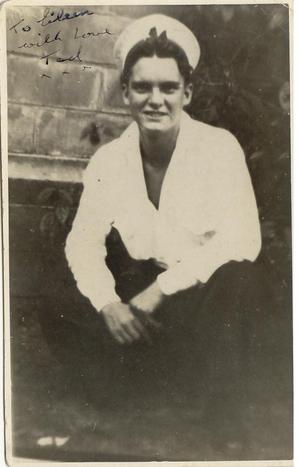
Freetown 1943
1942/1943
My first trip with the Royal Navy after I'd signed up, was to West Africa, aboard the Beagle - a B-class destroyer. We landed in Freetown, Sierra Leone and then proceeded to sail up and down the West African coast, searching for submarines. I ended up doing that for a year and a month.
Anyway, one day I meets this Sub-Lieutenant on board and he says to me: 'How's your hearing?', I said 'It's fine', so he said 'Go and give them a turn in the asdic room'.
Up on the bridge there's this cabin and in it was this machine; the centre of it was a wheel. Now, when you turned the wheel, a thing under the ship, which looked like a frying pan sticking out, well that turned. That used to send out radio signals - 'ping' - under the water and it could pick up signals - 'ping' - as well as send. It was called an echo sounder. I had to learn the difference between one 'ping' and another 'ping'. Now you might get a 'ping' off a big fish and that would be very like the 'ping' off a submarine. But there was a distinction, you could tell the difference.
So for all the time we went up and down the West African coast, I was a ping merchant. I was up there in that bleeding cabin — ping ping ping…They used to say: ‘they’re all barmy up there — ping happy!’.
One afternoon they sent for me; got a signal through from the Admiralty — I was going home. I takes passage on this destroyer and the next thing I know, I’m in Gibraltar. We went from Gibraltar to Portsmouth in a couple of days.
After my leave, I got orders to go to Fort William in Scotland. I made my way there and when I arrived at the naval establishment, I got the surprise of my life — it had been a nursing home for expectant mothers. It still had the signs on the doors — ‘lying-in room’ and ‘nursing room’ but there were all these bearded sailors in all the rooms!
I spent quite a time up there, training. After 3 months I got a draft again. I was hoping against hope that I’d be sent down to Greenwich, so I could pop home To Bethnal Green, but I was ordered to Liverpool. Gladstone Docks, Liverpool. When I got there, I got on board a free-French ship — the SS Lorraine. Everyone was French; didn’t speak a word of English. I was the only English bloke on board.
We got out into the Bay of Biscay and I said to some bloke ‘I wonder where we’re going?’.
He said ‘Don’t you know, we’re going to Freetown’.
I said ‘I’ve just come from there!’.
Charming. All the way back to West Africa again.
It was a good ship. We used to have French food and with every meal, something which I still don’t know what it is to this day — a big lump of fruit jelly; a very very strong, thick jelly which had to be cut with a knife. Plus of course, you got the old vino — vin blanc. The crew had a jazz band and one of them played an accordion — the French way — so we had good entertainment. There was a party of nuns on board. About 20 nuns, all dressed in white. Now I don’t know who suggested it, but we put on a boxing display for the nuns. I thought to myself, ‘well that don’t seem very appropriate, but still, if that’s what they want to do, sod them.’ So they put on this boxing display, fixed up ropes and what have you. I went in against this bloke, but prior to the match some of the others had bombarded him with stories about me, how I was a boy champion and had boxed for Repton Boys Club and rubbish like that. So he wasn’t looking forward to getting in the ring with me. Anyway, I won and the nuns and all the other passengers got up a collection for us and presented the winners with tobacco.
When we got to West Africa, I went ashore and the barracks - it was a camp really - was in the village of Kissy. Kissy Barracks. All the huts were made in the colonial style, with verandahs on them. Anyway, I was stuck in Kissy Barracks for about 3 weeks and then I joined the Amarynthis - a flower class Corvette. We had an officer aboard there, he used to be a butcher in Bristol. He spoke with a West Country accent. He said to me one afternoon, 'I want you to go ashore to the naval office and tell them that Mr Fee has sent you for the Gwarf papers.’
I said, ‘What, Sir?’.
‘I said, tell them Mr Fee is sending you for the Gwarf papers.’.
So off I goes.
Well, these machines that they had, when the ‘ping’ went out, there was a continuous roll of paper going round; graph paper with all little squares on it and the machine would make an indentation on the paper.
But I didn’t have the faintest idea what he wanted. So I walked into the office at the barracks and I said to the petty officer: ‘I’ve come from Mr Fee, on the Amarynthis.’
He said: ‘Oh yeah?’.
I said: ‘He’s sent me ashore for the Gwarf papers’.
This petty officer looked at me. He picked up this box and handed it to me. He said: ‘There they are and if you come in here again taking the piss out of officers, you’re for it.’.
So I walked back with the graph papers and Mr Fee was pleased when he got them.
I had another experience like that when I was on the Beagle. I was up on the bridge and I was a Communications Rating between the bridge and everyone else. I used to have earphones and a speaker strapped to my chest, which I spoke into. We were round the South Atlantic and I don’t know how I misunderstood him — but he wasn’t speaking to me, that’s why. I said ‘Avast there, Blue Watch close up’. So all of a sudden, this Jimmy-the-one says to me ‘Who told you to close the Watch up?’
I said: ‘You did’.
‘I done no such thing’, he said.
I said: ‘You just done it — I heard you, you said ‘Close the Blue Watch up’’.
He said; ‘I asked for my blue coat to be passed up…’.
I’d stood down half the bleeding ship.
© Copyright of content contributed to this Archive rests with the author. Find out how you can use this.


 Recommended story
 Story with photo