

- Contributed by
- actiondesksheffield
- People in story:
- Arthur Ward, Jack Lamer, Johny Legon, Staff Sgt. Sam Barnes, BSM Finch, Harry Webb, Sgt Pervical, LA Kitching, Lt. Wigmore, 2nd Armd Brigade Commander Brigadier Goodbody, Eric Ward, Stella Lyne, L/Bdr Dai Davies, Gunners Short, Williams, OP Holmes, Westlake and Cowman, Mr. Platt and Mr. Rodgers, Captain Stevens and Major Richmond, Dr. Martin
- Location of story:
- Barletta, Bari Coast, Taranto, Ortona, Italy, Pescara, Roseta, Pedaso, Civitanova, St Clemente
- Background to story:
- Army
- Article ID:
- A4764099
- Contributed on:
- 04 August 2005
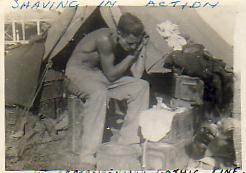
September 06, 1944 - Sergeant Arthur Ward shaving in action using 25 pounder “Ammo” boxes for a bathroom on the Gothic Line in Italy close to the Republic of San Marino.
This story was submitted to the People’s War site by Roger Marsh of the ‘Action Desk — Sheffield’ Team on behalf of Arthur Ward, and has been added to the site with his permission. The author fully understands the site's terms and conditions.
Refer to Chapter 1-- A4345544 -for links to other chapters.
LIFE IN THE ARMY
by
ARTHUR WARD
Chapter 21 — The Gothic Line
June 25, 1944
I was Regimental Orderly Sgt and I had to mount the guard at RHQ and organise a Church Parade for the RSM.
My address is now: L/Sgt. A Ward 954330
`E' Bty, 11th (HAC) RHA
Central Med Forces
We were now having the usual parades, maintenance and several outings to Barletta for a swim in the Adriatic sea and dinner at a smashing Sgt and WO's Club.
Also we were able to visit Bari on the coast and go to a cinema or theatre.
I usually went with new mates of E Bty:
Jack Lamer
Johny Legon
Staff Sgt. Sam Barnes
BSM Finch
Harry Webb
Sgt Pervical
LA Kitching
June 26, 1944
Moved on road with an ‘A’ Bty convoy (to whom we were attached) to make a transit camp near Taranto. Lt Wigmore was in charge. We built cookhouses, fitted triplet stores and put up tents etc.
We had several trips to Taranto where I was able to buy some films for my AGFA (German) camera.
We were on a beach on the Med again. The camp was called `Clarke' camp and we organised it for French troops, who kept coming for short periods to train and be equipped ready to invade the South of France.
We supervised the feeding arrangements but the French made some marvellous coffee. They had a boiler filled with water which was kept on the boil all the time with a calor gas stove. They kept adding coffee and water as it was used and when milk and sugar was added it was the best coffee we had ever tasted.
Most days we were able to have a swim after tea when the weather was still warm.
June 28, 1944
Orders came through that I had been promoted to full Sergeant and back dated to June 11, 1944.
August 01, 1944
I signed over to be No.1 on a Sexton self propelled gun on a tank chassis and our Priests were handed over to the American Army. We had become attached to the Priests as we had been the first to use them, and we all thought they had saved a lot of casualties which would have occurred on 25 pounder guns.
August 04, 1944
We left Clarke Camp and moved back to the main ‘E’ Battery camp.
We started learning how to use Sextons, which are 25 pounder guns mounted on a Grant tank chassis, and of course the usual maintenance.
Early in August I left camp with 30 gunners with the Sextons and half tracks at 13:30 hours. We travelled by road to the station of Taranto and loaded onto rail cars. We moved off at 07:45 hours. We travelled inside the Sextons, but the train only travelled at a reasonable speed so we were able to walk from one low loader to another for a chat or a brew.
We stopped for a time outside Bari. We had 2 very bad experiences on the train journey. Twice we passed through very long tunnels and as there was only one line the rail cars with a tank on top took up nearly all the space, and as we had a coal burning engine at the front and one at the back, we were in pitch black and nearly suffocated, both engines used very dirty coal which produced thick black smoke.
We were pleased to be out in the bright sunlight after the dark tunnel, and we were all as black as chimney sweeps and could spit liquorice allsorts.
We arrived at our destination, Ortona, where we unloaded and drove to a temporary camp near a Canadian cemetery. The town was badly bashed about as it had changed hands 3 times during the heavy fighting, about 5 weeks previously.
We had also passed through Barletta just before Ortona.
We stayed in this area for 4 days. The countryside was different from what we had been used to - steep hills and valleys covered with trees and bushes.
We walked down to the beach, which was covered in pebbles - I took some snaps of Italian kiddies.
At 06:30 hours we moved on our own tracks on the road through several villages and towns including Pescara.
At 11:45 hours we stopped at Roseta which was a very nice town.
In the afternoon we had a swim in the Adriatic then had a walk round the town and had several drinks at a bar.
At night we took a half track down to town. There was a fiesta during which all the people paraded through the streets with Tableaus etc. whilst the church choirs sang - a very grand sight, all the girls were dressed in white. After the Fiesta fireworks were let off and people all sat out on the pavements until after dark.
We aroused much curiosity as we were the first British Troops to stay in the town. The town had been liberated from the Germans by Polish Troops about 5 weeks early, but the town itself had not seen much fighting.
The inhabitants treated us very warily, as they had been abused and treated very badly by the Germans and then not much better by the Poles. They could not understand how well behaved the British Troops were, except for the singing and good humour after much vino.
We returned to the camp at 21:30 hours and decided that we had seen some of the best looking and smartest girls that we had ever seen.
Next morning we left at 05:30 hours up the coastal road to a camp by the sea at Pedaso.
Here we had a lecture from the 2nd I/C that the Sextons had to be calibrated before we moved on because we would soon be in action and at the next stopping place, everything had to be calibrated with no movement.
We maintained the Sextons, tightened the tracks etc. After 3 days, the remainder of the battery came up in 3 tonners.
Jack Lamer brought me 10 snaps which had been developed, and they were very good.
We went swimming several times a day when not on duty, and had a walk into town at night - there was not much activity in the town, only 2 barbers' shops and a bar which sold raw vino (which we did not like much).
August 08, 1944
We calibrated the guns in a Wadi and fired into the sea.
We moved off at 16:15 hours up the coast road via Porta St George, near to Civitanova. We camouflaged the guns and tents in an orchard on a farm. We had some laying drill and made the guns ready for action.
August 15, 1944
Sunday. Had a church parade, then a lecture by 2nd Armd Brigade Commander Brigadier Goodbody (Ex Co. 11th (HAC)).
He said that a big battle had started the night before and that when the `break through' was made, the 2nd Armd Brigade would pass through and would be the spear head of 1st Armd Division, who were leading 5th Corps and the remainder of 8th Army.
This meant that we would be in front of all troops in Italy. The objective was the River PO then on to Vienna. It turned out to be wishful thinking.
The weather was now very hot and sunny, and we were being pestered by millions of flies and mosquitoes.
The mail started coming through after having had none for a fortnight.
I had a letter to say that my brother Eric and Stella Lyne had been married whilst he was on leave from the Navy.
We were now 40 miles from Ancona which was very near to the front line.
The railway near Ortona had been badly damaged, so all supplies had to come up by road.
There was only one main road in the area with dozens of diversions where bridges had been blown, and Bailey bridges or Pontoons were fixed by the Royal Engineers.
My subsection is now:
Sgt A Ward,
L/Bdr Dai Davies (Welshman)
Gunners:
Short (Geordie)
Williams (Taffy Welshman)
Gunner OP Holmes, (Derby)
Driver Mechanic Cowman (Skipton, Yorks)
Spare Ammunition Numbers:
Platt
Rodgers
We moved down to a workshop in Civitanova and had new rubber tracks fitted on the Sextons. It had been realised that the original steel tracks made too much noise (especially at night), so the enemy would hear us coming and they were damaging the asphalt roads. This work took 2 days.
We went back to camp for 1 night and then moved on our own tracks on the main road at 21:15 hours bound for the Gothic Line.
We travelled almost continuously for 2 days and 3 nights over high hills, bad diversions and deep fords across rivers. The route was a tank track almost parallel with the coast road and touching Ancona.
We went into leaguer with the IX Lancers. We had 4 hours rest and maintenance then moved onto the Gothic Line.
September 1944
THE GOTHIC LINE
The line had been broken but we should have passed through the 46th infantry division, but the terrain was unsuitable for the Sherman tanks and the enemy were well dug in with anti tank guns, and many tanks were lost.
This held up the attack although the 1st Armd Division had been on the move for 7 days and thrown straight into action, which was not a good idea.
We had a gun position behind the Canadians and the 46th Infantry Division and I saw several trucks with the 70th Field Regt. Logo on them
We leaguered for the night but at 00:15 hours we got the order "Prepare to Move".
We moved at 00:45 hours, and just after daylight, and after a very tiring journey of 8 miles over bad tracks, we crossed the River Conca.
We took up action positions whilst 200 yards in front of us, the tanks were being very heavily shelled.
September 03, 1944
After ½ hour, the shelling stopped and after testing our sights, we went into action for the first time with the Sextons.
The gun position was closely packed with all kinds of vehicles - Royal Engineers, Divisional HQ etc. and there was a P. of War cage about 100 yards away.
We did a fair amount of firing by day and night.
Jerry was quiet during daylight, but sent over single planes at night dropping crackerjack bombs, although none fell too close, but they caused sleepless nights.
On the 3rd night, Bofors Ack Ack guns opened up on them, so I decided to sleep in a slit trench due to all the splinters flying about.
During the first 6 days in action, my new gun fired about 400 rounds.
September 10, 1944
I took some snaps of the boys in action in water proof clothing, after a very heavy rainstorm.
During one session of firing I shouted ‘fire’, when unbeknown to me, our driver (Cowman) walked to the front of the Sexton to get some tea from a container, and the blast shattered his eardrum.
He had to go to hospital as he was deaf and we learned that he had a perforated eardrum.
The 25 pounder gun has a terrific explosion when fired, and it is an unwritten law that no-one walks in front when in action.
We also heard that Captain Stevens had been killed and Major Richmond (2nd in Command) had been wounded.
We picked up some leaflets which the RAF had dropped on the German troops, giving them news from all fronts and telling them how to surrender.
We moved to another position through St Clemente, down a long winding track on a hill which was being shelled at frequent intervals.
We went into action in a wadi among some grapevines. A Gurkha infantryman had been killed and his body lay forlornly on the gun position. We still keep having these reminders of what could happen to any of us at any time.
One night during a heavy barrage from guns all round us, a 25 pounder shell dropped short and landed between my gun and the command post. It was worked out that it must have been fired by 2nd RHA, but fortunately no-one was hurt.
We had a visit from our new MO (Medical Officer), a South African.
Our own MO, Dr Martin was promoted to Major and posted to 46th Division. This position was very quiet although 6 shells fell just behind No.1 gun.
For several nights we had crackerjack bombs dropped near us, but Beaufighter planes began to operate and things quietened down.
Driver Westlake was posted to my subsection to replace Driver Cowman.
During the night, we moved 4 miles into a ploughed field. We were firing during the daytime and night time as well.
September 12, 1944
On the night of September 12, 1944, at 18:00 hours we fired a concentration of 42 rounds HE. This was repeated at 19:45 hours, 21:40 hours and again at 23:06 hours, after which the Infantry put in an attack.
After this we kept on firing on DF and harassing fire tasks in support of the Infantry.
During the night I fired 250 rounds. We were kept busy firing until 11:30 hours when things quietened down.
We heard that the attack was going well. At 10:45 hours we had fired 20 rounds HE per gun, on a spot where Jerry was setting up counter attack.
This battle was for 2 high ridges, south and west of Rimini, and the fighting on the wireless was described as violent with heavy casualties on both sides.
The Germans had positions well dug in with plenty of 88 mm guns and many tanks and reinforcements brought from other sectors.
The Polish troops and Canadians were on our right and 46th and 56th Divisions on our left.
We listened to the news 3 times a day on No.19 wireless in the Sexton, and it was relayed over the Tannoy system.
We heard that the Americans had crossed the German border in 2 places in France and that things were going well.
We also heard the Saturday football results from England.
September 19, 1944
We stayed here for 3 days then moved at 11:00 hours to a position on the River Marano. We saw plenty of German Mark IV tanks which had been knocked out in this area.
We were dismayed when we found out that a RAF 8001b unexploded bomb was buried on the gun position. Fortunately it was still intact when we left.
We filled up with petrol (High Octane) and discovered that our carburettor was leaking so we had to travel back to LAD through Coriano on the division `down' route.
Whilst there, the mechanics carried out a 50 hour vehicle check.
It was now raining heavily and the code word "Rainbow" came through and this meant that all movement by tracked vehicles was cancelled due to the poor state of the roads.
On this check we realised that our new 25 pounder had fired 1,178 rounds so far.
After 3 days we were allowed to travel back to the Regt., but we had great difficulty as the roads were blocked with traffic.
Arrived at the gun position at 18:30 hours where we `brewed up' (made tea).
The Griff was that we would be moving at 02:30 hours so we bedded down in the Sexton for a few hours.
We travelled for 1¼ hours in pitch blackness and my Sexton was leading the Battery, when the edge of the track gave way and we slid down into a field at an angle estimated to be near to 55°. This was alarming as the tipping angle of a tank is said to be 45°.
We all baled out and waved the Battery past. They were able to pass with great difficulty as we were on a farmers single track with a bank on one side, and about an 8 feet drop on the other into a field.
A half track pulling a trailer also went off the track near to us.
We made several attempts to get back on the track or to go down into the field, but one of our tracks had come off, so we could not move at all.
We were marooned there for 3 days when a `wrecker' vehicle from the Lancer's LAD (Light Aid Department) pulled us out and back on to our displaced track.
September 26, 1944
On the way forward to find the battery. We were lost and by mistake we crossed the border into the `REPUBLICA DE SAN MARINO', but soon found a diversion which brought us back on the road which the battery had used. We only had signs on the roadside which the Battery had left for any stragglers.
We could see the town of San Marino which was a small country, which was not involved in the war, although we had reports that the Germans were using the mountain on which the town was perched, for an OP (Observation Point). After an hour we found the battery gun position just off a main road which was being shelled at intervals. We learned that the Battery was staying in this position for 2 to 5 days to rest.
Pr-BR
© Copyright of content contributed to this Archive rests with the author. Find out how you can use this.


 Recommended story
 Story with photo