

- Contributed by
- actiondesksheffield
- People in story:
- Arthur Ward, Lt Wigmore, BSM Finch, Sgt Legon, Jimmy Wolstonholme, BC Maj Mansell, Bdr Dai Davies, Gnr Williams, Dvr Cowman.
- Location of story:
- Italy, River Reno, Rimini, Stadium Stortivo, Pesaro,Ravenna, Cotognolia, Lugo.
- Background to story:
- Army
- Article ID:
- A4767096
- Contributed on:
- 04 August 2005
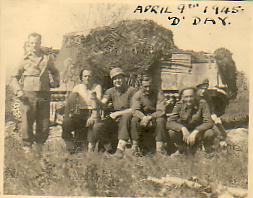
April 09, 1945 — ‘D-Day’ in Italy Gunners Williams, Short, Bombardier Davies, Driver Mechanic Cowman, L/Bombardier Duckworth G.P.O. ACK. Waiting for barrage to start.
Refer to Chapter 1-- A4345544 -for links to other chapters.
Chapter 24
January 12, 1945
We travelled in trucks from the camp to the railway station, boarded a train and travelled the same route back to Orte where we stopped for a meal.
We arrived in Rimini at 10:00 hours, then back by road to the Battery. We were just too late for the Battery Inspection by BC.
At night we went to a dance in a nearby village; there were 5 men to every girl so we came away at 21:30 hours. I didn't have a dance.
January 15, 1945
Usual parades, maintenance and for a change marching and rifle drill.
January 16, 1945
I was Orderly Sgt and Lt Wigmore was Orderly Officer.
I was Senior Sgt at this period as BSM Finch and Sgt Legon were on leave so I had to act as Troop Sgt Major.
At Pesaro we visited a cinema and saw "Chip Off The Old Block" which was very good.
I had a letter and telegram from Nessie, she was OK.
I gave 1 pint of blood as a voluntary donor (I was group 04).
At the cinema, we saw 'Captain Blood', 'Two Senoritas', 'One Dangerous Night'.
Football started again. 1st round of TMIMI Cup I played for the Battery.
‘E’ Bty 5 v ‘B’ Bty 1 but this match had to be abandoned 15 minutes from time when a sudden hurricane blew up and blew down the goal posts.
I played for Regt 11 (HAC) Regt. 3 v Brigade HQ 2 in the first round of the Brigade Cup.
Semi Final 11th RHA 2 v 661 Workshops 1.
January 17, 1945
I played in goal for the 11th (HAC) Regt. in the Final of the Brigade Cup on a very muddy ground at the Stadium Stortivo, Pesaro.
Result 325th RASC Coy 7 v 11th RHA 1. We were outplayed by a bigger team on a very wet ground.
I had a good game but we lost Rosie with a leg injury after 30 minutes play.
Team: Sgt A Ward (E Bty), Holder (RSC), Bennett (E), Rourke (RC of Sigs), Adams (A), Cowman (RHQ), Pickering (E), Rosie (A), Ebdon (A), Kilgannon (E), WolstonHolme (A)
Jimmy Wolstonholme came from Sheffield. On the same night I went to a dance organized by ‘A’ Battery at the Teatro de Danse Pesaro. Music was played by the RAF band which was very good. I enjoyed the night from 18:00 hours until 21:30 hours and for a change, there were plenty of girls present.
January 29, 1945
We had a heavy fall of snow.
January 31, 1945
We had a party in our Sergeants' Mess given to officers and Sergeants. Everyone was very merry and we did not break up until 03:30 hours in the morning. It was snowing.
We had had some light falls of snow during the last few days and I took some
snaps of Sergeants with snow on the ground.
February 01, 1945
I went to the Garrison Theatre which was an Opera House before ENSA took it over.
We were all sitting round in small boxes. We saw Professor Chirelly, who was a famous Italian hypnotist. He was very good and we had a night of laughter with the antics of the people he had on the stage doing daft things when under his spell. He was noted for using hypnosis in hospitals for people to have operations.
Prepare to move - The main party moved off once again towards the front line.
February 02, 1945
We moved off with the Sextons on transporters at 15:30 hours via Cattolica, Riccione, Rimini, Cesena, Forli to Ravenna, arriving at 22:30 hours. We unloaded and I slept in the Sexton.
February 03, 1945
Moved off on trucks at 08:00 hours and we took over gun positions from 1st RHA. 1st RHA were going out of action because 130 men from the Regt were time expired, so they would be returning to England after 4'/z years overseas. ‘B’ Sub were in Fox Troop for 2 days whilst one of their Sextons came back from LAD after repairs.
I was No. 4 gun.
German planes came over at night dropping parachutists to carry out acts of sabotage.
February 07, 1945
The weather is getting warmer. We have frost at night but sunny afternoons.
The snow has all gone but plenty of mud is left behind.
We are having a quiet and unusual easy time just now.
February 08, 1945
Defensive fire called for at 05:15 hrs very urgently and my gun was the first to fire in the whole Regt. (24 guns).
We had to track for 29°, which is a large change of direction, but we only fired 3 rounds per gun. We found later that only one gun in the whole area had beaten us by firing first, the enemy must have been mounting a counter attack, which must have failed.
February 10, 1945
Inspection by Colonel. He was pleased with our gun turnout.
February 12, 1945
We fired 3 rounds on a calibration shoot observed by a spotter plane.
February 17, 1945
Inspection by BC Major Mansell. It was pretty good but he found several faults.
February 19, 1945
I was in charge of 40 men from the battery under the command of Canadian Royal Engineers. We were levelling out hardcore to form a 3rd class road. I did not like this as they expected NCO's to work manually with the men and it was very hard and tiring work.
February 20, 1945
Later in the day we had an inspection by the MO.
February 21, 1945
Fired on Clover SOS lines 2 rounds per gun at 05:15 hours at a German Patrol.
February 22, 1945
2 men per gun had to sleep in the Sexton each night, this was because Fox Troop had been 4 minutes late in firing on a defensive fire plan.
February 23, 1945
Fired 3 rounds a gun at 17:00 hours on a divisional target.
February 24, 1945
Inspection by BC Major Mansell -Very good he said to me.
February 25, 1945
Sunday. A sunny, warm day. I took some snaps in a field - we were wearing our new ties which had been issued to us for the first time.
L/Bdr Dai Davies was promoted to Bdr and back dated to December 19, 1944 and he went on leave to a rest camp at Loretto.
February 28, 1945
We moved over the river Lamone through Villanova and took over a gun position from ‘A’ Battery.
I had to sleep on the Sexton every night as we were firing harassing fire both day and night.
After 2 more days the gun position was taken over by 25 pounders of the 53rd Regt RA, who were in the 8th Indian Division, then we moved through the village on the Ravenna road.
We fired about 30 rounds a day on HF and observed shooting. We were now supporting Italian Infantry and a Jewish Brigade. One day I went to Ravenna to the Diamond Theatre and saw '2 Girls and a Sailor', which was very good.
March 08, 1945
Gunner Williams had gone to Florence for 7 days leave and he was followed by Gunner Sims. I received letters and a parcel of cigarettes from Nessie.
We were getting news on the radio of good progress by the Russians on the Eastern front. Also the River Rhine had been crossed in Germany by the British Troops.
March 12, 1945
I went over to ‘A’ Battery to see my old mates. I played in 2 scratch football matches whilst there.
Sergeant Legon's Sexton was taken out of action to calibrate his gun so I took over as No. 1 pivot gun and averaged firing 120 rounds a day.
The weather was now `smashing', sunny and warm with early morning mists.
I slept on the Sexton every other night, and Bdr Davies took over on my night off.
March 19, 1945
We were in action on a farm and between our gun and A sub, was a haystack which caught fire at 22:30 hours. We tried to put it out but it was impossible and was completely burnt out. We had to move the 2 Sextons further up the field so there was no danger to our ammo.
We were frightened that the blaze would bring some shelling from the enemy, but we did not have any.
March 20, 1945
We were relieved by ‘A’ Battery and we moved back 1,500 yards behind the River Lamone into position in another farmyard.
March 21, 1945
All the battery went up to the coast and calibrated the guns within 3,000 yards of the enemy line.
Then back to maintenance and laying drill.
March 26, 1945
Went on the road practising quick actions. In between we kicked a football about but we were very upset when a truck ran over it and it burst.
We fixed up a tannoy in a farmhouse so that we could hear the news.
The news from the Western Front was very good with Monty's and Patton's troops being well to the fore front.
March 28, 1945
Moved off in the dark at 21:30 hours down route 16, then up the coast road just short of Lake Commachio and the River Reno. We carried out a night occupation, erected camouflage nets and I slept in the Sexton. During the day we had to keep well camouflaged and under cover as we did not want enemy planes to know we were there.
Easter Sunday
We put our clocks forward one hour. We prepared 200 rounds to be fired on a fire plan to support a big attack by Marine Commanders. Zero hour was at 23:00 hours but we had to sit waiting until 04:45 hours because some of the assault craft had been stuck in mud.
The attack was an invasion force hoping to land behind the River Reno and cut off enemy troops.
We fired 62 rounds HE 222 airburst over a bridge. Then 44 rounds HE119 in support of the attack. There were 150 guns involved in the attack.
Next morning showed that the attack was going very well.
The Colonel came round to speak to everyone about his 14 day leave in Blighty.
The weather was still sunny and warm.
Easter Monday
I took some snaps of the lads under the camouflage nets drinking the Easter issue of bottled beer.
This area reminded us of the areas of Derbyshire with grassy hills and hollows covered with yellow gorse bushes.
We were firing during the day to support more attacks and we heard that the Commando's had landed OK and captured 600 Prisoners of War and 8 guns. We then chased the enemy up the `spit' of land between the Adriatic sea and Lake Commachio.
Next day we followed on over the River Reno and into a position by the lake. Several German 105 mm Howitzers had been abandoned in this area in a good condition.
We stayed here for one night firing HF.
When the planes dropped flares the whole area was lit up just like daylight.
The Commando's were held up by strong enemy opposition on a canal.
At 04:30 hours we moved back down the road and further inland.
April 05, 1945
We fired in support of an attack by 56th Division over River Reno. We fired 200 rounds a gun until all objectives were taken.
April 06, 1945
Moved down to Ravenna in daylight and arrived at 19:15 hours. I had an hour in the Church of Scotland canteen.
April 07, 1945
We moved off at 02:30 hours down a railway track to Russi, then on a road to a gun position just over the River Lamone (we were near to a bridge which was being shelled at frequent intervals).
We heard that 2 ½ hours before we arrived, the gun position had been heavily shelled and the Command Post director had been hit (instrument for setting up guns on line).
We camouflaged the Sextons laid on line, then bedded down for the remainder of the night.
My gunners slept in a farmhouse, but there would not be much sleep as it was already 05:40 hours and nearly daylight.
We were in danger from Spandau machine gun bullets which were being sprayed over our position.
During the day, we dug into the ground and buried 300 rounds of ammunition, and after dark, a further 300 rounds arrived.
It was hard work but fortunately the enemy were very quiet.
For the past 7 days, we had had very little sleep and everyone complained of having headaches and being run down.
April 08, 1945
Had a good 8 hours sleep.
April 09, 1945
D DAY IN ITALY
This was the start of a big attack by 8th and 5th armies and we were to play a big part.
At 14:00 hours, the sky was full of bombers of all kinds including Flying Fortresses and Liberators of the USAAF which were to blast the enemy positions over the River Senio, then came medium bombers, fighter bombers, rocket firing Thunderbolts, Bostons all escorted by Spitfires.
We were told that 1,640 planes were to be involved.
The heavy planes were guided though lanes of Ack Ack shell bursts and flames on the ground towards their targets. We saw one Liberator come down in a spin and crash over enemy lines. I took a snapshot of Driver Cowman staring up at the sky in amazement.
The sky in front was black with smoke.
At 15:20 hours, our programme started. We first fired a softening up programme, then at 19:20 hours, which was H hour, the Kiwis attacked in force and we fired a counter mortar programme to keep the enemy front forces' heads down.
Then at 20:10 hours, we fired a creeping barrage so that the Kiwi infantry could follow up a little behind our shell bursts.
We had to lay our guns very accurately on these barrages, or we would be firing on our own men.
We kept on firing until 23:00 hours and then we were able to bed down. We did not sleep very much and we were about very early in the morning ready to start again.
The Regt had fired 13,000 rounds in 24 hours. The attack was going very well and 2 bridgeheads were made over the river by the Kiwis, and on our right, the 8th Indian Division were across the river. On our left on Route 9 the Poles went across so the troops were well established over this very strong point.
April 10, 1945
Many bombers were over again by now. There must be many punch drunk troops on the other side of the River Senio.
The weather was perfect. We moved forward into a position near Cotognolia and we prepared to fire a barrage, but it was cancelled.
Bdr Davies was seen smoking on the Sexton by the Colonel and I had to `put him on a charge'. He was up before the BC who gave him a reprimand. Smoking was disallowed on the Sexton due to High Octane petrol and cartridge cases which could soon flare up, as they contained gunpowder and cordite. We were always loaded up with ammunition.
April 11, 1945
We moved forward over the River Senio and through Lugo. Here the civilian population were still dazed from the shelling and bombing but were pleased to see us.
We moved into leaguer with the 9th Lancers and 2nd Armd Brigade.
We were given the `Griff' that we were waiting for 8th Indian Division to get a bridgehead over the River Santerno and then the Queen's Bays and ‘A’ Battery were to pass through them, then the 9th Lancers and ‘E’ Bty were to push forward as an armoured column.
The Kiwis already had 2 bridgeheads across the river.
There was a terrific amount of shelling by both sides, but the enemy shells were falling in front of us.
April 13, 1945
We crossed over the River Santerno and we were the first artillery across the river; we leaguered with 9th Lancers.
We had 4 M10 tanks to protect us against enemy tanks.
We moved slowly forward behind these tanks that had bulldozers with them to construct rough roads.
At 15:30 hours we pulled into a gun position. The enemy were putting up great resistance. He shelled our area and an ammunition truck was hit and set on fire on the road about 200 yards from us.
We were in danger from flying splinters as 75 mm shells exploded.
April 14, 1945
Enemy planes were strafing chiefly after dark and of course down came the crackerjacks to keep us awake.
We moved forward into a position just short of the River Reno. The forward Sherman tanks were doing well but they were being held up by the many mines the enemy had left behind.
April 15, 1945
We made a long detour to get over the River Reno as the bridge was not completed because it was under heavy enemy fire.
We travelled down Route 16 over the River and up a large hill on the other side.
We went into position among some trees and fired a barrage of 200 rounds.
At night, chandelier flares were dropped in front of us by the RAF to make night turn into day. We felt very vulnerable as we knew the German front line was not very far away.
Pr-BR
© Copyright of content contributed to this Archive rests with the author. Find out how you can use this.


 Recommended story
 Story with photo