

- Contributed by
- Frank Yates
- People in story:
- Frank Yates, Donald Yates, the Yates family, Ting Bell, Buster Bell
- Location of story:
- Sheffield
- Background to story:
- Army
- Article ID:
- A7119795
- Contributed on:
- 19 November 2005
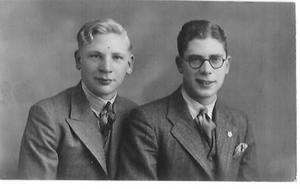
Frank (left)and Donald Yates 1939
WW2 People’s War.
Memories of Frank Yates.
Introduction
I am the last of member of my family to be born in the first quarter of the 20th century, 24/02/1921 to be precise. My children have persuaded me to write my memoirs, including as much family information as possible, for the benefit of my grandchildren and possible great grandchildren. To this end, at the age of 82, I bought myself a computer. I have completed, so far, 75 chapters, with another 40 years of memories still to go!
I have not included the first 15 chapters which contain family details, and the social and economic life of a Sheffield grammar school boy, leading up to the world shaking events of the late 30’s. Neither have I reproduced any details after my release from the Army in 1946.
The seven years in between formed the most interesting part of my life, the description of which has given me pleasure, some of which, I hope, will not be lost on a possible reader.
The following 48 Chapters cover the period 1938 to 1946 in chronological order and cover my time in Royal Artillery Light Anti-Aircraft Regiments and the 53rd Welsh Divisional Head Quarters group.
So that the reader may better understand the narrative, without having read the earlier chapters, I append a few useful notes.
Family home 274 Springvale Road, Crookes, Sheffield.
My father, Leonard Yates, was in the cutlery trade, dying in 1939.
Mother, Laura (nee Fox) died in 1959.
Brother Ernest, died at 63, in 1963.
Sister Gladys (married name Edmonds) died in 1978.
Brother Don, died in 1965, aged 49.
Brother Len, died in 1986, aged 76.
I was a Scout and a Rover Scout, at St Timothy’s Church in Crookes, Sheffield. The Group Scoutmaster, a very charismatic WW1 veteran, called AE (“Ting”) Bell, was a very potent influence on my life. His son, Michael (Buster), figures in my early wartime experiences.
May I point out that this is not a history of WW2, or of the Welsh Division, but my personal experiences in the context of WW2, written purely for the benefit or embarrassment of my descendents.
*************
CHAPTER 1
In 1936 Germany reoccupied and remilitarised the Rhineland and began building warships, in contravention of the post war treaty. These ominous events, to which the Government took no reprisals, caused unease and prompted stern warnings from Winston Churchill. Fortunately the armament industry was designing superior fighter planes and researching into Radio Location in secret.
In October 1938, Hitler invaded the so called Sudetenland, in Czechoslovakia, and, together with the occupation of Austria and the activities of Mussolini in Africa, war seemed inevitable. Chamberlain flew to Munich to see Hitler, returning, waving a piece of paper and declaiming “Peace in our time” This fooled nobody, and I, together with thousands of others, joined the Territorial Army, the R.N. Reserve, or one of the R.A.F. Auxiliary Squadrons.
Scoutmaster “Ting” Bell, who, at this time, had played an influential part in my life, put the proposition to the Rover Scouts that, as a war was almost a certainty, it might be a good idea to volunteer to join a unit of our choice, rather than to be conscripted later, into something less desirable. So, after some discussion, several of us decided to join the 71st. Field Regiment, Royal Artillery, at Edmund Road Drill Hall.
On a pleasant evening in October, accompanied by “Ting” driving his car, and “Buster” driving his Mum’s car we went to the Drill Hall and swore allegiance to the King. (I can’t remember whether we received the King’s shilling!) The volunteers were Don Yates, Frank Yates, Michael, “Buster” Bell, Cecil Ramsbottom and Jack Birkenshaw, who afterwards, were treated by “Ting” in the Roundabout Bar of the Grand hotel in Leopold Street. In those less complicated days, parking in the centre of the town was no problem and there were no worries about drink driving!
On one evening, each week, we reported for training, a regular staff sergeant called Godley, being in charge. I thought him to be a great bloke. On the first session, as he lined us up for some introductory foot drill, his remarks went something like this: - “Gentlemen, you are now members of THE ROYAL REGIMENT OF ARTILLERY, you are RIGHT OF THE LINE, you take precedence over all other Army regiments, and when you march you will not scuttle about like blue arsed flies, as the rest of the Army does, at 120 paces per minute, but will proceed at a dignified 90 paces per minute”.
Sgt. Godley, very soon, had us marching up and down the Drill Hall with some swagger, once we had mastered the coordination of arm and leg!
We were assigned as signallers and our first priority was to learn the Morse code and practice sending messages, both with the buzzer and the Aldis lamp. Although we found, later, that telephonic communication was the norm, the Aldis lamp could provide a useful standby in case of a land line breakage. I learned the Morse code on the tram journeys to work committing about four characters to memory each day.
In the May of ’39, we intrepid soldiers went on a weekend training camp at Sandbeck Park, the seat of the Earl of Scarborough. “Ting” told us not to mind the bad language which might sully our delicate ears and not to be surprised if some of the old soldiers even put profanities in the middle of words! This prediction was quickly vindicated when a spider lowered itself, on a thread, from the apex of the bell tent and our bombardier exclaimed”Look, a taran f*****g tella”!
We rode about the Dukeries, in a 15cwt. truck, paying out W.D. telephone cable into ditches and hedgerows, connecting the imaginary gun sites and the imaginary command post with the so called observation post. A copper earthing spike was knocked into the various sites and a large one, called a “Snake” was hammered into the Earl’s turf at the command post. The minor spikes were each provided with a brass terminal, the “Snake” having several of them. We were shown how to connect the ends of the cables and the terminals to the “Field telephones, mark 1” and, amazingly enough, everything worked. The sergeant explained that, should the soil be dry, better results could be achieved by urinating on the earth spikes
Saturday evening was interesting, some of us walked down the road, to the ruins of Roche Abbey, new to me, and looking spectacular in the setting Sun. Then on to the local pub, where the Salvation Army were selling the “War Cry”, another new experience for me- I mean the “War Cry”, not the pub! Please do not get the wrong idea, I was just eighteen and this was only the third time I had been in a pub.
During the summer months, the Army began to catch up with the enormous growth of the T.A. and we were issued with the new “Battledress” uniform, a big improvement on the uniform already worn by the older soldiers, all brass buttons and a high collar. The greatcoat, a massive piece of kit, still had lots of brass buttons, which had to be cleaned. We were introduced to the “Button Stick”, an essential piece of equipment, a six inch length of brass, with a narrow slot, three quarters of the length down the middle. This cunning device was slotted behind the button, which could then be polished with “Brasso” without soiling the cloth.
Army boots were a bit of a culture shock, most of us having been used to fashionably light shoes. Once having got used to the weight of the boots, we found them much more comfortable than the narrow pointed shoes, which were the fashion. These clodhoppers had a serious disadvantage, however, they had to be polished ritually. The effort was concentrated on the toecap. Three items were required, “Cherry Blossom" polish, the handle of an old toothbrush and last, but not least, SPIT! (Hence the expression “Spit and Polish”) The high gloss is achieved by using the toothbrush handle to burnish the spit and wax mixture to a very high gloss.
It was the custom that the “Terriers” went to a firing camp, at Redesdale, a bleak spot in Northumberland, for two years and then to a “Holiday “ type camp, for the third year. We were delighted to learn that our August destination was to be Bridlington; for me the 18th. August in a row!
So, on the first Saturday in August, we set off, by rail, Don and I having had a word with Dad, who was now bedridden. We took flannels and sports coats with us for off-duty use. The kit bags were left at the Drill Hall to be separately transported so that we were able to march to the station, luggage free.
The camp was on Bessingby Fields, an area lying between the main road and the railway, with easy access, over the lines, into the town. After the war, the area was the site of the main council housing estate. There were rows of the ubiquitous army bell tents, with marquees for messing, canteen and office. Ablution provision was by a series of open air wooden tables, with galvanised wash basins and a row of cold water taps. Quite a culture shock! Fortunately the weather was superb and we soon became acclimatised to washing in cold water.
It was not long before we were festooning the East Riding hedgerows with our wires, much as before, in Sandbeck, and it was pleasant to be lying in the sun, passing on telephone messages.
On the second day, Don and I were summoned to the Battery Captain, who told us that he had a telegram, with the sad news that Dad had died. He wrote out a railway warrant and told us to go home and return after the funeral.
We did our best to console Mum, who must have been expecting it to happen I suppose. We had a look at Dad, looking asleep in bed, the first time that Don and I had seen a dead person, but certainly, not the last. The funeral service was at St. Tim’s with the internment at Crookes cemetery.
After returning to camp for the last few days of the fortnight, there was a lot of free time and, as Brid was packed with holiday makers, a good time was had by all! Apart from the “Grand Military Ball” held on the last evening, in the Spa Royal Hall, an event remembered for its excesses, crowded trips on the pleasure boats, the Yorkshireman, the Yorkshire Belle and the many other boats taking trips to Flamborough Head, and, more adventurously, to see the sea birds at Bempton cliffs were much enjoyed. There was a ridiculous popular ditty of the time, sung, or, better, shouted by the girls and the soldiery on board.
The first bit went like this:-
That’s my brother Silvestre,
He’s got a row of forty medals on his chest
BIG CHEST.
Killed forty niggers in the West,
He takes no rest.
Hell Fire!
Son of a gun!
Don’t push,
Just shove,
Plenty of room for you and me!
He’s got an arm, like a leg
SOFA LEG,
And a punch that would sink a Battleship.
BIG SHIP
And so on: Among his many feats he swam to Italy with the Lusitania on his chest, after fighting Jack Dempsey!!
Russia invaded Finland. Germany, already having walked into Austria, signed a “Non Aggression” pact with Stalin and massed troops on the Polish border. We began to think that we would not get home before the balloon went up. In the event however, they kept 50 “Volunteers” behind, to cope with the anticipated paper work. This duly arrived on our doormat, inviting us to report to Edmund Road Drill Hall, at 0900hrs on Saturday Sept. 2nd 1939 for service against His Majesty’s Enemies.
So ended an era, a simpler time in which to grow up, a world with no TV, or computers, no central heating, very few houses with piped hot water, a motor car for a very few people and yet we youngsters found plenty to amuse us and our parents often did not bother to lock their doors. What a shame that this was to come to an end, due to the ambitions of the evil totalitarian monsters in power in Germany, Italy and Japan.
© Copyright of content contributed to this Archive rests with the author. Find out how you can use this.


 Recommended story
 Story with photo