

- Contributed by
- Diane Turner
- People in story:
- Peggy M Robb (nee George)
- Location of story:
- Norfolk, Morecombe, RAF Stations at Marham, Credenhill and Gloucester
- Background to story:
- Royal Air Force
- Article ID:
- A6434895
- Contributed on:
- 26 October 2005
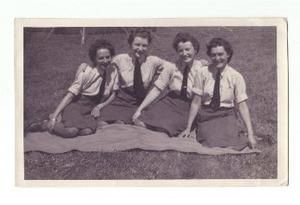
Peggy with Violet, Nora Rothwell & Gwen Escot, 27th July 1945 at Records, Gloucester
Everybody during war time had to carry a tin helmet to help prevent injury if there was an air raid. It was also a possibility that the Germans could launch a gas attack so everyone carried a gas mask to protect them against such an attack.
Robbie and I got engaged on 20th November 1944, after which he was posted overseas from 14th December 1944 until 4th January 1946.
When Robbie was abroad he often sent me tins of sweets and tinned fruit — the pears were simply delicious. There were 12 WAAFs in our hut and we all used to share any treats. Mothers often sent cakes, especially on birthdays and I remember my sister Ivy sending me a lovely cake on my 21st birthday.
At Credenhill the nights could be very cold in our huts with only a tortoise stove to keep us warm. We all had to huddle round it and when we ran out of fuel — either wood or coal — we used to creep out at night and crawl under the wire fence and pinch the coal from the compound. What a good job we were never caught!!
We were lucky enough to have a cinema on the camp and also ‘The Browned Off’ Club for socialising.
All RAF stations had a NAAFI (Navy Army Air Force Institute) canteen where we could get a cup of ‘char’ (tea) and a ‘wad’ (rock cake) which was very aptly named!! The tea had bromide added to it which, supposedly, deterred any ‘hanky panky’ between the sexes.
Three of us went on a trade test to Bristol and we were near the Bristol Channel. A large American ship was moored there and a crowd of civilian sightseers had lined the dock to watch. We were in uniform so were invited on board and treated like VIP’s. We were given a lovely meal on board ship — steaks, tinned fruit etc — food we had not seen, let alone eaten, in ages. The captain invited us back for an evening meal but we had to decline as we were due back at camp.
As I was in charge of railway warrants I made out my own. On one occasion I made the outgoing ticket from Hereford to Aberdeen and the return ticket from Aberdeen to Hereford. I left a space on the outgoing ticket, sent it in to the Adjutant to sign and then filled in ‘via Norwich’ in the space. This was not allowed as the travel warrant stated the journey must be made by the most direct route. When I got to Norwich I was stopped by the Ticket Collector and sent to the Railway Travel Officer who kindly let me off with a very small charge. I was really worried because if I had been reported to Credenhill I would have been in real trouble — not only confined to camp for 7 days I would probably also have had to work in the kitchen doing menial tasks. This was commonly known as ‘jankers’.
The food wasn’t very good, I have to say, and if we did not like what was on offer we walked up to the café along the road and had dried egg sandwiches.
I was paid fortnightly and had to collect my pay packet from a male Pay Officer. He was seated in an office and, as we walked in individually we were brought to attention. After saluting, I had to call out ‘Sir 211’ - these three numbers were the last three of my service number which was 2035211.
I still have my pay book and my wage at the time was 3 shillings a day — 15 pence in today’s money. We did not have to pay for food, clothing, travel or, strangely, sanitary towels. A very generous Lord Nuffield footed the bill for this essential and very personal female item — I do not know if this generosity extended to females in the other services. My pay did increase by a further 10 pence when I was awarded a ‘Good Conduct Badge’.
The next posting I received was to Records Gloucester. This was (and I think still is) where records of the whole of the RAF are stored. I arrived there in December 1944.
It was whilst I was here that Winston Churchill declared war was over in Europe (VE Day). On May 8th 1945 it was announced at midnight over our tannoy in the hut. We all got out of bed in our service blue and white striped pyjamas and danced on the parade ground. There were great celebrations. On VJ day (Victory in Japan) August 15th, 1945, if I remember rightly the same celebrations took place.
Robbie came back from overseas on 4th January 1946 and we were married at Brundall Church on 6th April 1946. I borrowed my wedding dress from a WAAF as I didn’t have enough coupons to buy everything. As I had not been demobbed (demobilised - officially released from the WAAFs) I couldn’t get any coupons so I had to borrow some.
After honeymooning in Ilfracombe, Devon, I then had to return to Gloucester. On 3rd May 1946 I travelled to Wythall near Wolverhampton to be demobbed and hand in
my uniform etc. I had joined up with the surname ‘George’ and demobbed in my married name of ‘Robb’. It was then we were issued with clothing coupons also £40 for our war service.
I then eventually joined Robbie in Aberdeen.
On joining the WAAFs our rank was Air Craft Woman 2nd Class. I rose to the dizzy rank of Air Craft Woman First Class. I first joined as a Telephone Orderly and then I remustered to Clerk General Duties, which I really enjoyed.
Whilst serving in the WAAFs I was very happy and made lots of friends. They were all very trusting and kind and we never had any cross words. We were like one big happy family and we stuck by one another through thick and thin. Initially I found it quite difficult settling down to civvy street ways.
If I had my time over again I would do exactly the same, I just wish I had kept in touch with the many friends I made.
© Copyright of content contributed to this Archive rests with the author. Find out how you can use this.


 Recommended story
 Story with photo