

- Contributed by
- drewhaze
- People in story:
- Margaret Patricia Taylor
- Location of story:
- London
- Background to story:
- Royal Air Force
- Article ID:
- A3264095
- Contributed on:
- 12 November 2004
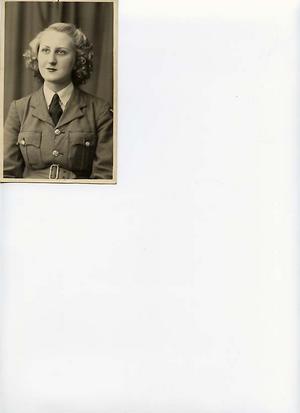
Peggy Taylor in WAAF uniform about 1942
Margaret(Peggy) Taylor was born in South Bermondsey in 1923. She joined the WAAF in the early years of the Second World War and was stationed in Calshot, near Southampton and Wig Bay in Scotland amongst other places. She married RAF Flight Sergeant Alexander Mackenzie in 1947 and lived in Preston, Lancashire for more than 50 years. Now 81 and a widow, she lives in a care home near Blackburn. This is her account - written at the time - of her experiences during the Victory weekend in London.
London Victory Weekend June 1946
We (Nancy and I), and also Gladys who was going on sick leave to Portsmouth and travelling with us as far as London, left camp at 1 o’clock. We caught a reserve train at 1.40. Gladys managed to get a seat but the train was very crowded, and Nancy and I had to stand in the corridor until we reached Crewe, when quite a few people got out, and we found seats in the same compartment as Gladys. Nancy had a pack of cards with her, so she brought them out, and using my great coat stretched across from Gladys’s knee to mine for a table, we played cards. A F/Sgt A.G. aircrew boy asked if we’d like a foursome, so he joined in too. First we played knock-out whist, then he taught us solitaire, and then we taught him nap. We played for money, and by the time we reached Euston Nancy and I had lost a shilling each, and the F/Sgt had won quite a little pile.
Just outside Euston station the train stopped in a tunnel for about half an hour. Eventually we steamed into the platform and all filed out. Gladys had to make her way to Waterloo Station, so we thought a cup of tea in Euston buffet would help us all on our way. We fought our way through the crowds towards the buffet side of the station, when suddenly we were stopped by a huge crowd of people staring at what seemed at first to us, to be a blank wall. But on further investigation we found they were studying the big train timetable. We skirted this crowd and made our way round to the next platform still in search of refreshment, when, on suddenly looking up at the people standing on the luggage trolleys and trucks waiting to meet people from the arriving trains, I saw Aunty Min. Her eyes were fixed on the timetable, therefore she didn’t see me at first. But she suddenly looked round, saw me, and jumped down. It was really a miracle that we should have found her like that, and also very lucky, because she had been waiting there for over 2 hours.
We managed to push our way through the mob and out of the station. Thank heavens the car was there waiting across the road in the car park, because the underground station had been closed owing to the terrific congestion. We filed in and took side roads and turnings but passed through Trafalgar Square, Whitehall and over Westminster Bridge to Waterloo Station, where Gladys was to catch her train. People were already taking up their places on and around Nelson’s column, and on stools and boxes along the pavement edges, in readiness for the parade the following day. I didn’t envy them their all-night vigil. We passed Admiralty Arch and the Mall, and they looked absolutely wizard. Literally dripping in huge flags in honour of every colony and nation who took part in the war on the side of the allies.
Passing through the outskirts of London the decorations grew smaller and fewer, although Lambeth and Brixton, where the mechanised column was to pass through the next day, were gaily festooned. After passing through Clapham and Mitcham we reached Morden and at last our destination. Grandma and Aunty Elsie were waiting anxiously for us, and were we glad to get in and take off our things and have a meal! After a little natter and a smoke, we thought we’d call it a day, and tired but happy, we went to bed, to fall asleep as soon as our heads touched the pillows. There was to be a long day ahead of us tomorrow!
June 8th V JOY DAY
At 5.45 a.m. we were awakened with a nice cup of tea by Aunty Elsie. Still half asleep, we drank our tea, got up, washed, dressed, and came downstairs to a lovely breakfast of porridge, bacon, toast and marmalade. At 7 o’clock we were leaving the house armed with a haversack filled with cheese and beetroot sandwiches, cheese straws, cake, apples and a Thermos of tea. It was our intention to eat our lunch sitting on the grass in the Park (Hyde Park or Green Park) in the sun and listen to the music and perhaps dance. But I’ll relate that later.
We caught a bus to Morden Station right away, got in a queue for our tickets, and stepped into an almost empty waiting train. Gradually the train filled, and by the time we reached Hyde Park Corner we were packed like a tin of sardines. After being pushed into the throng up the escalator, we crossed the road and took up our places amongst the waiting crown on the corner by St George’s Hospital. At that time the spectators were only about 4 or 5 deep, and we stood behind an army major on the edge of the pavement. He was quite tall and when he turned and saw Nancy and I behind him, he made us change places with him, so that he stood behind us. It was only 8 o’clock when we first took up our stand and before very long the sun came out, and it seemed as though it was going to be terribly hot. We took off our hats, and Nancy took off her collar and tie.
The major had a programme of the Victory celebrations which he gave to me, and which proved very useful, as every item of the parade, and day’s entertainment were in it. Little by little the crowd grew deeper and deeper and then we found ourselves gradually being pushed this way and that way, until we were in a position where we “Couldn’t see a damn thing,” as Nancy kept saying. Although at that early hour there was nothing to see. The tallest man in the country found a very good position directly in front of me, which blocked my view altogether. But that wasn’t for long, because the major found me another footing on the edge of the kerb. All sorts of music was being transmitted through loudspeakers on top of the arch leading to Constitution Hill – music of the British Isles, marches, popular songs etc.
About 8.45 a pipe band dressed in full tartan uniform crossed from Hyde Park to Constitution Hill, probably on their way to the saluting base. Then at about 10.15 the King and Queen and the two princesses came through the arch in their open landau and went through the Hyde Park gates. The major nearly lifted me off my feet to enable me to see them, but all I saw were the footmen and coachmen in their bright scarlet and gold coats, and black caps. The cheers were tremendous. A little while later we saw an ice cream man, and Nancy wandered off and came back with three. One being for the major. Our bag of eats was getting rather heavy by now, so he offered to hold it for us. I must describe him because we had quite along chat with him. He was tall and had a very large walrus moustache but looked quite young. He was in the R.W.A.F.F. and had brought over the contingent of West African Forces for the parade. He wore khaki battledress, a hat with a large brim turned up at one side and held with a big green feather and heavy army boots and gaiters. Several times he wandered off to see if he could find a better view for us, but came back unsuccessful. About an hour before the parade came our way he went off on his own to look for a better position. Soon after this we moved away too, and managed to get quite near the arch leading to Constitution Hill from under which the parade would be coming. We heard the mechanised column passing by but couldn’t see it, as they didn’t come right by our way. Then a little after 12.30 the beginning of the parade came in sight. Soldiers, sailors, and airmen of every nationality, race and colour passed by. Even Egyptians in their little red fezzes, and some in long flowing robes of white.
We saw Chinamen, Americans, Mexicans, Canadians, Australians, New Zealanders, South Africans, black soldiers from East and West Africa, Greeks, Norwegians, Dutch, French, Polish, and everything you can think of. Not forgetting miners with their little lamps lighted in their helmets, and nurses in their white uniforms, police, merchant navy, civil defence services, National Fire Service, Women’s Land Army, and of course the Women’s Services, WRNS, A.T.S., and W.A.A.F. One of the most outstanding things was the Indian pipe band, and also the very last contingent in the parade, which was the 51st Highland division with a huge pipe band and dozens of drums. Nancy and I nearly went mad. They looked smashing in their kilts and sporrans etc. Of course, we couldn’t see everything perfectly, but we both had mirrors, which we held up high, and so enabled us to see more than if we had been just tip-toeing looking through the crowd.
Planes flew over then, the Sunderlands were first. Towards the end of the parade it started to rain, but nobody seemed to care, and when the parade was over, and everyone was flocking away it started to pour. There was nowhere to shelter and the police closed the Hyde Park Corner tube station, so we pushed our way along the road, turned into Park Lane, and walked right along it to Marble Arch. It was very funny to see all the people with their sandwiches sitting in the doorways of the large Park Lane houses and hotels, sheltering from the rain. We still had our own lunch in the haversack, and although we’d eaten a few sandwiches when we had been waiting for the parade, we hadn’t been able to sit down and open the flask.
When we reached Marble Arch corner, we saw a terribly long queue waiting for the underground. It was miles long, so it was hopeless to wait there in the rain. We thought we would walk along Oxford Street to the next tube station, and we hadn’t gone far when we suddenly saw a restaurant that was open, and no queue! We just walked in, found a seat, took off our wet jackets, ordered a meal, and almost immediately we were served. After we had left there, we continued on our way to the tube station, but once more stopped when we noticed another café open, only this one sold bread. It was as if we had found a pair of nylon stockings. We dashed in and bought one loaf each, and carried it home under our arms. The bread shortage during the weekend looked so serious that we thought we had saved the situation, but when we got back, we found that four loaves had arrived while we were out. A cockney in the train back to Morden was in very humorous spirits. He saw Nancy and I sitting opposite him with a loaf of bread on each of our laps, so he turned to me and said “ I’ve got some corned beef here ducks, can I have a bit of bread?” Of course, everybody laughed.
I bet we must have looked funny, the two of us dripping wet walking along in the downpour with a loaf of bread under our arms.
We arrived back at the house at about 4.15 p.m. and sat down to a lovely tea. The rain seemed to be stopping, and we hung up our things to dry and listened to a running commentary of the things still going on in London on the wireless. About 9.45 we decided to go to Wimbledon Common to see the fair, the fireworks, and bonfire.
When we arrived there, Grandma and Aunty Min sat in the bar, and Aunty Elsie, Nancy and I went to look round the fair. Nancy and I went on a moon rocket sort of thing, and we tried to win a prize on a couple of the stalls, but without luck. Then we watched the fireworks. They were really lovely, and every sort and colour you can think of. Then we went back to the car, and as we were driving away, we saw the huge bonfire that was blazing on the other side of the common.
We got back about 11.30 p.m., had supper, and went to bed – so ends Victory Day, and in spite of the rain, and hours of standing, I still say I enjoyed it, and it was worth every minute of it.
Whit Sunday June 9th
Aunty Elsie called us about 9.15 a.m., and we got up and came down to breakfast at about 9.45. We were in the middle of breakfast when Aunty Min came in from church. After breakfast we cleaned shoes, talked, and Nancy played the piano. We had dinner, (roast lamb, mashed potatoes, cabbage, and suet pudding, and for sweet stewed apples and custard.) Then we pressed our uniforms, and generally tidied.
© Copyright of content contributed to this Archive rests with the author. Find out how you can use this.


 Recommended story
 Story with photo