

- Contributed by
- John Inman
- People in story:
- Anthony Inman
- Article ID:
- A8108093
- Contributed on:
- 29 December 2005
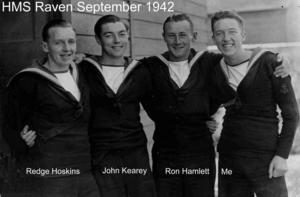
HMS Raven Sep 1942 Tony Inman on right
A View from the Back: The Recollections of a Fleet Air Arm Observer 1941-1946 by Tony Inman Part 3 of 14 (Jul-Sep 42)
Eastleigh
After some weeks we moved on from Whale Island to Signal School. Signal School was at Eastleigh which is now Southampton Airport. Here we learned all sorts of naval communications. The emphasis was on Morse of course, because that was what we were going to use with our radio sets, so we did Morse every day, sending Morse, listening to it and writing it down, until Morse code was so hammered into you that you automatically interpreted every sound you heard into a Morse signal. Not only Morse, we did semaphore, naval flags and I used to know them all - I don't now. We learned how to manoeuvre a battle fleet, turn it round in circles or make it go to the right or to the left and, to drive this into us, when we were marching about and taking it in turns to be in charge we didn't give orders like "quick march" or "right turn" and all that, but we would say "G4" and then everyone would put their hands up, and when they were all up that meant they understood what "G4" was. When you saw all the hands up you gave the command "down" and down would come all the hands and off they would go. "G4" was go at 4 knots - which was walking pace. If you wanted to turn to the right it was "Green 9", so up would go the hands, you gave the command, down they came and everyone would turn to the right. Red 9 was left. So we marched about the place hands up, hands down, turn left, turn right. Quite pleasant, a nice place, good company and good weather although we did have duty there. I was on sentry duty one night, prowling round as sentries do and I came to one hut and it sounded like somebody was snoring inside. So I advanced my bayonet and approached the door which I couldn't open because it was locked. I decided to go round the back of the building, still with my bayonet out in front and all of a sudden I realised that the snoring was now coming from behind me. How could this be? Then I realised it wasn't someone snoring but an engine over at the railway yards at Eastleigh which was sort of snorting away as they sometimes do. Luckily there was no-one else there.
It was here that I had my first taste of "Pusser's kye". This was ship's cocoa. At the end of my stint of sentry go, I was relieved and went back to the guard hut where the guard commander was an old petty officer who we swore had been in the Navy in Nelson's time. He had retired, stayed in the Reserve and like many others had been called up to do these sort of jobs - they were known as "barrack stanchions". This old boy had made the cocoa. In it he had put great big slabs of chocolate which were melted or dissolved in water or something. Then condensed milk was added and about a pound of sugar and you had a sweet, thick mess of cocoa which could be so thick that you literally needed a spoon to eat it with. But my word it didn't half go down well.
The airfield at Eastleigh was all grass, no runways, so it grew a great amount of mushrooms. After finishing duty at 8am (or earlier if you didn’t do the last patrol) you would take your hat and rush out onto the aerodrome to pick the mushrooms. This was a favourite thing when weekend leave was coming up because they were an almost unheard of delicacy during the war. On the course there were a large number people who had already been on the pilots’ course and failed and amongst my photographs you will see the one taken at Eastleigh of the PPP (the "piss-poor pilots") with the drawing of the gremlin which was supposed to have caused us to fail.
On that course, usually everything was done alphabetically so I got very friendly with the blokes that were around me: Ron Hamlet, Redge Hoskins and John Kearey - "H", "I", no "J"s and a "K". Redge was a New Zealander and his name was spelt R-E-D-G-E, never to be forgotten. There is a photograph of the 4 of us (see next page). Ron was later killed at Machrihanish, when I was there, Reggie lost his life in Northern Island, and after we left Eastleigh I don't know what happened to John Kearey. He went off to Trinidad and I didn't see him again.
In the book about the Fleet Air Arm that was issued by the Stationery Office, I have got a copy somewhere (up in the roof I expect), there is a photo of a young fellow standing there, gazing at the sky with his flying boots on and his sailor's uniform. That was taken when I was at Eastleigh and the chap was standing on top of a grass covered air raid shelter, but it looks a most impressive photograph - almost like the boyhood of Raleigh pointing out to sea.
August 1942 was the time of the famous Dieppe raid and, although we didn't know what was going on, we knew something was up because Portsmouth is not all that far from Eastleigh, and for all of that day there was the sound of gunfire and air battles coming from the direction of Portsmouth. We could see bursts in the sky and hear the aircraft.
At this time Betty was working in Redbridge, Southampton and so at every opportunity I was off down there to see her. One of the chaps on the course with me had a bike which I used to borrow when I could, to cycle to across the other side of Southampton. It sounds a long way now but when you are young and in love it isn't very far. All this was leading up to us getting married but that is another story….
Arbroath
So I came to the end of my time at Eastleigh and the next stage was Arbroath which was the main part of our course and where we would start our flying. As I said before, the course was now split - about half going to Arbroath (HMS Condor) and the other part going to Piarco in Trinidad. The call for opting for Trinidad was quite strong of course but young love conquered and I decided to stay home with my new wife, even though Arbroath was a long way away it was a lot nearer than Trinidad. From now on there will be an almost or part contemporary record in that I start my flying training and my flying log book contains a lot more information with dates and things and even a record of places where I served.
I went to Arbroath on the 19 Sep 42 and had my first flight on the 23 Sep 42 starting at 5 minutes past 2. The flight lasted for an hour and 20 minutes and it was in a Swordfish. Arbroath was a peacetime aerodrome, probably the main aerodrome for the Fleet Air Arm in Scotland, which meant that the hangers were permanent, brick built things and a lot of the accommodation was brick built, but for the expansion of the observer course there were a lot a temporary wooden huts. There were 3 courses training at Arbroath at any one time, with a new course coming in every 2 months. The accommodation was in 2 huts, the senior course in one, the middle course in the other, and the newcoming junior course split between the 2. When the senior course graduated what was the junior course occupied the rest of their hut, so again the incoming junior course was split.
We were issued with our flying clothing, which was a padded siren suit, head-to-toe long sleeves, long legs, and with zips up the side legs and arms as well as up and down the body for ease of access. On top of that there was a canvas Sidcot suit which was similar, with a fur collar with pockets on the front and on the thighs for keeping all sorts of odds and ends. We were issued with 3 sorts of gloves: a silk pair, a woollen pair and a pair of leather gauntlets. We had an old style flying helmet, none of these bone domes they have now, and a pair of goggles. In addition there was our navigation equipment, a chart board, known as a Bigsworth board (which had parallel rulers), a course and speed calculator, and a device for calculating wind speed and direction. The chart board was a bit more than 2 foot square and the course and speed calculator was a device on which you could set your air speed, the wind speed and direction, and the direction in which you wished to go. Then by setting all this and twiddling something round, it indicated which course you should fly so the effect of the wind would put you onto the track you wanted to go along. How the thing for calculating wind speed and direction worked, I have no idea. I know it was round like a dinner plate but that's about all.
We then were issued with a parachute harness which the staff adjusted to fit us and that stayed with us while we were there, it was like part of our kit. It was no use to anyone else because it would not fit. We also had a little kitbag which contained all your flying kit if you rolled it up and stuffed it in. The parachute harness was not the usual one which you see strapped on with the parachute already attached to sit on; this was just the harness and we drew the parachute individually from the parachute section every time we went to fly, and they were just a pack which you kept in a rack in the cockpit. If you wanted to use it you picked it up and it would clip on the front of the harness. On the front of the harness there were 2 big spring clips which attached to 2 D rings on the parachute which clipped on and then the ripcord for deploying the parachute was sticking out in front of you. During the course sometimes we spent time in the hanger practising parachute landings if we should have to jump - what good that was supposed to do us if we landed in the sea I don't know - but anyway it was just part of the course.
Each day was divided into part for flying and part for ground work where we learnt navigation (of course), meteorology, wireless telegraphy, Morse, photography and various odd things. Some we didn't take seriously. Photography meant nothing to me; meteorology was interesting because we learned about the clouds and got some idea of what weather was approaching - although we never came anywhere near the expertise of the met man. He was an old Lt Comd who had been a meteorologist all his life and he would amaze us. One day we were due to fly in the morning but it was dull and the cloud was low and it was raining so it was cancelled. We had some meteorology instead and he said, "We'll get on with this now because you'll be flying this afternoon, the sun will be shining by about 2 o'clock". I think the sun came out at about a quarter to 2 so off we went and did our flying in the afternoon instead of the morning.
We did navigation exercises every day in the classroom and Morse every day and, whatever else was on, we did those all the time. At this stage, the navigation was theoretical but we learned how to find a wind, take fixes, how to come back to a ship which had sailed on after you took off, and how you plotted a course that ensured you arrived back at the time that you wanted. We also learned ‘creeping line ahead search’ which assumed you had taken off from a carrier with the fleet and you were having to search ahead of the fleet, zig zagging across in front in the way the fleet was going. You had to calculate your course so that whenever you crossed the line of the direction the fleet was sailing you were the same number of miles in front. I can't remember how to do it now, but I did at the time. All these old skills were done without radar, which was in its infancy - at least as far as naval aviation was concerned. We did a little bit of radar but the sets were not fitted to all training aircraft at that time. The radar was directional, searching normally at about 10 degrees either side of straight ahead, with the operator able to move the aerials another 5-10 degrees. Revolving beams were in their infancy and available only to the RAF.
© Copyright of content contributed to this Archive rests with the author. Find out how you can use this.


 Recommended story
 Story with photo