

- Contributed by
- simpson22
- People in story:
- Tom Simpson, Tommy Dumble, Ozzy Kitchen
- Location of story:
- Head Wrightsons Engineering Works, Thornaby, North Yorkshire
- Background to story:
- Civilian
- Article ID:
- A6515093
- Contributed on:
- 29 October 2005
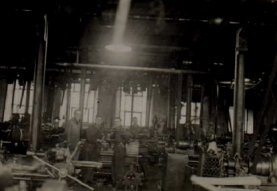
The machine shop, full of shafts and belt driven machines. Taken sometime in 1944
I left school at fourteen 1938.I wanted to join the Royal Navy as a boy seaman.Sadly at the time, I was turned down as my left eye was weaker than the right. I have often wondered what would of happened had I been accepted.
Two years as a butchers delivery Boy at the Co-op at Yarm brought me to sixteen.At sixteen your employment was terminated.My time at the Butchers was enjoyable, occasionally the Grocerery manager borrowed a rowing boat and under his supervision we rowed up the river for a swim afterwhich he he allowed us to smoke one cigerette .
When War was declared, I was visiting some relatives at Blue Jacket House Staithes, a small fishing village on the North East coast
We were crowding round the radio when Mr Chamberlain read out the news. Deep depression set in as members of the family had lost son's in the first world war including my Grandfather who was lost at sea.
I managed through a family friend to gain an interview to be an apprentice engineer at Head Wrightsons engineering works Thornaby.
I attended wearing an overcoat and trilby, you expected to be smartly dressed, on reflection i must have looked like a junior gangster.
However I got the job and started on another phase of my life.
I had two options of travel,use the Bus or cycle to work. The distance from Yarm where I lived to Thornaby was four miles.
The times for staring and finishing was seven thirty to five o'clock Five days a week,Saturday you worked untill lunchtime.Week end off.
The works produced many items, from small parts to huge forgings and castings.Landing craft were built a little further down the river and most of the welding was done by women who were first class.
I started work on the top floor of the factory, the machinery was mostly made up of small drilling machines.my job for while was drilling tiny holes in clevis pins,I broke dozens of small drills until I mastered the technique.The shop foreman had a lot of patience and as we progressed under his supervision we moved down a floor to where there were a lot of centre lathes ,capstan lathes, large drilling machines , and milling machines all driven from overhead line shafts and leather belts. The line shafts were driven a huge electric motor at one end of the workshop.
© Copyright of content contributed to this Archive rests with the author. Find out how you can use this.


 Recommended story
 Story with photo