

- Contributed by
- Colin McGlone
- People in story:
- Irene Alice McGlone(nee Parry).
- Location of story:
- Essex.
- Background to story:
- Civilian Force
- Article ID:
- A4378593
- Contributed on:
- 06 July 2005
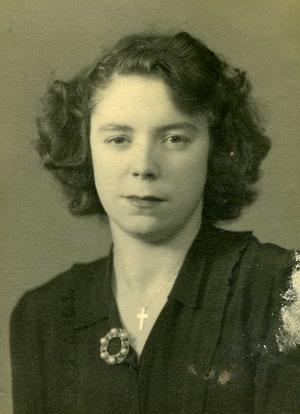
Rene Parry, aged 17 in 1943.
This is the story of my Mum's war. At the outbreak of war Rene Parry was just about to turn thirteen. There followed the so-called "phoney war" until, in 1940, the Battle of Britain began. From the then rural countryside of Wickford, Essex, Rene and her friends were able to see first hand the fighting in the skies above. They would see planes and pilots from both sides crashing down and would sometimes reach the aircraft before the authorities could get there. Only now does Mum tell these stories, of finding planes and crew "in bits".
In October 1941 Rene and her sister Barbara were evacuated to Wales. There passed an unhappy time until they returned to Wickford in June 1942.
In the spring of the following year Rene had a job at the local dairy. One bright sunny morning she was cycling to work at the usual time of 7.30. Meanwhile, earlier that morning, a group of Stuka bombers had been attacking installations in Chelmsford, probably the Marconi factory. They were promptly chased away by Spitfires and began their journey back across the Channel, passing directly over Wickford en route.
With the Spitfires in hot pursuit the Stukas flew low over the village. Rene's theory is that the sun glinting off the metal of her bike caught the Nazi pilot's attention, maybe he thought it was an anti-aircraft position. Whatever the reason the Stuka now bore down on Rene as she pedalled ever faster, "the cock-pit was open and I could see the pilot's face, his goggles, it seemed an evil face". The Stuka opened fire and bullets tore up the earth, smacking into a nearby tree. In desperation Rene rode her bike into the bushes at the side of the road and threw herself off into the ditch. The plane passed over and amazingly, apart from a few bruises, she was safe.
After a period in the Auxillary Land Army Rene eventually ended up in the NAAFI. In the last days of the war she worked at an Army Intelligence camp near Stevenage. On that final day Rene was in the kitchens preparing dinner. "Churchill came on the radio and announced that the war was over. All the soldiers in the canteen stood and sang Land of Hope and Glory, it was wonderful. Then we comandeered a bus, drove to London and went to Buckingham Palace to see the King and Queen!"
Colin McGlone.
© Copyright of content contributed to this Archive rests with the author. Find out how you can use this.


 Recommended story
 Story with photo