

- Contributed by
- Hamish Riddle
- People in story:
- Kenneth Whyles
- Location of story:
- London
- Background to story:
- Royal Air Force
- Article ID:
- A8958892
- Contributed on:
- 29 January 2006
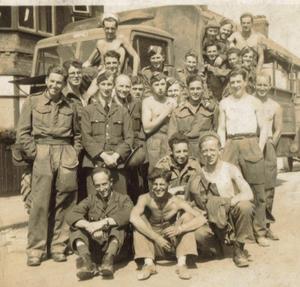
This picture was taken in London during the war. I am sitting on the bonnet of the truck wearing a sailors hat!
I was in the RAF during the war. There were about 20 of us waiting in London for a ship to take us out to Africa. At this time we were asked if we wanted to help out the RAF regiment who were doing First aid bomb repairs, we were asked to volunteer to help them while waiting for the ship. Most of us agreed to this and we would then have to travel to one or two other places. Eventually we were housed in barracks on hall-church airdrome. And from there with some three tonne Lorries we were going into London everyday in the morning (coming back at night) under the instructions of the RAF regiment we were putting tar on top of the damaged houses’ roofs and making cellophane frames for the broken windows. At times this was quite dangerous work, buzz bombs were landing in London all the time, sometimes quite near to where we working! In fact on day we went up onto the roof and a buzz bomb went over the roof at the bottom of the street about 30 or 40 feet above the house and crashed about five or six hundred yards away. We just had to take the chance; there was no other way of getting the job done!
At Doge Island where we were at first some of the houses there were filthy. I remember one house where a blind lady lived on her own. The mats and carpets were appalling, we had to take them all out and destroy them. During this time at doge island we used the local air raid shelter to change our clothes when we arrived, put on our overalls, and at night we took them off and left them there, which were then taken away to get washed. It was as bad as that in fact I have never been into London before, and hadn’t realized that people had been living in atrocious conditions.
We moved from place to place, wherever we were needed. We never knew from one day to the next where we would be. I remember we were in China town for a week or so and then in the white chapel area. It was funny really, in some houses where the roofs were damaged, we could see into the attics. A lot of people had stored their belongings up their, and had got damaged or destroyed during the bombings; whether they claimed compensation or not, we never knew! I remember once that there was a brand new block of flats in one area; obviously the people living in them come from a debateable area and they would still be putting coal in the bath. All these lovely new places were being destroyed by the occupants using the baths like they did in their old houses, not accustomed to the new flat!
After we had been doing this for a week or two, one of the London newspapers discovered we were there and what we were doing. They wrote an article on us with the headline ‘Buzz Bomb Boys!’ I don’t know whether there are many people living today who remember this, but there were young people living in the houses, teenagers mostly, who hadn’t been evacuated out into the countryside, it was quite a shock to see how many children had stayed.
I remember that where ever we went we were more than welcome and cups of tea were offered (and excepted) where ever we went, the most generous people were living in the most atrocious conditions.
Of course travelling to areas which had been bombed the night before or the day before, it was inevitable that we should come across disaster. I remember on one occasion that there was a house that had been destroyed into more or less piles of bricks. I saw either a husband or a relative trying to move all these bricks to try and find his wife or relative. It was obvious to us of course it was an impossible task. The demolition and rescue people eventually managed to convince the man that it was a hopeless task and he was lead away. It’s an experience you would have to see to appreciate why somebody would attempt to do that sort of thing, even if it was an impossible task!
On another occasion, we saw a whole family dead in an Anderson shelter. At first we thought that they were drowned, as not to far away from their Anderson shelter was a EWS tank. These emergency water tanks were all over the place for the use of the fire service. It turned out that these people weren’t drowned but killed by the blast of the bomb. The pressure from the explosion went straight into the shelter and killed the whole family instantly. Normally you wouldn’t have seen these sorts of things, but we were on these sites very early in the morning and so before the emergency services had cleared the areas we were more or less there; so we did see quite a bit of the rough side of life during the war! How the Londoners took this day after day, week after week is beyond me, we were there for about six weeks, and by the time we had finished we had had enough of it! The last thing that happened to us before we left Hornchurch dome was when we returned one night from London, we came to find that the aerodrome had been bombed and there were bomb craters all over the place. The barracks weren’t hit so that was lucky and we were able to have a good night sleep!
We were taken down to Southampton to catch our ship to Africa, which I remember was the Athlone Castle; before the war is was a holiday cruise ship, and after the war for that matter. However it wasn’t a luxury liner for us, as it had been striped down to be used as a troop ship. But nether the less, we could see that in fact it had the potential to be a luxury cruise liner!
I hope that we did some good during the war; the reception we got from the public when we turned up at the scene was quite remarkable, so one can only hope that we were some help to the public during the time that we were there!
© Copyright of content contributed to this Archive rests with the author. Find out how you can use this.


 Recommended story
 Story with photo