

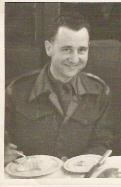
John Suffolk Divisional Inteligence officer, native of Sheffield
- Contributed by
- Frank Yates
- People in story:
- Frank Yates, John Suffolk
- Location of story:
- Bayeux
- Background to story:
- Army
- Article ID:
- A7378392
- Contributed on:
- 28 November 2005
Memories of Frank Yates CHAPTER 30
The Normandy weather was hot and, as I have already mentioned, the countryside was redolent with flies and the all over stink of dead cows and men. Added to these problems was the fact, a main source of grumbling throughout the beach head, that we had seen no bread for over a month, having to make do with hard biscuits of the naval “hard tack” type. Bread is bulky and soon goes stale and it is evident that it was low priority in the temporary ports. The annoying thing was that Normandy butter, the world’s best was readily available in Bayeux, as was Camembert cheese. The biscuits however were a poor substitute for bread.
We were burdened, at the time, with an ancient Lt. Colonel, some sort of LO, but no one seemed to know what he was there for. He had a jeep and a driver/batman who had a black moustache, painted on his upper lip! He was always called “The Count”, because he looked a bit like Bela Lugosi, the film actor, who played the Count in “Dracula”. On his travels, the colonel would buy several packs of Camembert, but, unlike us, would keep it for days until it was a dark brown semi liquid, claiming that it was not worth eating when new. As you can imagine, it contributed substantially to both the scents and the flies! It appears that an officer of his rank should be in the general’s “A” mess, but he was foisted on our “B” mess, for reasons, now clear to us!
Eventually, the happy day arrived when the odd couple departed, to pester some other unit, and quite a large farewell party had gathered to see them off. As the “Count” and the Colonel sat bolt upright in the jeep, the assembled drivers and clerks, fell about, because we could see in the gap, under the bonnet lid, four little fires. Some person or persons, unknown, had poured a little petrol into the four hollows in the cylinder head where the sparkplugs are located and left a plug lead unclipped. The count started the fires by turning on the ignition; he then turned off the engine because it was running on three cylinders. A couple of drivers went to help. They opened the bonnet, reconnected the plug lead and effected a two second repair. The odd couple departed, thanking the drivers for mending their jeep!
Eventually, about the beginning of August, we got a bread ration, two slices per man, the best bread we had ever tasted!
While on the subject of food, it is a good time to mention the famous 14 man ration pack, on which the Army relied for a long time into the campaign. This wooden box contained the food for 14 men for one day and, of course, 7 men for two days or one man for 14 days. In practice the packs were pooled, according to the ration strength of the mess. They contained tinned bacon and egg powder for breakfast, packets of tea, sugar and tinned milk. Tins of meat and vegetables, tinned sausages, tinned puddings and potato powder to make “mash”, they also had a packet of khaki coloured toilet paper, (known as “Army Form Zero”), cigarettes and boiled sweets. I personally very much enjoyed the bacon and the sausages, never before seen in cans!
As well as the butter and cheese, the other commodity readily available in Normandy was Eau de Vie de Calvados, the fiery distillate of the rough cider. We found the stuff virtually undrinkable, but when poured over the tinned puddings and flamed, it improved the taste. We heard that the Germans used the stuff in their petrol tanks. Whether true or not, if you had tasted the Calvados you would have believed it!
At this stage of the war a strange change came over me, I grew a moustache. I was quite proud of my blonde face fungus, but after a time, it became stained brown, in the centre, with cigarette smoke and so I got rid of it. Fortunately, no photographic record exists!
From time to time I will tell of my companions. John Suffolk was the Intelligence officer, born in Glen Road at Nether Edge. Mrs Suffolk got in touch with Peggy and they worked together in a canteen, based in the YMCA in Fargate. John had a degree in German and spent a lot of time in pre-war Germany. I don’t know the details, but he was instrumental in getting a girl out of the country. He was a very fluent German speaker and as a big part of his job was to interview and interrogate prisoners, he used his “streetwise” German, swearing at them, and sometimes scaring them. When he was considered for a commission, he was interrogated at great length by MI5 about his clandestine adventures in Nazi Germany. Although a quiet schoolmaster in Blackpool, he ranted and raved at some prisoners. I well remember, right at the end of the war, we were given a captured German Intelligence document, giving debriefing details of a German NCO, who had been captured by the “Tommies” and had subsequently escaped.” He had been bullied by a fair haired Jew, wearing a “W” on his arm. This “Jew” had made him dig a hole and threatened to shoot him unless he answered the questions, and said that he would bury him in the hole”. The good soldier “Could not wait for victory so that he could give evidence against this animal, and have him shot”. John laughed about it, but I expect he was glad to be on the winning side!
When we were on duty, on the Div net, it was of course necessary to send in code and to decode incoming messages. The basis of the code was a card, divided into about 200 squares, each square having a word, a letter, a number, or even a phrase or group of words like “O Group, Nil returns required”. Along two edges of the card, were written in, each day, a series of letters. The method of use was simplicity. Should you wish to send a message “Orders group Div HQ, 1200 hrs.” a square would be found containing “O Group” and the letter along the top would be read and then the letter down the right hand side, just the same as reading a map reference, so that the first group could be “HL” .”Div HQ” might be “PZ”. Some cards had all the times from 00 hrs to 2400 hrs, in the squares, so that “1200hrs “could, perhaps, be “SN” otherwise the separate numbers would have to be used. The message transmitted would read “HL, PZ, SN”. After a while the bloke at the other end would say “Received and understood”, or ask for a repeat If it occurs to you that the code could easily be broken, remember that the reference letters were changed daily and the cards once a week,
I called at a chemist’s shop in Bayeux for some talcum powder, and decided to try my schoolboy French on the shopkeeper. I asked “Du poudre talc, si’l vous plait” “Oui Monsieur” and he poured the powder out of a jar into a paper bag and sealed it. (Nothing sophisticated like tins in wartime France.) I then, full of confidence, said “Combien” (“How much”) and he said “Four”, I was stumped. I didn’t know a French word ”Four” so I repeated “Combien” and he repeated “Four” and we went on like this several times until the good Chemist put up four fingers and said “Quatre”. I paid him his four francs and left, clutching my packet! I might put on record, that for the rest of my service in French speaking Belgium and even in Paris, on a visit, even though, having had problems with French at school, I could always make myself understood.
© Copyright of content contributed to this Archive rests with the author. Find out how you can use this.


 Recommended story
 Story with photo