

- Contributed by
- actiondesksheffield
- People in story:
- Rolf Heymann, Jacqueline Heymann, Herta Heyman, Nina Heymann
- Location of story:
- Sheffield, Yorkshire, Yeovil, Somerset
- Background to story:
- Civilian
- Article ID:
- A7187592
- Contributed on:
- 22 November 2005
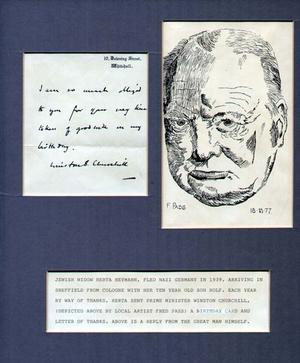
One of Winston S. Churcill,s letter to Herta Heymann
This story was submitted to the People’s War site by Roger Marsh of the ‘Action Desk — Sheffield’ Team on behalf of Rolf Heymann and has been added to the site with the author’s permission. The author fully understands the site's terms and conditions.
Kristallnacht and how the Kindertransport saved Rolf Heymann’s life
Part 3 — Marriage and an all new way of life
Transcribed By
Roger Marsh
Post War
I left school at 14 years of age and my first job was at The Builders' Centre on Suffolk Road. I went to work there on munitions, making magazines for rifles, which were still being made at the time. However at 19 shillings and sixpence (97.5 pence) per week, I was not very happy at that. So I changed jobs and moved across the road to Kennings Garage doing an apprenticeship there. I then went on to work at various different garages. I also went to work in the steelworks.
I was so fed up with life that I went to the Labour Exchange in West Street. The fellow there said to me, “Do you want to go on a farming course?” I thought, “What the Eck! Back to my roots with my granddad being a horse breeder.” I thought, “Back to the land might suit me.”
I went down to Yeovil in Somerset for an interview and they said, “You can start in a week.” So I went a week later but it was a very upsetting experience. It was October/November time and there must have been about twenty of us billeted in this beautiful old house that had been converted into a type of hostel. Originally, someone very rich must have lived in it. The routine was up at 6 o’clock in the morning to cycle to the farm. In this particular farm where I worked, they had 150 cows and there were just two lads, this other lad and me. We had to turn the cows out of the shed into the yard, but not into the field. Then we had to get all the cow muck out of the shed with big shovels and load it into a big skip that they had in those days. When all the muck had been loaded we would fasten the skip on to the tractor and we would go and spread the muck onto the fields. When that was done we would put the cows back into the shed and then we would cycle back to the hostel for our breakfast at 8 o’clock.
After that, we would be sugar beet pulling and all other farm work and at that time of year everything was covered in frost and our fingers would be freezing.
One morning we had turned the cows out and had got all of the cow dung into the skip ready for the muck spreading. I had a driving licence but the other lad was only learning to drive. This did not make any difference because we were only driving on the farm fields, and not on the public roads. Well this morning the lad said to me, “Can I have a go? Can I drive?” So I said, “Yes”. I was sitting on the edge of the skip and he got into the tractor to start it up and, he stalled it. All that I can remember was that I fell backwards into four feet deep cow dung! Everything went black but fortunately I kept my mouth shut, but I could not keep it shut that much longer because I had to breath. Then I could not remember any more. When I came round I was laid on the floor with everybody around me. They were cleaning me up with the hosepipe and were pumping my back to get the faeces out of my mouth. They took me to hospital and pumped my stomach out, and I thought, “That’s the end of farming for me.” The next day, I went back home to Sheffield.
When I came back to Sheffield, I went butchering at Bents Green.
I than worked for Hay & Sons, driving a wine and spirit lorry. They were located next to where the Crucible Theatre is now. They also used to have the Hay’s Wine Lodge.
It’s amazing that I am not an alcoholic working there.
My mother was very very grateful to the people of Britain for allowing us to settle in England and she used to express this gratitude in an unusual way. She used to write to Winston Churchill thanking him for letting us come to England, because she thought that it was Winston Churchill that had allowed us to settle in England. Every year on his birthday, she would send him a card congratulating him on his birthday and every year we would get a letter back from him, from 10 Downing Street, Whitehall, written in his own handwriting, thanking my mother for her good wishes.
An example being, “I am so much obliged to you for your very kind token of good luck on my birthday. Winston S. Churchill.”
My mother received two or three letters like that, and I was always in favour of my mother’s correspondence with Winston Churchill.
I only suffered from racial intolerance in England once, but never in Sheffield. I used to go to Liverpool to visit a family there whom my mother knew. This particular day, I went to a Jewish Youth Club with another boy named Geoffrey; he had a hole in his heart and was not very well, I was 16 years of age and I think that he was about 12. We came out of the youth club and were walking down the street to catch the bus in Liverpool at around eight or nine o’clock at night, when we saw three youths walking towards us. They were not much older, 17 or 18 years old, and I actually stepped into the gutter to walk round them. All of a sudden, one shouted back to me and I stopped. He came up to me and he must have been a half a head smaller than I, but he was very broad. He asked, “Have you come out of So and So?” I cannot remember the name of the club. I said, “Yes” and he grabbed hold of me by the lapels of my jacket and his forehead smashed into my face in what is known as a ‘Glasgow Kiss’. The next thing that I knew was that I was flying backwards over a front garden and that was it. He did not quite knock my teeth out but they were very loose afterwards, and that was the only racial incident that happened to me in England.
My life in England was very confused up to the time that I got married. I had quite a few girlfriends and really what changed me happened because I had some very nasty experiences with two Jewish girls in particular.
I went out with one Jewish girl who worked in the offices at Kenning's. She was only 15 years of age and I was only 16. I used to take her home to the bus and I took her to the pictures once or twice. Then she decided to take me home for Sunday tea and there I got the third degree from her parents. “What were my prospects?” “What was this?” “What was that?” I thought, “Do I need this grilling I am only a mechanic?”
Knowing my circumstances, where I had come from in Germany, and knowing that we were very wealthy and lived in a 16-roomed farmhouse with a thousand acres of land, because my grandparents were horse breeders, and here I am getting the third degree. To be grilled by this Jewish family as to what my prospects were, really upset me. When they found out that my prospects were nothing, because we had left everything behind in Germany, no one in the Jewish community would have me.
The same thing happened with another girl in Leeds and that is why I swore to myself that I was determined to marry a Christian Girl and I would never marry a Jewish girl, and I am not a practicing Jew any more.
I had been brought up so strictly religious, it’s just unbelievable. I mean, Hebrew is read from left to right. I could read it from right to left or upside down and I could recite it. The only trouble is that I can still read Hebrew but I have not got a clue what I am saying; I cannot understand it. If I were talking to an Israeli he would know exactly what it was that I was saying, but I do not know myself. I never learned the interpretation when I left Germany. They had just taught me to read Hebrew but I did not know what it was that it meant.
Religion disillusioned me a long time ago, first the Jewish religion. If it was a perfect world I think that there should be just one religion and it does not matter which one. I think that I believe in God, but I am certain that there is a devil because the devil must have invented the plurality of religions. But I am still a Jew. I was born a Jew and I shall die one, that does not change.
I worked for Hay & Son, which was a wine and spirit merchant, it was practically opposite the Crucible Theatre and later became The Ruskin Gallery.
Whilst I was working there, I think I was about 20 years of age; I used to go to the City Hall dancing, and that is where I met my future wife. My life changed I can tell you, when I met Jacqueline in the City Hall, a Christian girl from Sheffield; we hit it off straight away.
When Jacqueline took me home to meet her mother and father, I was out of work, but they could not have cared less if I was a dustman, road sweeper or what ever.
When Jacqueline and I became engaged to be married, my mother, Herta Heyman, was very very upset, in fact she even got me a one-way ticket on the Queen Mary to go to the United States of America, because I had an uncle there. The only thing that she had against Jacky was that she was not Jewish.
I left my mother’s house three days before we were to be married and my mother threatened to commit suicide if I married Jacky. She said, “If you get married I will commit suicide.” Now those were her words. I was 22 years old and so I said to myself, “Well it's my life, though I have to thank my mother for getting me out of Germany, but it's still my life.” Although I was hoping that my mother would not carry out her threat.
In fact she even came up to my future in-laws' house to speak to my future mother-in-law to ask her to stop me from marrying Jacky, only because of me marrying out.
In 1951 nine months after we had met, Jacqueline and I were married.
I was out of work at the time so we only had a three-day honeymoon because we only had £17:0s:0d between us.
When we got back to Sheffield, I went to my mother’s house not knowing what to expect. I still had the key to the house and I let myself in. My mother was very deaf, and there she was dressed all in black, sat on a stool saying the ‘Jewish Pray for the Dead’ for me. As far as she was concerned, I was dead. She had nothing against Jacqueline, it was what would our few remaining relations say because I had married out. I was the first one to do so, but I loved Jacqueline and my life changed from the day that we got married. From that day I became less religious; that is when my life changed. I had not eaten bacon up to that time.
Having married Jacqueline, I found that I had the most fantastic Mother-in-law and Father-in-law. I have said to Jacqueline many times that I should have married her mother, she was so good to me. I do not think that anyone could have been so good to a son-in-law as Ada was to me.
My mother-in-law was the most perfect person that I have ever known. I have said that when I came to England, that the only English that I knew was 'yes' and 'no', but in Germany, I had also learned gentleman and lady. I had learnt what a gentleman was but I did not know what a lady was. I can only say that about my mother-in-law, “She was a lady.”
When my mother-in-law died, my wife had to learn how to cook because Ada did the lot.
When we went to live in Bolsterstone, we lived in a four-roomed house, after living in Germany in a 16 roomed house. There was just a small bedroom and in the first six months of our married life, we slept in a single bed. Then Jacqueline became pregnant and we had to buy a three-quarter bed because the bedroom was not sufficiently large for a full sized double bed.
Jacqueline’s father was the manager of Bramall’s Scrap Merchants and he got me a job there, and after two years, I started up on my own. Now I have worked in the scrap business for a long time and I still do a little bit.
It was not until six months later, when we found out that Jacqueline was pregnant that my mother started slowly to come round. She had come round by the time that our daughter Nina had been born.
My daughter went to the Church of England school in Bolsterstone. Jacqueline said, “Shall we have her Christened?” and I said, “Yes, if you want to.” And so she was Christened.
They say that the Jews are God’s chosen people, but if you say that to anyone, their backs go up. Why should the Jews be the chosen people? I believe that the Jews are the chosen people for a load of grief and aggravation. They were chosen for people to vent their feelings on, that’s the only thing that they were chosen for. I do not know if God chose them, but that is my personal belief.
My mother lived to be 91 years of age and in the last four years of her life, she came to live with us. It was then that she told Jacqueline that she could not have had a better daughter-in-law.
When we go on holiday to Spain, we visit the little town of Sitges on the coast, north west of Barcelona, staying at a small hotel that is over a hundred years old, which we prefer to one of the modern blocks. We had been there a couple of days and we had noticed what looked like businessmen running around.
On the third day I had said to Jacqueline, “We must have an early night.” We had just got back to the hotel and as I asked for our room key at reception, two swarthy Spaniards approached us.
They said “Mr. Heymann?”
I said, “Yes”
They then said, “Could we have a word?”
The concierge nodded to tell me that the men were all right. They asked me, “Would you like to be in a film that we are making?” I looked at them, it was midnight, I said, “You are kidding?” They said “No”
They told me, “We have been watching you for two or three days.” They went on, “We have a problem with an actor who has become ill and we would like you to take his part.”
I had had quite a few drinks and must have been very inebriated, and I said, “Yes, why not?” because at the time, I thought that they were kidding.
They showed me a script and my part was to play an American Admiral, Admiral Dorty of American-Irish ancestry, and here was I, a Jewish fellow from Germany speaking English with a German accent.
After sixteen takes, I managed the part that they had given me, I had done it, and it was released; I have a copy of the film at home. There were quite some big film stars in the film: Fernando Ray and Robert Foster, Martin Sheen’s son.
Every year I go back to visit my dad’s grave. He was the next to last person to be buried there. His ashes are buried there and they must have come from Auschwitz Concentration Camp. It says on his gravestone that he was murdered, and I always think that but for the sake of a few months, that could have been me.
When I go back to Germany, I never speak to any German over 70 years of age. The other Germans, especially the young ones, they feel really embarrassed. I get on with all the Germans except when it is someone over 70 years of age; I think that they could have been in the Nazi Party of the Hitler Youth.
When I have been asked how I feel about Israel, my answer is that I have never been to Israel and do not have any feelings for that country.
Pr-BR
© Copyright of content contributed to this Archive rests with the author. Find out how you can use this.


 Recommended story
 Story with photo