

- Contributed by
- Heather Margaret Leybourn (nee Godber)
- People in story:
- Harriett Elizabeth Godber
- Location of story:
- London and Oxfordshire
- Background to story:
- Civilian
- Article ID:
- A8998591
- Contributed on:
- 30 January 2006
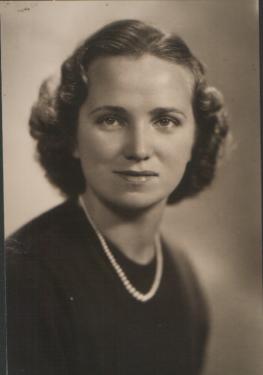
My mother, Harriett Elizabeth Godber, taken in 1937 when she was 21
Life at the BBC at the Beginning of World War II
My mother was Harriett Elizabeth Godber (known as ‘Betty’). She was born in Battersea in 1916 and died in Weymouth in 2001, just before her 85th birthday.
In the late 1930s she got an office job with the BBC at Broadcasting House in London. She first worked in the multigraph section where documents were duplicated.
In her own words, she wrote, “The BBC gathered news from all over the world and translated it into English. It was typed on wax sheets for the duplicating machines. All the printed pages were set out along the entire edge of a trestle table. With rubber fingerettes we formed a chain gang and ran round the table collecting a copy of each page as we passed and then a girl at the end stapled them all together. The papers were put into envelopes. Outside of Broadcasting House was a string of motorbikes, their riders waiting in the entrance hall of the building. These riders came from the headquarters of the armed forces, government ministries, 10 Downing Street and even His Majesty King George VI. The envelopes were given to these despatch riders who then delivered them on their motorbikes. This happened every day. As war broke out on 3 September 1939, we at the BBC all had to sign the Official Secrets Act and we had special identity cards with our photograph on.”
The BBC had an excellent sports centre at Motspur Park. My mother played for the BBC hockey, netball, cricket and tennis teams. She also joined the mixed table tennis team which consisted of 5 men and 3 women. This team played teams from other firms such as banks and the Civil Service in the evenings. The majority of the BBC team worked in the Staff Records Department, so my mother asked to be transferred to this department, and this request was granted.
The Staff Records Department was located in the Langham Place Annexe of Broadcasting House. In September 1940 a 1,000 pound time bomb was dropped on the Annexe. Following this, a number of lorries were commandeered from the Army and all the staff formed a human chain from the office, down the staircase, and out onto the pavement into the lorries. All the piles of files and record books were loaded into the lorries and all the staff piled into another lorry and all were taken to safety in Oxfordshire.
The staff were evacuated initially to the Manor House at Weston-on-the-Green, a few miles outside of Oxford. This proved to be too small, so the staff were then transferred to Bletchington Park, a large country house in Oxfordshire. The stables of this house were turned into offices and that is where my mother worked, with only one oil heater to heat what had been 20 stables.
My mother continued to play for the table tennis team at Bletchington Park. The five young men in the team were all in the Volunteer Navy. They eventually received their call-up papers and were to report to HMS Royal Oak in the Solway Firth. Because they were confined to Bletchington Park, they talked quite freely about the ship that they were joining and where it was berthed. As we all now know, a Nazi U-boat sneaked into the Solway Firth and torpedoed the HMS Royal Oak before she could even get underway. All five of my mother’s table tennis team mates were killed and my mother was devastated.
At Bletchington Park, my mother became aware that she had become the centre of attention of a tall, blond and rather good looking young man. He would hang about the table tennis room and was always asking my mother to go with him to a country pub about half a mile down the road. My mother always declined to accept his invitation.
In the early part of 1941, Hitler ordered the bombing of airfields and BBC transmitting stations. My mother was by this time in charge of the staff records of BBC engineers. She had details of their next of kin, and of the shadow transmitting stations to which survivors were to be sent.
One evening, my mother was reading in the library. The blond young man came and asked her to play table tennis with him in a nearby barn, which she agreed to do. Whilst they were playing table tennis, MI5 burst in and seized both of them. They pulled the young man’s jacket over his head and revealed that he was carrying two pistols. It turned out that he was a German spy.
My mother was interrogated by MI5, but was honestly able to say that she had told the spy nothing about her work for the BBC. MI5 advised her that they believed that if they had not moved in when they did, the spy would have forced my mother at gun point to unlock the office so that he could get the details of the shadow transmitting stations that she had access to.
My mother was very traumatised by the whole experience, and always wondered if the spy had passed on information about the Royal Oak, which had resulted in the deaths of her 5 table tennis team mates. Apparently she spoke her mind to MI5 and told them how stupid it was to tell servicemen details of where they were going, etc, when about to go into action.
My mother was happy to leave Bletchington Park in early February 1941, when she married my father and went to live in Kent.
© Copyright of content contributed to this Archive rests with the author. Find out how you can use this.


 Recommended story
 Story with photo