

- Contributed by
- John Constant
- Background to story:
- Army
- Article ID:
- A6950991
- Contributed on:
- 14 November 2005
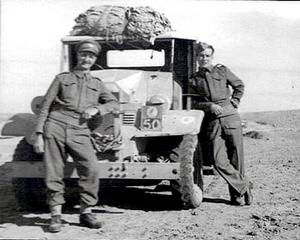
My Driver Sykes & wagon with Corporal Paterson
A disaster of World War 2 ?
by
Brigadier John Constant, late Royal Engineers.
Introduction
Many readers will remember that the Second World War victory was preceded by a series of disasters, each of which has etched itself on the minds of those who survived it. The 4th Field Squadron was one of the first new Sapper units raised in that war, and it went on to great success later, but only after a dreadful start. Recently, examining some notes I had made in the Fifties, I came across extracts from War Diaries I had written a decade earlier at the time of one such disaster..
Initially accompanied by a Field Park Troop, this account entwines the events both of "the Squadron" and of the "Field Park"; these, with the Headquarters of the "CRE" (Commander Royal Engineers), to whom I was Adjutant, were the initial constituents of the Seventh Armoured Division Engineers. Having been raised in the UK in April 1940, and retained to defend South East England, while the RAF won the Battle of Britain overhead, the unit embarked in the troop-ship "Orontes" at Liverpool on 5th October and set forth without a convoy, as NO warships were available, round the North of Donegal, where we witnessed the dreadful sight of another ship of the same group being bombed and sunk in rough weather. Soon afterwards, we were heartened by the appearance of 6 of the old-fashioned 4-funnel American destroyers in line abreast, "surfing" the huge Atlantic waves towards us.
Continuing without further incident across the Atlantic and back to Freetown, we formed a convoy with several more ships escorted by a cruiser, and made another generous loop nearly to Brazil before refuelling at Capetown. Thence Northward to Aden and up the Red Sea without the Italian warships in Eritria being able to harass us, as they had run out of fuel. Disembarking at Suez, the unit was equipped with vehicles and equipment near Cairo, and was still undergoing desert training and clearing old mine-fields near Mersa Matruh in the Western Desert of Egypt, when the initial British success in battles there had led to the whole of the Eastern half of Libya being cleared of the Italians.
General Wavell, the brilliant Commander-in-Chief of the Middle East Forces, who had overseen the whole strategic success in North East Africa, was then ordered by Churchill to denude the newly won Cyrenaika, in order for most of our troops there to go and fight in the Balkans. My story begins in February 1941, when a Territorial "formation" called 2nd Armoured Division, with few troops, some without any desert experience and little real training, was sent forward from Egypt to "hold" Cyrenaika, in case of enemy counter-attack. It was our fate to be added to their involvement, and German aircraft were already on the offensive there.
Operations
Instead of being given any rational plan of action under our own commander, the CRE, orders were received to send sub-units forward piecemeal, to what turned out to be an uncertain chain of command, and on 23rd February the Squadron’s First Troop was moved to Barche, and then on 2nd March the Field Park followed . The latter were sent progressively forward, until at Bilal, they came under command of 3rd Armoured Brigade for operations in the area Bir el Sweyra to el Hasseyat-Gitafiya. Passing through Ajedabiya on 9th March, they came under attack by German aircraft, losing 2 killed, 2 wounded, and some vehicles. Here, they first found the salt-pans, as in due course we all did, each of which had become a quick-sand after the winter rains, and was to become hard as concrete when they dried out in the heat of summer.
Covered by the armoured-car screen of the Kings Dragoon Guards, these damp pans became a feature of the initial British defensive position, and they were still sticky in March, but drying out fast. The Field Park’s initial tasks were water-supply and track-marking, using an abandoned Italian grader to make new tracks. Outlying wells were effectively denied to the enemy by pouring diesel fuel into them, to render the taste too unpleasant to drink. For each "bir" (the ancient underground stone cistern), a concussion charge was exploded in order to force the contamination into the walls; but poison was not used. Sometimes an auger-hole on either side was filled with explosive, to be used for creating more desolation. Generally, a "scorched earth" policy was to be implemented, in order as far as possible to deny any counter-attacking force the logistical resources otherwise available.
Meanwhile, the Field Park wrecked the Ajedabiya power-station and prepared the water supply for denial, they mined and cratered the air-landing ground and stood by with 500 mines to be laid on the roads and approaches, but permission to do this was inexplicably withheld by the Brigadier commanding the troops there. By 10th March, the Squadron’s First Troop had gone forward under this same command and into the salt-marshes of Sebket Serrira, for the supply (and preparation for denial) of drinking-water; they also prepared the main road near Mersa Brega for cratering, and laid anti-tank mines nearby Then the Squadron’s Third Troop went to join an Australian Armoured Cavalry Regiment 300 miles back across the sand sea, in order to clear the Italian Garrison at the Jarabub oasis, and John Bond’s gallantry there was rewarded with the Military Cross. A fortnight later, the CRE was moved with his HQ into Cyrenaika and, like the other units on the move, were continually being "strafed" by German aircraft. Having climbed the escarpment at Saloum and passing Bardiya, we spent the night at the little port of Dernah. The Jebel Akhdar ("green mountain") was looking beautiful in contrast to the desert and we continued to Barche, the local Army HQ, where we met LieutGeneral Neame, VC, commanding the whole Western Desert Force.
We went on to stay that night in Bengazih, pounded all night by enemy air-raids, and continued in the morning through the desolation of Beda Fomm. There, just a month earlier, the Italian Army fleeing South had been blocked by an outflanking sweep across the desert conducted by a column of our Division, the earliest elements of which had heroically cut the main road and had caught the Italian Army including its Commander, as they panicked. Evacuating their families with them, the Italians had sacrificed their women and children on the battlefield, which we found was still bearing the hateful signs of that carnage, disfigured as it was by clusters of recognizable children’s toys and feminine personal effects. We could also observe the number of Italian tanks abandoned there, which were now being repaired by British mechanics for issue to one of our own armoured units, as replacements for their earlier losses. However, we continued Southwards on 24th March, frequently strafed by German aircraft, and reported to Major General Gambier-Parry, the Commander of the 2nd Armoured Division, some 30 miles beyond Ajedabiya. He had relieved the Australian Brigade and, sadly, had very few troops at his disposal.
The Squadron, less its two detached Troops, had been following us, but more slowly, and I went to meet them on 28th March at Magroun, where they had just been viciously dive-bombed and machine-gunned by several Messerschmidt 110s. Three men were wounded and one new Ford 30 cwt GS lorry was partially damaged, but later repaired by unit fitters; this was an experience designed by the Germans to be terrifying, as indeed it always was, but the actual damage was light because we had, by then, developed the technique of carrying an air-sentry in every vehicle, to give sufficiently early warning to be sure of dispersing everyone out of the vehicle, in time to be clear by the moment the bomb or bullets actually hit. All our weapons were fired at every aircraft, as we had learnt that they were minutely examined on landing, and the visible bullet-holes were likely to cause the aircraft’s detention out of action until slower, more careful inspection and repair had been completed.
In the five days covering the 800 mile journey from Baggoush, the Squadron had experienced considerable trouble from the second-hand Morris 15 cwt trucks issued to them at Alexandria on 18th March. Many mechanical breakdowns resulted, and the MT staff were out each night on recovery, for which they had no suitable vehicles; it really was preposterous that no Light Aid Detachment (the small section of recovery and repair mechanics) had yet been allotted to the Engineer unit; they were badly needed in order to keep our vehicles in fighting trim in the desert. Now the Squadron, less two troops, leaguered about 6 km west of Antelat; while the First Troop continued working with the Kings Dragoon Guards near Aghaylah. This was a busy time of reconnaissance and excitement, during which it soon became apparent to us that the defeated Italian enemy had been replaced by the first Germans to land in Africa; however, it took some days to convince GHQ in Cairo that, indeed, they were Germans, and well trained. As the enemy activities stepped up, and conflicting orders appeared to be given by GHQ and by the General at Barche, we realised that this 2nd Armoured Division was a division in name only. Not only was its HQ completely untrained, there were grave deficiencies in the signal equipment, resulting in interminable delays and insufficient battery-charging capacity; even worse, the armour was not battle-worthy. The old cruisers of 5th Tanks had come all the way across the rocky desert from Alexandria on their tracks, which consequently kept on breaking down.
The 3rd Hussars were equipped with worn-out British light tanks, and the 6th Tanks were still on the battlefield of Beda Fomm with the mechanics, salvaging the knocked out Italian armour, in order to use it themselves. The only infantry we had to cover an area the size of Wales was one newly arrived battalion of the Rifle Brigade, the Territorial "Tower Hamlets"; They had not even been acclimatized to the desert conditions, but the deficiencies in their training were fully compensated by their enthusiasm. The daily wireless reports of Hitler’s bombing on the East End of London had much accentuated these riflemen’s determination to kill the Germans, and this became noticeable, as soon as they realized that our immediate adversaries there were no longer the much despised Italians, but actually the hated Huns !
Defensive positions were not easy to select; either they had to be sited in hard, rocky ground, where trenches were difficult to dig, or lower down in the edge of the swampy salt-pan. The engineer tasks at this time would have included the laying of unlimited minefields, if only there we had had more than the few thousand mines already laid; however, the local Brigadier there did not agree to use those we still had ready. A fair quantity of explosive, most of it civilian, was available and, with this, all the water resources were gradually being denied for enemy use (at least in the short term). The provision of potable water for our own troops was an ever-present nightmare, as the circumstances of vehicle dispersion and lack of suitable containers led us, wherever practicable, to set up water-points where all arms sent their water-trucks to be refilled, day or night. With a daily ration of one gallon per man for all purposes, the individual had to exist on his one quart water-bottle, and the distribution of water to detached sub-units was made in cans, a cumbersome procedure, indeed. If any driver was foolish to allow his vehicle to boil, the water had to be replaced from his own ration..
© Copyright of content contributed to this Archive rests with the author. Find out how you can use this.


 Recommended story
 Story with photo