

- Contributed by
- davidbeeb
- People in story:
- Eileen and Arthur Atkins
- Location of story:
- London
- Background to story:
- Civilian
- Article ID:
- A4052891
- Contributed on:
- 11 May 2005
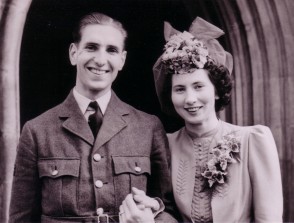
Eileen and Arthur Atkins - wedding 15-3-41, London
WW2: WAR and WORK
I was born on the 16th September 1918 and christened Eileen Alice Charlotte Jagelman. My parents were William George Jagelman and Cordelia Elsie Jagelman (née Penny).
My father was born in South London to John Jagelman and Alice (née Crockett). He was one of six boys. He excelled at school and on leaving was accepted for the Civil Service. He started as a boy clerk in the Home Office, rising to Assistant Secretary. At the time of his retirement he was Prison Commissioner in the Home Office. During his service he received the C.B.E.
My mother was born in Gravesend, Kent. Her parents were Thomas Penny, who worked in Chatham Dockyard, and Charlotte (née McLeod). My mother came to London to work and in 1917 married my father.
At the time of my birth we lived at 19 Malwood Road, Balham. I had a sister Elsie Florence born on the 25th October 1919 and a brother Kenneth William born on the 25th August 1922.
At approximately the age of four and a half years we moved to Leytonstone in East London. I attended the local council school named Kirdale and was fairly bright. At 12 years I went to Coborn School for Girls in Bow. Having started a year late for various reasons, one being time lost through ill health, I found keeping up was difficult in some subjects and began to lose interest in schooling. My one desire was to leave and work in a store. My father said if that is what you wish you are going to work in the best store in London!
I was apprenticed for three years at Debenham and Freebody in Wigmore Street, W.1. I enjoyed my time there very much as it was interesting meeting all sorts of famous and well known people.
Then in 1939 it all came to an end. War had been threatening for two or three years. In 1938 Neville Chamberlain met Hitler and came back promising peace. No one really believed it, but at least it gave us a year to make some preparation, for in 1938 we were totally unprepared.
Having been born at the end of the first World War and hearing the many stories, seeing films and knowing that it had lasted four years, we were quite frightened when on 3rd September 1939 we found we were at war with Germany. Almost immediately the sirens went. However this turned out to be a false alarm.
This was on a Sunday morning. We had just returned from a holiday in the Isle of Man and were all gathered together. Arthur's parents also being with us. Monday morning we went to work but were told to return home unless we lived near enough to walk or just a short bus ride.
However, after a week of idling, most people decided that life had to go on, despite war and so far we had not been attacked. Consequently I reported for work and life for a bit carried on as usual.
We were losing a lot of shipping and things were going badly on the continent. Finally Germany overran France, Belgium and Holland. The troops fell back to the French coast and we had to get them back to England. Every available ship was commandeered and the biggest rescue operation of all time took place. It filled us all with a great pride of country, but also we knew that we were now alone fighting the might of Germany. Quite frightening. We do not know why Hitler did not attack us at once, but thank God he didn't. Instead he declared war on Russia.
However, the daytime air-raids began and they were very frightening. We continued working and as soon as the sirens sounded we went to shelters, where we spent many hours. I remember one day we spent all day there. Damage was very heavy in some areas, certainly the docks were targeted, but the Germans were not too fussy if the bombs dropped on hospitals, churches, etc. Fortunately our RAF pilots were wonderful and gradually the daytime raids lessened.
Arthur during this time had gone into the RAF and was being trained to be a Wireless Operator. He was moved all over the country and when he came down to Wiltshire in a camp at Compton Bassett he was able to get leave. He arrived home on a Saturday in September and we were going to get engaged, the sirens went which meant all the shops closed, so we could not get out to buy the ring. Fortunately, late afternoon, the all clear sounded and we flew out of the house, caught the bus into Wembley High Road, selected the ring and got home just as the sirens went again. We were determined to celebrate and in the evening went to a dance hall just near to us and despite gunfire and plane noise, managed to enjoy ourselves.
It is now some months later that I open this book and carry on the story. I am afraid after so many years trying to think back becomes difficult and many things may be out of sequence.
Life carried on with day and night raids. We were losing ships, Rommel was winning all the battles in N. Africa - not much joy anywhere.
It was felt that Hitler might invade us, but this did not happen, then he made the fatal step of going to war with Russia which took the threat of invasion away.
My sister and I were called upon to fire watch. Elsie had returned from being evacuated with the firm she was working with. She went into the Air Ministry.
March 1941, Arthur was given leave prior to going overseas. We decided to get married before he went. It was a great rush around but it was all accomplished. Two days later Arthur left, finally ending in Iraq. He returned home three and a half years later in September 1944.
Women were being called up at this time for the forces and war work. As I was married I did not have to go in the forces. My friend Peggy Davies and myself were interviewed for a job in the Air Ministry, a section called A.I.D. (Aeronautical Inspection Department). We trained for three months at the Aeronautical College in Wimbledon. A very "condensed" engineering course! I ended up with Bush Radio at Chiswick and Peggy went to Handley Page at Cricklewood.
We lived through flying bombs, V2's and everything that Germany could throw at us. We lost friends but fortunately escaped in the family with no loss of life.
After the Japs bombed Pearl Harbour the Americans came into the war. We had stood quite alone for the period after Dunkirk which was a terrible period. However, the bravery of all the people at that period should never be forgotten. No one thought that Europe would fall so quickly to the German advance.
Gradually the tide turned and we pushed Rommel back into North Africa and then pushed on into Italy. Mussolini was defeated and we began to look forward to the prospect of peace, though still a long way to go.
Japan was busy on the Eastern front, taking Singapore and many other places. Our troops were then being sent there. My brother by this time was old enough to be called up and went into the Tank Corp; very soon he was in Burma. This was a terrible area of fighting and the cruelty of the Japanese was appalling. Prisoners suffered badly and those men on the Burma road, those that came home, were never the same again.
In Germany people were rounded up, especially Jewish people, and were herded into gas chambers. Millions died this way. How can humans treat each other this way?
Finally on 6th June 1944 we opened the second front and soldiers landed in France. It was a hard long struggle but advances were gradually made until May 1945 when Germany capitulated. Such joy for us all. We had parties in the streets, to be free at last was shattering but wonderful.
However for some the war was still going on in the East and the men were having a very hard time. They thought of themselves as the "forgotten army". Finally the Atom bomb was dropped on Hiroshima, a terrible thing, but it ended the war in August 1945.
All that terrible time was to bring peace to a world which really never wants peace. Though we in Europe have been free since for 60 years, there have been other wars going on all over the world. Peace is a dream we all want but seem unable to find.
Eileen Atkins
~~~~~~~
Reading this through, so much is left out. One should keep a diary of events as they happen.
However I hope it gives a true picture of what it was like.
© Copyright of content contributed to this Archive rests with the author. Find out how you can use this.




 Recommended story
 Story with photo