

- Contributed by
- The People's Theatre.
- People in story:
- The People's Theatre
- Location of story:
- Rye Hill, Newcastle upon Tyne
- Background to story:
- Civilian
- Article ID:
- A4086489
- Contributed on:
- 18 May 2005
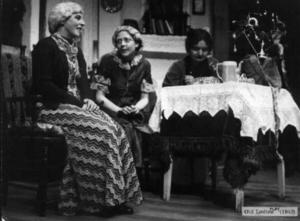
It's amazing what can be done with blackout curtains and camouflage paint. The Old Ladies, May 1943
The following is the text of an anonymous typed manuscript from the Archive of the People's Theatre. It was probably written in 1945 after VE day as the first (incomplete?) chapter of a book covering the war period.
Martin Collins
People's Theatre Archive
The management committee of the People’s Theatre which met on the evening of Saturday, September the second, 1939, must have been a small and gloomy one. An ultimatum from the British government had been delivered to Germany, to the terms of which it was not anticipated that she would accede. War was imminent, and the existence of a new weapon of offence, the bombing plane, made the circumstances of this war a matter of the grimmest conjecture.
A year before, the conflict had been postponed; outside the theatre we had bought and read eagerly the newspaper accounts of the Munich conference, by the light of the street lamps. This time, there was no thought of postponement, and the street lamps were out.
By a hastily promulgated order, all theatres, cinemas, and other places of entertainment were closed, until further notice. The People’s Theatre, existing precarious but happily on a tiny income derived from the showing of the world’s best plays, was now deprived of that source of income. A mortgage of £2,300, huge in comparison to the nett profit of twenty-six pounds four shillings and tenpence for the previous year, was the theatre’s greatest liability; in addition, there were rates, taxes, and maintenance expenses to be faced. And there was no income while the official order remained in force.
The committee had started happily enough on the theatre's programme for the approaching season. A number of excellent plays had been chosen; Alf Simpson, newly appointed. Productions Manager, had begun with all the traditional energy and zeal of the new broom. All the plays had been cast up to Christmas, and the appointed actors had received their scripts. Producers were nominated, publicity had been printed and distributed, even the income of the coming season had begun to dribble in. The first half of the season was well begun when catastrophe supervened.
It was our view of the catastrophe which the Management Committee had met to discuss, and the discussion can have had few cheering aspects. The minutes of previous meetings showed a certain perturbation at the falling-off of audiences, but this was a fairly normal state of affairs. It had, however, left us in no case to face this new menace. In all probability, the official order would not keep the theatre closed for long, but who knew? This was a new kind of war, not likely to be bounded by battle-fronts; the very haste of the government in preventing the gathering of large assemblies showed that they feared that not armies, but civilians, would sustain the brunt of casualty. Who knew? It was just possible that places of entertainment would be closed throughout the war, and steps had to be taken accordingly.
Another difficulty had also to be considered, that of manpower. Already some of the men of the theatre had been called to the forces, and a further steady drainage seemed inevitable. It has always been the practice of dramatists to have in their plays a vastly larger proportion of men than of women, a matter of anxiety to nearly every dramatic organisation under the sun; and it seemed that the new circumstances would unbearably aggravate an old trouble.
It is not on record which members of the committee met to ponder over these problems. Alf Simpson was there, and Herbert Scott, both indefatigable workers in the theatre, but the only record existing is a report composed for presentation to the Annual General Meeting of the company, which had already been arranged for September the fifth, a few days ahead.
The report was brief, and not cheerful. It commented shortly on the accounts for the previous year, and dismissed them as satisfactory. (After all, there had been a profit of twenty-six pound.) It stated the anticipated difficulties, and that it was impossible to implement the programme for the coming season. It recommended that the annual general meeting should limit itself to formal business, and further recommended that the new management committee to be elected should consist of only six members, with unlimited powers of co-option. The conservation of man-power had already begun, at least in our own small activities.
On September 5th 1939 twenty-two members only attended the annual general meeting, and this unusually small body of members accepted in toto the recommendations of their management committee. There were elected to the committee, in addition to the secretary, Wilf Taylor, and the treasurer Gladys Bowden, the following members:
Edith Bulmer, Bill Crabtree, Arthur Kay, Norman Murphy, Herbert Scott, Alf Simpson.
It was these eight stalwarts who had to negotiate the theatre through the troubled year ahead, and they called their first meeting for Friday September the fifteenth.
Four of them attended, and the proposals agreed reflected the uncertainty of the times. All theatrical activities were for the time being abandoned, and it was decided to return the money of subscribers who had already contributed to the new season. Alf Simpson suggested the possibility of performances in outlying areas, less likely to be subject to enemy action, but obviously this suggestion was not very far pursued.
It was agreed that the services of the caretaker should he dispensed with. It is surprising how often the subject of the caretaker came up at these meetings, unless one releases that he was our only paid employee.
Herbert Scott was instructed to explore the possibility of letting the property to a Government department; and this more than any other single item was an indication of the state of mind of the company. Once the theatre passe-a into the hands of the government, its chances of survival were finished for the duration of hostilities.
One note of cheerfulness was struck. To quote the minutes, “It was generally agreed that as long as the Theatre was available, we should endeavor to keep the dorm any together by any social activities that could be arranged." To this end a theatre party was arranged to take place a fortnight later.
It was not until Thursday, October the twelfth, that the committee, recovering somewhat from the shock of the declaration of war, met to discuss the possibility of a first wartime theatrical performance.
George Bernard Shaw had some time earlier completed his play, “Geneva,” and it was characteristic of a theatre which had always prided itself on its Shaw productions that this play should be chosen to inaugurate its wartime programme.
“Time and the Conways,” by J.B. Priestley, was chosen as on alternative, should the Thaw play be not available, and it was derided to attempt to establish a “guaranteed” audience for the production.
Rights were obtained to perform “Geneva”; a or at was selected, and rehearsals were to commence on October 26th; the date of the performance was fixed for Thursday November 30th 1939, and the subsequent evenings, with a matinee on Saturday afternoon, and a further performance on the Sunday if permission could be obtained for this or, alternatively, on the following Wednesday. The Publicity manager was co-opted to the Committee, and it was arranged that the caretaker, that eternal barometer of our fortunes, should be asked to return to us for three days a week.
Arrangements were made for a second production, to take place early in 1940, this to be “Time and the Conways,” and it appeared that the work of the theatre was being taken up again after that brief lapse with all the old enthusiasm.
A dash of cold water was thrown by the treasurer, who proclaimed that while she had in land the sum of ten shillings and ninepence halfpenny, the costs of the coming season were estimated at £456. This heavy estimate was partly due to money already spent on the planned programme which the declaration of war had interrupted.
Lack of money had never been a deterrent to these theatrical enthusiasts, however. An estimated cost of £40 for the production of “Geneva” was laid before the committee, and it was felt in a spirit of decent optimism that a substantial profit would almost certainly result, to be placed against the anticipated deficit at the end of the season.
The some optimism resulted in a decision to employ the caretaker for the three days before the production end for the entire week of the production. One cannot help wondering what the caretaker felt about these mercurial changes in his circumstances.
It is to be supposed that rehearsals for “Geneva” took the customary course of People’s Theatre rehearsals; an earnest band declaiming in the rehearsal room before the producer, Norman Murphy, while those not so occupied discussed theatre and current topics around the greenroom fire.
Upstairs, the stage-manager and his assistants would be working on the construction and painting of the set, while in box-office and wardrobe other problems of the production were being settled.
The only new factor, for the time being, were the blackened windows and the inky darkness without, and the beginnings of six years of transport difficulties; darkened trains, buses, and trains, depleted services, long walks home after late rehearsals.
These difficulties notwithstanding, the date appointed saw "Geneva,” a fancied page of history in three acts, by George Bernard Shaw, take the stage. Shortage of paper had not yet made itself felt and our programme wore its usual air of dignity and beauty. One thing only echoed the vast changes that bad taken place and those that were impending in the outside world. The programme note, usually a happy comment on the play, referred discreetly to our new difficulties, and asked for the same co-operation from our audiences as had been given by players and others responsible for the production.
End of part one.
© Copyright of content contributed to this Archive rests with the author. Find out how you can use this.



 Recommended story
 Story with photo