

- Contributed by
- junekc
- People in story:
- James Alexander Omer
- Location of story:
- Humber Estuary
- Background to story:
- Army
- Article ID:
- A3264888
- Contributed on:
- 12 November 2004
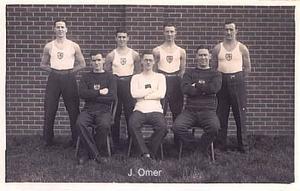
APTC Training Course for Instructors
My father, James (Jim) Alexander Omer, was born in Hull in 1914 and died in 1997.
In 1939 my father was working at Reckitt & Colman where he was a time-served electrician. He and my mother were married on 1 July 1939 and as noted in the diary he was called up on 24 August — this must have been a very traumatic and dramatic beginning to married life. (He was a member of the Territorial Army and I believe that they were the first to be called up.)
My father served in the Army Physical Training Corps from January 1940 until he was demobbed in 1945. It was hard work but I know from the manner in which he described his service life he found it a broadening and interesting experience. He had always been involved in keep fit/gymnastics and so it was fulfilling for him to be able use his interest and talent to assist the war effort.
In 1945 my father returned to his job as an electrician at Reckitt & Colman in Hull. The skills he had acquired during his time in the army did not go to waste as he ran evening PE classes at various youth clubs in the area.
Following my father’s death, my husband was sorting through a box of his papers and came across the following piece — handwritten on a single sheet of paper. We thought that it would be an interesting anecdote to add to the archive. There is a photograph attached (I don’t know which year this was taken) and my father is in the middle of the front row.
Kind regards.
June Campbell
James Alexander Omer War Diary
24th August 1939
I was called up on this day my notice being sent about 4 p.m. I was on holiday at the time. I went to the Barracks in Colonial Street and from there about 10 p.m. by bus to Kilnsea, where we stood for about 5 hrs in a violent rain and thunder storm because the driver of the rail car had forgotten us.
The next day, 25th, a party of us went by tug to Haile Sand Fort. The fort was under repair and the roof of the only habitable barrack room was open to the skies and water was flooding the whole place. I spent about 11 weeks on the fort and got wet through almost every day. We had to carry our rations from Grimsby, across the sands, which were full of pools and streams etc. We had several things happen whilst we were there. An old welder who was working on the fort went off about 10 p.m. one October night at low tide. There was no moon or light of any kind and he lost his way. About 3 a.m. he started shouting for help, we could not put the search light on him as that would have given the position of the fort away to any hostile aircraft that may have been about; so the old man was caught by the tide and drowned. We found him when it was light, his mouth and ears were full of sand. The firm sent another man to finish the job: it was the old man’s son.
I applied for a P.T. Instructor’s Course and I was sent to York on the 11th of November 1940, having previously been promoted to L/Cpl about 2 weeks beforehand. I stayed at York for 2 weeks. The course was the first War Course for Assistant Instructors (Northern Command). It was held in the Railway Gymnasium, York, which was then the largest in the U.K. I went back to Spurn Pt on the 25th November and I was recommended to go to the A.S.P.T. Aldershot for a short advance course, with a view to becoming a Sgt Instructor. (There were 4 out of 53 recommended, Sgt. Wragg, Bdrs. Backhouse and Rigg and myself: all but Sgt. Wragg became A.P.T.S. S.I.’s). I spent December on Spurn Point and saw ships mined, bombed and driven ashore through bad weather. The Danish motor ship “Canada” was mined about 2 miles off Withernsea and cases of raw rubber, dried fruit, small cases of spirits were washed up on the shore (the R.A. at Kilnsea soon snaffled the spirits). A Nazi sea plane machine gunned Bull Sand Fort, one Gnr was wounded in the thigh from a ricochet.
© Copyright of content contributed to this Archive rests with the author. Find out how you can use this.


 Recommended story
 Story with photo