

- Contributed by
- Rickoh
- People in story:
- Robert George McArthur (Sergeant)
- Location of story:
- England, Canada, Northern Ireland, Iceland.
- Background to story:
- Royal Air Force
- Article ID:
- A8946787
- Contributed on:
- 29 January 2006
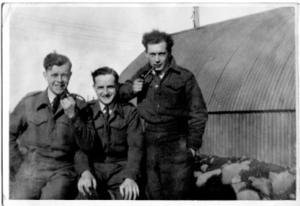
The writer smoking a pipe (to keep his nose warm).
I was posted to (I think) Number 10 I.T.W. at Scarborough and arrived there in the middle of January 1942. If it was cold in London it was arctic in Scarborough. We were billeted in Boarding Houses, which had once held happy laughing holiday makers in the summers before the war, but had now been completely stripped of anything which might have been slightly comfortable. Each bare room had two or three iron bedsteads and on each bed there were three square mattresses filled with some straw-like substance and known as "biscuits", a pillow which had solidified into an unyielding lump and four damp blankets. This was officially known as your "bedspace" and within its dreary confines your kit had to be stacked and displayed with military precision. Three of the blankets were folded into a perfect oblong; one blanket was then folded lengthwise and wrapped exactly round the other three which were then squared up and positioned exactly in the centre at the head of the bed. Across the bed, four inches from the blankets, was laid your spare towel, which, of course, had to be spotless, and on the towel was placed your gleaming mug into which you put your fork on the left, your spoon in the middle and your knife on the right. The possibilities of something being slightly wrong were endless. We knew at the end of the afternoon session of lectures when we marched at the RAF pace of 140 paces to the minute back to our boarding house billets. As we came crashing to a halt and were stood at ease, the door of the house opposite opened and out came our flight sergeant. He had a slight limp and a sardonic smile and carried a piece of paper in his hand. In a Welsh accent, which I can hear even now, he would say, "Fatigues for tonight. Spoon not in the middle, 271 McArthur; ditto fork 121 Matthews, blankets not straight 146 Smith D." And so on until he had listed enough "janker wallahs" to peel the several hundredweight of potatoes that waited for us in the cookhouse. This was one of the more pleasant "fatigues", as we had endless cups of tea if the right cook was on duty and sometimes a real fried egg. Not so lucky were those polishing the dustbins, or whitewashing the kerb stones, or emptying the day’s swill from the remains of yesterday's food.
I suppose that the fatigues, and the other mostly senseless tasks, were to instil in us the idea that any command however futile must be obeyed without question,. and that unquestioning obedience in every circumstance was part of our training. What else were we trained to do? Know a little bit about "The theory of flight"; recognise aircraft from blacked out silhouettes; learn to transmit and receive Morse code with buzzer and Aldis lamp; become acquainted with various out-of-date weaponry; understand the principles of navigation, vector triangles, and since one of our instructors was American, something related to airspeed indicators and "ventoori toobs". All these lectures were held in wooden beach huts with little or no heating and sometimes, when I walk on a beach, I can still imagine myself tramping up and down trying to march in step over the shifting and shining pebbles.
Finally, we were examined on our newly-acquired skills. Not very arduously, I'm afraid. The armament exam seemed to follow the same pattern with me as with many of my fellows. A Corporal sat at a table surrounded by bits of disassembled weaponry. You entered, stood to attention and gave your name and number. He spoke, "You don't happen to have any fags on you, do you airman". Primed in advance, I said" Yes, Corp. I've just bought a new packet". "Can you spare one? I've just run out". "Yes, of course Corporal, please take the packet". "That's very good of you. What do you think this bit here is called'?". It was, according to legend usually the same bit. "That's the rear spring retaining lever keeper, Corp". "Well that's right, and this?" " That's a Lewis gun". "O.K. you've passed!" During the aircraft recognition exam. our Pilot Officer, very new and in charge of his first flight, realised he had been teaching the wrong syllabus and passed discreetly amongst us murmuring, ever so quietly, "You know that one surely? It's a Ju 52". "Oh no! that's a Lysander" etc. etc. We all passed.
The signalling Aldis lamp exam. was held in blinding sleet on Scarborough Promenade. A corporal in an upstairs room flashed messages to us as we stood in groups of two, one facing the flashing lamp and the other with his back turned writing down the letters called out by his partner. By now, we had learned to station the more expert readers of the signals in strategic places amongst the groups. They called out the letters to their partners in slightly raised tones and by listening carefully and writing down their responses on our own pads, we were spared the agony of trying to decipher the letters on our own. We all passed.
And so to the Passing Out Parade. In our "best blue" uniforms, buttons twinkling in a wintry sun, boots ablaze and leaking like sieves, we marched along the Promenade. I think we were wearing the newly-sown propellers on our arms to signal to the world that we were now Leading Aircraftsmen. We all swung our arms to the shoulders and were all exactly in step, except for our newly-fledged Pilot Officer who, leading the parade, had got off literally on the wrong foot. The front row of our flight, however, by much diligent whispering and guttural, "Change step sir", just managed to straighten him out by the time we marched past, I think, Wing Commander Critchley who was taking the salute. It seemed somehow appropriate that his muttered corrections in our exam and our sibilant whispers had saved both our bacons. And so our Initial Training ended. I cannot remember being instructed at any time on the controls of an aircraft. I dimly remember being shown the outside of a Link Flying Trainer which simulated all types of flying and being allowed to look at the cockpit controls but there the experience ended. We were to be posted to Elementary Plying Training School without flying so much as a paper aeroplane!
© Copyright of content contributed to this Archive rests with the author. Find out how you can use this.


 Recommended story
 Story with photo