

- Contributed by
- Julie Howarth
- People in story:
- Philip Howarth
- Location of story:
- Italy
- Background to story:
- Army
- Article ID:
- A8944086
- Contributed on:
- 29 January 2006
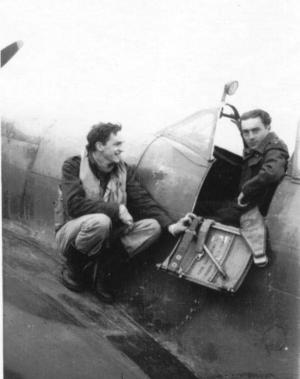
Capt Philip H Howarth RE (right) with his cousin, Officer Pilot John Howarth RCAF, Italy 1944.
This is the second of four sections of an account written my father Philip Hamer Howarth. It follows on from his experiences in the Middle East and Tobruk (A8943681) to his time in Italy with the King George V's Own Bengal Sappers and Miners. He wrote it several years before he died in March 2005.
After more than two years with the King’s Own Royal Regiment I left the 2nd battalion in late September 1942, having just completed 7 months of intense jungle warfare training in Ceylon. I made my way south by train to OCTU, Bangalore for officer’s training and was commissioned in May 1943. During this period I met my wife-to-be, Wilma, whose family lived in Bangalore. On heading north to join the Bengal Sappers and Miners who were based in Rhoorkee, I managed to meet up with her again at the School in the hills where she taught. We became engaged.
Around the end of October 1943 I was posted to Egypt to HQRE 4th Indian Division and became Field Engineer to the CRE. In December shortly after arriving in Italy I was reposted to 8th Indian Division and joined 7 Field Company.
7 Field Company spent a dreary winter of road and track maintenance in support of 17 Brigade on the front North of Lanciano and the Moro river in Abruzzo. It came as a welcome change when in March we were pulled back South of Lanciano to do bridging training. This was the first step in our move towards the River Rapido at Cassino on the other side of Italy, and as part of this process I attended one of the early Bailey Bridging courses at the newly opened International School of Military Engineering at Capua.
When the company convoy threaded its way west from the Adriatic to what we had come to regard as the 5th Army side of Italy, it was curious that we seemed to leave winter behind us on the other side of the mountains and arrive in the vicinity of Naples in the spring. En route we were interested to observe the good smoky display put on by Mt Vesuvius which had been acting up in sympathy with local war activity.
It was during this period that I had the remarkable good fortune to be able to meet up with my first cousin John Howarth, a fighter pilot in the Canadian Royal Air force. We had learned of each other being in Italy in letters from our folks back home. I learned that John was flying from an airstrip at the mouth of the Volturno river just north of Naples and given a day clear of work, with careful map reading and about a day’s drive, I managed to locate his base. When I arrived he wasn’t there; I found out from his HQ that he was on a mission in Northern Italy and later witnessed him fly in. We had much to talk about and I experienced a taste of what it was like to sit in the cockpit of a Spitfire (photo). John had been born and brought up in Canada and this was the first time that we had met since the early 1920’s when we were both toddlers in Canada. My parents returned to England after experiencing a few very tough years farming on the prairies. Years later John revealed to me that he was glad to be flying his Spitfire in contrast to the job of 7 Field Company which was far too dangerous for his liking!
By several stages 7 Field Coy moved forward towards the Cassino front until we were camped in the region of Mignano some fifteen kilometres back from the River Rapido which at that time and for some months past marked the front South of Route 6 and Cassino where the Germans had been well established since the winter.
We were in tented camp, dug in for protection and I recall that by this time the early summer had arrived and the days were very hot. This presented something of a problem because we were working nights and trying to get our rest and sleep during the hottest hours. Aware of the forthcoming Allied offensive we knew that our Divisional role was to cross the Rapido and punch through the German defences to the West of Cassino and Route 6. 17 Brigade had been given the sector opposite the village of San Angelo strongly held by the enemy and a prime objective.
Divisional Engineers' role in the days leading up to the offensive was that of establishing routes in the forward areas leading to the river, mine clearing and marking, moving up folding boats and engineer supplies and hiding and camouflaging them within easy reach of the river. This work could only be done at night because the whole area was dominated by the ruined monastery of Monte Cassino so life took on the rather unreal atmosphere experienced by temporary night-shift workers. We had an expressway to work, almost from our camp to the rear of the forward area, for the 5th Army by lifting the rails had turned the Naples-Rome railway track into a direct road forward. Our routine was to drive this route each night about 10 o'clock then proceeding on foot to our appointed tasks, work until shortly before dawn by which time we had to be out of sight of the German OP's.
Although it was not unknown for German patrols to cross into our area these night-shifts were for the most part fairly quiet and uneventful apart from the Germans' nasty habit of periodically tearing the night apart with a salvo of banshee wailing nebelwerfers. The weather being hot the evenings were warm, humid and still which brought out the glow worms and seemed to suit the many nightingales which didn't seem too disturbed by the occasional artillery duel, but their bird song seemed rather creepy in these areas which still smelled of death from earlier fighting.
One day forfeiting the opportunity of rest, 'Dickie' Richards and I jeeped forward along Route 6 until we were able to swing off to the Eastern reverse slopes of Monte Trocchio which we proceeded to climb. Along the top ridge were a series of well dug in Observation Posts from which we got a view of the Liri valley and an astonishing close view of Monte Cassino with the feeling that the Germans were watching and aware that we were peering at them. It was clear from the scars near the summit of Monte Trocchio that our shells did not always clear the hill. Somewhat disconcerting to be on the receiving end from our own as well as theirs!
The next section of my Dad’s story (A8944356) details the attempts by 7th Field Company IE, to cross the River Rapido as part of Operation 'HONKER' the offensive to take Cassino.
© Copyright of content contributed to this Archive rests with the author. Find out how you can use this.


 Recommended story
 Story with photo