

- Contributed by
- John Constant
- Background to story:
- Army
- Article ID:
- A6951486
- Contributed on:
- 14 November 2005
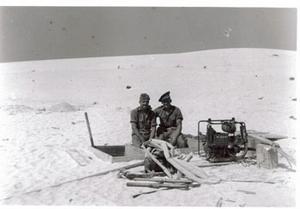
Buq buq Water-point
Resurgence
Meanwhile, the Brigadier’s driver from Matrouh had driven me, sound asleep in our commandeered truck, all the way to Cairo for a few hours blessed sleep in Shepherd’s Hotel, before I was woken by a staff officer bringing me a clean uniform to wear, and I found that it was already breakfast-time on 10th April. I was told that I was to be interviewed at GHQ., tired as I was. That was not surprising really, as it was just about 48 hours since John and I had escaped from our brief experience as Prisoners-of-War of the Germans at Mekilih. I had covered some 700 miles, half of it over rocky desert and the other half over the badly worn desert road. Bathed and shaved, in the new uniform, I reported to Colonel Wintle of GHQ Technical Intelligence staff, to whom I handed the rifle, equipment, boots, water-bottle and the 20-litre water-can; all taken from the German soldier we had captured. His assistant, Major Fuller made a written record of my verbal statement.
Then, I saw Major General "Daddy" Hughes, the Engineer-in-Chief of the Middle East, to describe all the major engineering aspects of what had happened. Still ignorant, myself, that so many of our detachments had safely reached Tobrouk, I was much encouraged when he accepted my proposal that John Bond and any other members of our units, who might have turned up there, should be evacuated as soon as possible with their specialist equipment. I suggested that we could then gather any others, who might be in hospital or on courses, in order to reform and re-equip the two units, with reinforcements as necessary, and return to the desert as soon as possible. The Engineer-in-Chief was calm and helpful, giving me strength for my other interviews, and telling me to take 2 days rest before I began the agreed task of re-forming the 7th Armoured Division Engineers.
It was not until years later that I became fully aware of just what a bad week that had been for General Wavell, the Commander-in-Chief Churchill had ordered him to defend both Greece and Yugo-Slavia, which had just been attacked by the Germans, and had sent Anthony Eden to Cairo as his personal representative, accompanied by Sir John Dill, the Chief of the Imperial General Staff. Salonika in Greece had fallen, and there was a resurgence of Italian activity in Abyssinia.. Then, Wavell heard that General Neame, his Commander in the Desert, had been captured by the Germans, and our disaster at Mekilih in Libya had occurred. Wavell flew to Tobrouk to impress on its Australian Commander that it was to be held as a fortress, resisting the enemy at all costs; however, on the way back from there to Cairo, the aircraft made a forced landing in a dangerous area near Gambut, and Wavell had had to spend the night without sleep, about the same time as I had been driven from Matrouh to Cairo.
That was the background, when I was reporting the next day, 11th April, to Brigadier Shearer, the head of Intelligence at GHQ; he interviewed me and was most helpful; amazingly so, as I later learnt that he had just heard of three additional serious problems: Tobrouk had been cut off completely by land, the main British defences in Greece had been breached, and orders had been received to relieve Rashid Ali’s local attack on RAF Habbaniya in Iraq. Afterwards, I also made a detailed statement about the "going" on those parts of the Libyan desert we had traversed. I was delighted to hear that my request had been accepted for our units to be evacuated by sea from Tobrouk, " taking such equipment as was possible". Needless to say, they themselves were even more pleased, when they were informed of their impending sea-voyage, as the enemy had occupied Bardiya the same day, cutting the road Eastward from Tobrouk.. During the next few weeks, I was granted the temporary appointment of OC 4th Field Squadron, and the Acting Rank of Major.
I was pleased that John Bond and Basil Terrell were each to be promoted to Temporary Captain, and that I could grant a commission to Sergeant Major Cumper, on his return from Tobrouk. I was also acting, in effect, as CRE 7th Armoured Division; and met the Div HQ staff. Enjoying the delights of Cairo for a few days, especially using the swimming-pool of the Gezira Club as an Honorary Member, I was also able to re-equip myself with new uniform, as well as going round the Base Hospitals to visit those of our men, who were patients in them. I took the welcome opportunity of improving the shining hour by visiting some of the watering holes of Cairo; one of those was the bar of the Metropolitan Hotel, where I was amazed to see three United States Army officers in uniform; that country was neutral and I had heard nothing about any such cooperation. In spite of their neutrality, they told me that the President of the United States had authorized the shipment of a hundred or more light tanks, and they were expected very soon, in order to be evaluated in desert operations by our experienced armoured regiments.
These officers had just arrived in Egypt and, with GHQ in disarray for the moment, they had not been given a reception, so they had no idea to whom they should report. Fortunately, I was able to use my newly established contacts in GHQ to obtain immediate introductions for them, and how important they turned out to be. When I asked whether this item of equipment had a distinctive name, I was told they called them "Honeys", in preference to their official title of Stuart Tanks. The three were a LieutColonel Piburn of the Tanks, an armoured Cavalry Major and an Engineer Captain "Herb" Ehrgott. They were very friendly and appreciative of my help, and that was how I began my great respect for US equipment, which continued throughout the war and thereafter.
Meanwhile, prompted by General Hughes, I was using my memory (for lack of other notes), to write a report on the operations we had undertaken in Cyrenaica, and I drew a number of conclusions, to which I added some strong recommendations. It was complete by 20th April, when I handed it to Brigadier Kisch, now appointed Chief Engineer Western Desert, with copies to the Engineer-in-Chief, and to Colonel Lloyd representing 2nd Armoured Division ! (Twenty years later, when I had become Chief Engineer Middle East in the humbler peace-time rank of Colonel, I happened to see that report again, and with some flattering comments written on it by several very senior officers).
On 21st April the survivors of the Squadron were evacuated by ship from Tobrouk, but their vehicles had to be left there, with some of their equipment, but the Australian Fortress Commander refused to let the Field Park go. Two days later, I received orders for one Field Troop to be ready for operations in the desert by 1st May, if necessary using reinforcements from the RE Base Depot at Moascar. Vehicles and equipment were to be found by our Division, and the remainder of the Squadron was to be made up to strength later. Still equipped with one vehicle only, the truck we had seized at Mekilih, but now properly maintained and clean, I moved to a camp at the Depot at Ismailiya on the Suez Canal, in time for the Squadron’s arrival on 24th April, as their voyage by ship from Tobrouk was followed by the rail journey from Alexandria.
Only 2 days later, finally released from Tobrouk with the remains of the Field Park, Captain Terrell, arriving in Cairo, reported to HQ 7th Armoured Division, and to the Engineer-in-Chief, as well as giving a report to Major Cracroft, representing 2nd Armoured Division, with a copy to Brigadier Kisch. Later that day, he and the rest of the Field Park joined us again. We celebrated, albeit briefly, that the whole of what was left of the Seventh Armoured Division Engineers was together again, and indeed on exactly the first anniversary of our original "birth". We remembered all the vicissitudes we had endured, and the sad loss of so many splendid men of all ranks, especially our unit commander, Lieut Colonel Alan Mitchell, the CRE, who would, I’m sure, have risen during the War to great heights, as he was so convincingly professional, both as a Commander and as a General Staff Officer.
Mourning our casualties, both killed and wounded, we enjoyed only 2 days together; then, on 29th April, Captain Bond reported to the much respected Brigadier Gatehouse, the Commander of 4th Armoured Brigade (a veteran of Cambrai, the very first ever battle using tanks). John had gone as advance party for his Troop which, by the next day, we had made up to its war establishment in men, and in most equipment, though not quite in vehicles. In spite of those casualties and the many disappointments in the desert, all ranks shared a feeling that our one year of existence had not been in vain. Both the Squadron and the Field Park had carried out their duties, in training and in operations, with a degree of honour, and all ranks had emerged resilient and more experienced.
It was interesting to see the majority of our men growing in self-assurance, learning the most effective way of getting things done, moving and living independently when necessary, confident of their ability to out-wit the Germans, but without suffering from undue pride; they seldom boasted, and they cherished a sense of humour, often regional. The resourceful leadership of the commissioned, warrant and non-commissioned officers, had been matched by the skill and determination of our Sappers. Although grossly under-equipped compared to our German enemies, we felt that each of our detachments had beaten them face to face in every individual engagement, and we were sure that we would do so again, however long the war might last.
Afterwards.
We were delighted to hear that 2 more had later escaped from German captivity; Captains Peter Moore and Bill Loring, Second-in-Command of the Squadron and OC of the Field Park respectively, had been taken with the rest of us at Mekilih, and had remained as Prisoners for some days before escaping near Dernah. They had then had the fortitude to walk, night after night and almost starving, along the coast some 140 miles to Tobrouk. Eventually, they were successful in penetrating the German troops besieging the Fortress, and were evacuated thence to Egypt.. Sadly Loring was killed later that summer, but Moore survived and later commanded 3rd Field Squadron, himself inventing the Eighth Army Minefield Gapping drill, which succeeded at Alamein and became accepted worldwide. After WW2 and Korea, Peter Moore became the most highly decorated officer in the Corps, with 2 MCs and 3 DSOs, commanding the Commonwealth Infantry Brigade Brigade in Malaya.
Soon, we had reinforcements and an improved scale of equipment, more suited to the extended warfare of the desert, and we passed a few days in camp, first at Mena near Cairo, and then at Amiriya, near Alexandria,. By then the evacuation of the troops from Crete was underway, and I visited the Navy in Alexandria Harbour, to witness the arrival of one of the last warships bringing the troops back. In spite of having been badly bombed, with the fore-deck all distorted, the ship came alongside covered in tired soldiers and, to my delight, I was able to greet Warrant Officer Loutit, my previous Chief Clerk, who had left us for Crete only 3 months before. At last, up to strength in men and equipment, as well as vehicles, we had a new Squadron Commander; the effervescent Gerry Duke, whom I had last seen in Dabah, before he went to Greece. In the face of the German assault there, he had been one of the very last to leave, and had escaped in a caique, which he sailed safely to Crete .
Then, we were also delighted to welcome LieutColonel "Punch" Clauson back, this time as CRE and he remained for over a year; calm and efficient, popular with all ranks and, also, with the officers of other arms in the Division. Only once did I ever see him angry, when he had just been reproved by a very senior General from India -- our new Army Commander (!), no less -- for not wearing a solar-topee, an object very rarely seen in the Desert. Ready for operations in good time, we deployed with the remainder of the 7th Armoured Division to the South West of Matruh, in order to attack the Germans in Operation "Battleaxe" on 15th June.
I had reverted to my appointment as Adjutant, although I often found myself given operational tasks in unusual ways; one of these was taking a truck full of mines and explosives into the battles, where the likelihood of our tanks breaking down and later being captured by the enemy was avoided, if possible, by the recovery-transporters hovering close-by. When they found a tank incapable of being removed, as many were, my duty was to blow it up; however, they did not give up until the "last moment", leaving me with only minutes to do the job. Sad as it felt, destroying each valuable tank when the situation demanded it, I developed an almost instantaneous technique, and had just completed one more of several "executions" that afternoon, when my truck was suddenly strafed by a Messersmidt 110. An incendiary bullet must have set my bedding alight, and that fire soon got to the explosives, which went off like fireworks, and on to the mines; as each was detonated with a loud bang. Inevitably, this drew undesirable attention to my driver and myself, standing there stranded as we were in a lonely piece of desert, but fearing the arrival of one of the pushy German 8-whl armoured cars. Fortunately, it was one of the excellent South African Armoured Car Regt, which picked us up, but I felt quite sentimental about the smouldering wreck of our burnt-out truck, as it was still the same one in which John Bond and I had escaped from Mekilih.
For the rest of 1941, the Squadron went from strength to strength; Gerry Duke was popular and efficient, operating the Squadron all over the Western Desert of Egypt, both in support of the armour and of the "Jock Columns", as well as some deep penetration tasks, preparing Emergency Landing strips for the RAF well behind the enemy. The Jock Columns were mobile groups, combining a Company of motorized infantry and a troop of 25-pounder guns, with a Section of Sappers for mine-laying/clearing; the latter were usually provided with a compressor-truck and explosives, so that they could assist the gunners digging their gun-pits into the rocky terrain. At any time, there were usually 3 or 4 of our Jock Columns harassing the enemy, and life in them was both hard and dangerous. In July I was allowed to invite my new United States acquaintance, Captain Ehrgott, to spend a few days in the Western Desert with me; the Division was very much in contact with the enemy, and he wanted to observe our engineer operations. Since the USA was still neutral, our General gave me instructions not to let him become involved with the enemy, as it would create an international incident.
In August 1941, the Commonwealth forces in the Western Desert of Egypt were re-structured as "The Eighth Army" with many reinforcements and new equipment, including the first of the splendid American-built tanks, we all knew as "honeys". The Field Park was enlarged to a Squadron and I was promoted to Major again, to command it, in good time for Operation "Crusader". Operating more like a Field Squadron, and frequently further West into Cyrenaica than any other unit of Eighth Army, we were really able to exploit the desert-worthiness of our Sappers, as part of the Allied effort to defeat the Germans for the first time of the whole war, when Tobrouk was relieved in December 1941, and the remnants of Rommel’s "Afrika Korps" were driven out of Cyrenaica for a while. Simultaneously, we were amazed to hear that the Japs had brought the USA into the war, but the result for us was a fatal reduction in our desert forces, many being sent to the Far East.
Soon afterwards, John Bond, who had escaped with me from the Germans at Mekilih in April, was tragically killed there, when he was leading a mine-clearing operation. That was on the very same day as I had had a very close "shave", neutralizing a new type of Italian anti-tank mine, when each of the others in that minefield had exploded, as they had all been booby-trapped. There followed many more vicissitudes but, nevertheless, the Division did triumph again in the winter of 1942, "knocking them for six out of Africa" in Monty’s words.
Fighting up Italy, and from Normandy to Berlin, 7th Armoured was always there and, with it, went the Squadron and the Field Park, reinforced later by an additional Field Squadron. After the war, the 143 was given a new number (not 43 as might have been expected), but the 4th has continued, now Armoured I believe, as we should have been all along.
© Copyright of content contributed to this Archive rests with the author. Find out how you can use this.


 Recommended story
 Story with photo