

- Contributed by
- kindlyladylinda
- People in story:
- David Thomas Wright,
- Location of story:
- France-Caen Belgium
- Background to story:
- Army
- Article ID:
- A8998285
- Contributed on:
- 30 January 2006
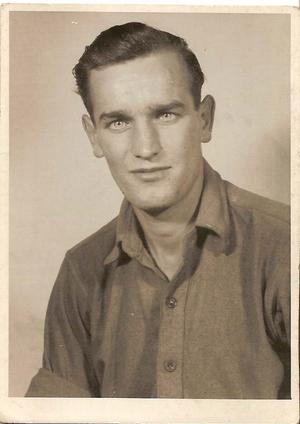
David Wright in Dusseldorf in the Div School, 1946
My Army Number: 147 23364
Call-up, Training and Embarkation.
When I reached the age of 18 in April’44, I received my call-up papers. At the time, I worked for Singer in Coventry as a radial driller, a capstan operator and a miller, making parts for army vehicles. I went to see my manager who told me I was needed there for a while longer yet, so my entry into the army was deferred for six months. It was a good job too, otherwise I’d have been in the first wave of troops in France on 6th of June 1944, and I wouldn’t have been here today. That extra 6 months I believe saved my life.
My 2nd call-up papers arrived when I was 18 and a half, off I went to Budbrook Barracks near Warwick.
On the way there I had a lot to drink, and had my last drink in Warwick. Everyone in uniform when we ourselves were in civilian clothes, made the war seem more real to us now. We received our uniform, pay book, and injections the next day, as well as our rifle.
I had previously been in the Home Guard, so this put me in good stead for the forces, I could do drill, handle a rifle, get dressed correctly in uniform and shoot. We had to help new soldiers who’d never known any of this. Hard training started before long, doing P.T in vest, shorts and pumps. We did gym and learned to climb ropes. At night we had cocoa — which was like cold sludge. We had to be washed, shaved and in uniform before breakfast time. For breakfast we ate anything from toast, bacon and baked beans or porridge, which was like mud, but it went down well. After 6 weeks of training we were all very fit men.
After 6 weeks of training, we had 36 hours leave, we had to be back in barracks on Sunday night. On Monday morning we were on parade and were given orders where we would be moving to and which would be our new regiment.
I was moved to the Lancashire Fusiliers at Berwick on Tweed, on the Borders. It was very cold; we stayed there for 6 weeks. The war in France had started on June 6th. Officers told us we were to be part of the occupation forces, involved in Operation Overlord. After a further 6 weeks, we went to Holt in Norfolk for another 2 weeks’ intensive training. This included how to carry all our equipment, everything we needed for manoeuvres, we learnt how to march and how to make our own meals. After we had 2 weeks embarkations leave. Following that we went back to our unit where we were told to go and wait for orders to go overseas.
We travelled to Southampton. There we were directed into tents with thousands of others for embarkation which didn’t take long, and then we were away to France. We didn’t know where we were going to land. We were on the way for some days and were all sea sick and in a bit of a mess. We landed in France, I don’t know where exactly, where we marched for miles and miles and miles. I remember being very hungry.
Caen.
We finally ended up in a R.H.U. camp awaiting further orders. We were in the Lancashire Fusiliers in Caen. There had been a great battle there where many soldiers had been killed. We went to a large camp. Thousands of soldiers were there for a week. Then we received our orders, some of us were transferred to the Welsh regiment, which was doing battle in Belgium. We soon joined them there. One night there was a big artillery barrage going on, not at all pleasant, when we scrambled for shelter. Next morning we were given our companies and platoons which we joined. A lot of the time I couldn’t understand the welsh accent. We had men from North and South Wales whose accents were different. We soon all had a taste of war. Every day was another battle.
Very soon I found I wasn’t only fighting for my country, I was fighting to stay alive. It was a matter of “keep your head down and you’ll live for tomorrow.” The war progressed, then we were given a rest. The R.A.F. used to fly over with their spotter planes, take photos for H.Q so they would know where our enemies were, then the battle started an hour or 2 of artillery barrage. The R.A.F went in and gave them a few shocks with bombs with rocket — firing typhoons, then put in an attack, artillery 1st, called carpet barrage, give them a few shocks with “creeper” bombs. Sometimes shells used to fall short and frighten the life out of us, but still we had to go on. We used to take a different place each day and lose so many men. We went on and on to Belgium and then Holland. There was a big place in Holland called Hertogenbosch, which we took. The Duke of Edinburgh was given the Honour of the city a while ago.
Hertogenbosch.
We were in Hertogenbosch for 5 days. I believe we took a factory. There was a Dutch family in it where I remember a lady gave birth to a baby there. It was the medics from our regiment who delivered the baby. They named the baby after the Welsh regiment, but I can’t now remember the name.
Nijmegen and the Ardennes.
We went towards the Battle of Nijmegen, but we didn’t know much about it at that time. We took a village and a farm. On this farm were a couple of banty cocks and a goose. I was determined to have that goose and my idea was, when we were to go back for a rest I’d give it to the 1st lady in charge wherever we would be, and we’d have it for our dinner! It took us half a day to catch this goose, what a wrestling match that was! I had to chop its head off. He was a big devil, a beast. Then the 3-tonners came to take us back to Brussels for a rest. We weren’t there long. After Brussels the Americans had let Rommel and his armies through into Belgium into the Ardennes. It was at Christmas time, all in the snow, so we had to go to the Ardennes and stop Rommels’s little game, so we never did have a Christmas and we never ate that goose after all! It was left with a family in Dingden in Belgium. In Dingden the policeman’s home had a lot of cells in it for prisoners, so there was plenty of room where we soldiers could sleep. From then on it was up to the Ardennes and it was a mess. Before we left the Ardennes we had to destroy a village. We were on top of a mountain, the village was down below, and we had the tanks with us and the artillery. I was on a Bren gun. We kept firing and firing and firing, but I don’t think there was any of the enemy there, they had all fled by this time, but we destroyed the village anyway, it was a crying shame, we had destroyed such a picturesque village. There was no choice, it was an army order. Then we went back again for a rest. 6 Airborne Division came and took over, they all wore white uniforms. We called them “The Snowdrops”. We were in khaki, they were in white. But they didn’t have any fighting to do. The fighting was all over. The enemy had been driven back, and we’d taken back the American position. The poor Americans! When we went up to their positions there were Americans lying dead everywhere, the ones there had really put up a good fight. They had sent that many troops, as we did, back to Brussels on leave for Christmas and of course Runsted knew this and he took all the U.S. tanks and equipment and used it on us, but they didn’t win. In the end they were pushed back.
© Copyright of content contributed to this Archive rests with the author. Find out how you can use this.


 Recommended story
 Story with photo