

- Contributed by
- John Constant
- Background to story:
- Army
- Article ID:
- A6951585
- Contributed on:
- 14 November 2005
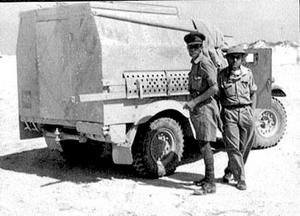
SSM Cumper & US Capt.
Conclusion
To avoid these notes being too egocentric and, in order to place them in a wider context, may I make an extract from Barrie Pitt’s excellent book about the Western Desert in 1941, which states:- "Throughout this period the desert troops were living in conditions of acute discomfort. In the winter months, although in the daytime some warmth was engendered by action and the bright but often watery sun, the nights were bitterly cold and rain often fell, so that during the brief spell of half-light in which every day’s "stand-to" took place, the desert was spotted with clumps of bone-chilled, unshaven, unwashed men groping clumsily for their weapons, for their water-bottles, for any remnant of their rations which they had saved, and for their boots if they had cared to take them off before they had fallen asleep.
If their days had not been riven by battle, pain, fear and the death of comrades, then they had been spent either in dry, dusty, flea-bitten and scorpion-ridden boredom, or in equally dusty and much more thirst-making hard labour at the wheel of a lorry, at the shaft of a spade or pick-axe, or confined within the shaking, reeling, jolting box of some vehicle or other, as it swayed across the lunar landscape with such inconsequential and unpredictable jumps and drops that it was necessary to cling fast all the time to some comparative fixture in order to avoid not only painful knocks, but the ever present risk of broken bones.
Thirst, fleas, grit, sweat-caked clothing, cuts, bruises and desert sores, sanitation at its most rudimentary; this was life in the desert for these men. The only comfort, even for those whose sense of privacy and individuality was the most developed, was the propinquity of lives circumscribed by the back of a lorry or by the group of weapon-pits; the aridity of life drove men in upon themselves, limiting their horizons to the world of their troop or even just their section; and if memories now recall the comradeship and the flashes of excitement and occasional triumphs, they forget the fear, the cold, the aching guts, the dreadful sights, the stench, the disgust."
And, of course, these conditions were repeated the following year. If summer was better in some ways, it was worse in others. However, within the ranks, there was little real complaint and, if we needed a laugh, we could always think of our enemies’ misery, just within sight of us, suffering similarly but probably worse.
FINALE
With 65 years hindsight, one must wonder whether Mekilih really was such a disaster !
Was Churchill right strategically to have denuded the Western Desert Force, in order to bolster Greece sufficiently to deter Hitler from going through Turkey to link with Rashid Ali and the Iraq oilfields ?
Was Churchill right tactically to sacrifice HQ 2nd Armoured Division at Mekilih, in the hope of that little prize having delayed Rommel sufficiently to give the robust Australian 9th Division time to fortify Tobruk effectively, and thereby to preclude the Germans taking the Suez Canal and the route to India ?
J C
PS.
I can send half-a-dozen photographs, if you would like them.
© Copyright of content contributed to this Archive rests with the author. Find out how you can use this.


 Recommended story
 Story with photo