

- Contributed by
- marchback
- People in story:
- James Badcock
- Location of story:
- Germany
- Background to story:
- Royal Air Force
- Article ID:
- A4520684
- Contributed on:
- 22 July 2005
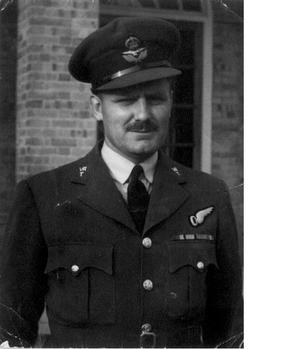
James Badcock
James Badcock — RAF Navigator 150 Squadron Bomber Command
Jim was shot down over the North Sea on 25th July 1942 and subsequently became a prisoner of war at Stalag VIIIB in Upper Silesia. The following is an extract from a collection of stories written by him which are now lodged with the Imperial War Museum Archive.
Chapter One
From time immemorial history has recorded epic marches. The Israelites fleeing from Egypt, Hannibal over the Alps, Napoleon to the gates of Moscow.
On 23 January 1945, at Stalag 344, 3000 odd British POW, with 2 hour's prior notice, began another epic, aided by the bayonets and the rifle butts of the German army. Without proper kit and with little food and in the intense cold of the Silesian winter we were forced out - away from the advancing Russians.
There were three columns of about 1200 men each accompanied by guards who were in a sheer panic. Quo vadimus? Nobody knew. The first couple of days set the pattern. We hadn't learned the drill yet and felt awful. We were pushed on and on, with little rest. When we did rest we just flopped down in the snow and then, when we resumed, suffered untold agonies from our aching limbs which had got set in the cold, whilst we rested.
Further food supplies already were meagre and water was non-existent. We sucked snow to refresh ourselves.
Naturally our casualties in the first days were high, from torn muscles - muscles we did not know we had - rifle butts etc. Sleeping accommodation was primitive. We were herded into small barns like cattle. It was quite impossible to lie down and if you could wash you were fortunate. Attending to the wants of nature was a work of art. The Germans, however, are not fussy and the roadside was our latrine.
After two days of torture about a hundred of us were ordered to fall out at a village called Prieborn. We were sent to a State farm and thought our troubles were over. We got a little food and managed to buy six very sorry-looking sheep for a few bars of English soap - manna from heaven to the Germans. Two of the sheep were slaughtered and made a wonderful stew for us.
On Sunday 29 January our dream was shattered. In marched the German Feldtjager and caught us with the rest of the sheep. They were going to shoot us for looting - until we produced a receipt for the soap, so they shot the vendor instead. They pushed us on the road again to the nearby town of Strehlin. We heard the guns for the first time.
We were housed, 10 to a cell, in the Young Offenders Gaol. Our gaoler was himself doing 3 years for a military offence and couldn’t have cared less. We stripped the gaol of movable fittings to stoke up the central heating and a party was sent to the local bakery to bake our own bread. Incidentally, we released a Pole, who was facing a murder charge. He was provided with a British uniform and left with the main column the next day. The town was in a state of panic. Evacuation was in progress - the Russians were coming.
The next day 120 of the lads who were sick were sent on by 'special' train. I was placed in charge of them. The train consisted of two open coal trucks and a metal, covered, wagon. It was snowing hard and the worst cases were put in the covered wagon which was then locked. It must have been awful inside. Nobody had a clue where we were going - least of all the guards.
It was bitterly cold in the open wagons but the first night was enlivened by a passing ammunition train which was on fire - and for some time we were in great peril from stray bullets. The journey went on for five weary nights and days, along little used tracks apparently leading nowhere. We felt thoroughly miserable. We got very little food, had no washing facilities or toilets. The guards were vicious and, of course, the lads themselves, were all sick men.
We spent the fourth day of the journey in the siding of a little wayside station. We got a little food, stole a little more, established a local Black Market and turned back two Luftwaffe bods who were supposed to be joining a unit in the east. They told us that prisoners were on the march everywhere.
That night we arrived at a busy junction near Gerlitz. After a bitter argument we were allowed to send a party to the local food depot. As we crossed the station I was accosted by two fat German fraus who demanded to know which was the next train to the West. I explained I was a Kriegsgefangennen but that didn’t worry them - they just wanted to get away. On the way back we came across a railwaymens' canteen. Two of us ventured inside and I managed to buy a couple of bottles of beer -no questions asked.
The next day we got to Gorlitz and rejoined the main party. Conditions were indescribable. In POW barracks designed for 140 men were crammed over 400. Of course, the barracks were filthy and food was scarce. A few of us were befriended by some Americans, newly captured in the Ardennes, and to them we owed a lot.
After five days of the utmost squalor we were on the road again. It was now 10 February. Hopes were higher, we were getting nearer home.
The pressure was now really on and by the 12th we had covered 58kms to Bautzen. Food, of course, was scarce and barns provided the nightly shelter. At Bautzen we got some hot food and even managed a decent wash - a luxury indeed.
On 13 February we had our worst day so far. We were forced along at a fast pace all day. There were very few rests and the Germans wouldn’t allow us any water. We were paraded through several villages and small towns to the delight of the locals. We looked pretty grim - unshaven and with our clothes all creased and dusty from the straw we slept in - we felt worse - it was most degrading.
We lost several stragglers by the wayside. The rest of us were not allowed to help them. Some got a ride on a cart which was with the column. That was alright until the cart was full then those who had recovered had to get off to make room for newcomers. Some just didn't get picked up. It was so tough that six of the German guards dropped out also. After 40, killing, kms we arrived at the barracks at Kaumenz. We got a little soup but there wasn’t room for all of us and so 400 had to march back to the town - another 3kms. The sirens wailed - the RAF were on their way. The guards panicked and marched close together at the head of the column - the POW were left to it.
We were taken to a magnificent church and, as we counted the lads, the bombing started on a nearby town. In their haste to get inside the Jerry failed to notice that we had lost about half of the party on the way down. The church was being used as an electrical stores. I went outside and laid down by a tombstone to watch the raid. I had never seen anything like it. There was one incessant roar as the bombs went down. The target was, I believe, Dresden. All I prayed was that one of the lads wouldn’t get off course and jettison over Kaumenz. The ground shook continuously this was some raid! Inside the church the guards were nervy and our boys were restless. In the morning a fight started in the main aisle. We quickly sorted the contestants out and off we went again. It was funny, as we marched back to the barracks to see our missing chaps appearing from shelters and joining the rear of the column. They had spent the night in air raid shelters, with the German civilians.
We pressed on for another 18kms but were held up for two hours by another raid. The Germans would not move when an Alert was on. We slept in tents and it poured with rain. All the food we get was 4 pieces of Knackerbrot (like Ryvita). On we went the next day for a further 24kms. There was a mad scramble for somewhere to sleep. It was very difficult to keep the columns in any sort of order. By Saturday we had reached the village of Nomartz, having gone 8 days without any butter or fats of any description.
Things were getting worse. A German officer had his rations stolen and there was a terrible scene - but how can one stop starving men from stealing food? The guards had fired at a chap who tried to get a turnip out of a wayside clamp. Our kit was a great problem. We needed it but it was a tough burden to carry.
We had a day's rest at a small farm but only got a little soup to eat. We saw a Polish maidservant beaten by the farmer because she gave us some water. It made us sick.
During the next week we covered another 142kms. We were in very bad shape by now the weather was awful, the sleeping conditions a disgrace, we could not wash, our clothes were filthy and, through lack of food, we were all getting very weak. On 20 February we got three days rations, amounting to 70% of a loaf and 33% of a small tin of meat.
We were back in the war alright. Air raids delayed us each day and everywhere we met refugees. We passed through many small towns, which had been bombed, and looked far worse than Bethnal Green. In one such town bricks were thrown at the column. They were aimed at the Palestinians, but we all had to duck.
The numbers dropping out were increasing and on the Thursday one of my friends died from pneumonia. There was nothing we could do. The Volksturmer, who were guarding us, were deadly. They were not so tough as the army, but a lot meaner. It was amazing to see the youngsters of 15 in the German army. Straight from the Hitler Jugend they came, real little Nazis. Even now they believed the Leader would pull them through. We had a skirmish with some of them at Liegnity Barracks and the tommy guns came out again.
Here I realized how much the Germans hated the Jews. I was on a scrounge for rations when I met a kindly old lady in the German kitchens. She gave my friend and I some soup and a piece of bread. She talked about London, where she had been a governess for 20 years, she was sorry about the war. Just then one of our Palestinian comrades came along and spoke to us. The old lady snatched the soup away from us. I asked her why and all I got was a violent tirade against the 'juden'.
We had been promised that we would be finished marching by the weekend. That kept us going. On Sunday we reached Eisenberg, which was supposed to be our journey's end, after a gruelling 28kms but we went on for another 8 kms before we stopped. The promise was forgotten. We were given a rest day but on Tuesday 27 February on we went again to Jena, 20 kms away.
Another peril had now attacked us - dysentery. This would have been bad enough in the best of circumstances but on the road, with no medical supplies to combat it, it was deadly. As the victims became worse they became unrecognisable. During this week we had marched nearly 100kms - on 3/8ths of a loaf and a small issue of raw meat.
During the next three days we pushed on through Hostedt and Mellingen to Urbich. We were constantly stopped for air raids, and on Thursday l March two chaps died during the night. What with our increasing weakness and the stoppages we couldn’t make the daily journeys nearly so fast and walked on into the late evening: that meant even more trouble over billeting and no food because it was too late. We were lucky if we could get a wash in 4 days now and it was a miracle we weren't all lousey.
At Ubich we were split up into smaller parties. The RAF contingent, which had been about 1200 strong when we left Lamsdorf, was now down to 300. Some had got detached when we split up before, some were dead, some had fallen by the wayside.
The first day with the smaller party was deadly. As we covered the 28kms the guards really went to town on us. The rifle butts were busy and one poor devil was shot. The only thing that kept us going, at this stage, was will power. If we could stick it out we were getting nearer home!
We 'rested' on the Sunday. It was a terrible day. We were searched twice by the Germans. Some of us got no food at all because others doubled up in the soup queue. It was enlivened only by the poor soul who developed an abscess behind one of his back teeth. Our M.O. did a marvellous job in extracting the molar. He used a small pair of forceps which he had from a sharpened match stalk, but no drugs - because he had none. Yet another chap was killed by a trigger-happy Jerry.
During the next week we battled on for another 111kms but they had to give us a rest on the Thursday. The weather was still bad and the rations had got fewer. The stench in the barns at night had got terrible. Those poor devils with dysentery were too weak to help themselves. During the rest day one poor chap went sick. At 11.00hours he was given a spoonful of arrowroot, to stem the dysentery. At noon his friend called me over - the chap was dead - choked - he hadn't the strength left to either swallow the arrowroot or spit it out.
We existed now, merely by instinct. We sold anything the Germans would buy. A lovely gold watch went for two loaves. A poor price - but we could eat the bread, time didn’t matter any more.
The Germans didn’t know what to do. The air raids were stupendous Everywhere we could see the results. One day we passed a large tanker riddled with bullets, by the side of the road. In a field on the other side they was a Fortress which had crashed. Some of the crew were still aboard - dead. We were afraid of being strafed by fighters but our luck held. Of the mighty Luftwaffe we saw nothing.
On Saturday 10 March we reached Sorga. It rained all day. We were given two days rations: a small piece of bread and a quarter tin of meat. We were told we had only two more days to go. Even that news failed to cheer us up. We were in such a state of despair that nothing really mattered. The deaths were increasing. I think that some of those who survived envied those who died, because they were out of it.
We staggered on for another 21kms on the Sunday to Freiwillingen. Our Medical Officer was struck with a rifle butt when he went to the aid of one of the sick. We got no soup or drink, but the end was near.
On Monday 12 March we walked for another 21 kms and arrived at Ziegenhain. Here we linked up with the main column and entered Stalag IXC. The march was over, for the present.
© Copyright of content contributed to this Archive rests with the author. Find out how you can use this.


 Recommended story
 Story with photo