

- Contributed by
- actiondesksheffield
- People in story:
- Arthur Ward, Jim Hodgson, Gnr Hufford, GPO Ack Duckworth, Lt Richardson.
- Location of story:
- River Po, Porto Maggiore, Lombardy Plain, Ferrara.
- Background to story:
- Army
- Article ID:
- A4767483
- Contributed on:
- 04 August 2005
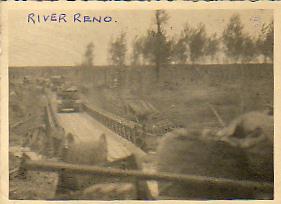
May 1945 — ‘C’ and ‘D’ Subs seen crossing a Bailey bridge over the River Reno, Italy This photograph was taken by Sergeant Arthur Ward from Sub ‘B’ Sir Donald Coleman Bailey was born in Rotherham he went on to design the Bailey Bridge which was of great military value in WW2.
This story was submitted to the People’s War site by Roger Marsh of the ‘Action Desk — Sheffield’ Team on behalf of Arthur Ward, and has been added to the site with his permission. The author fully understands the site's terms and conditions.
Refer to Chapter 1-- A4345544 -for links to other chapters.
LIFE IN THE ARMY
by
ARTHUR WARD
Chapter 25 — The River Po Crossed in Force
April 17, 1945
We moved at 06:00 hours behind the IX Lancers. They passed through the Queen's Bays and we were followed them through Argenta Gap.
We went into action about 08:30 hours approximately 700 yards from enemy lines - too near for comfort and much nearer to the enemy than artillery men usually were.
The tanks were mopping up just in front of us; we could see their machine guns firing away and Spitfires suddenly appeared and machine gunned the enemy, not very far away from us.
At 09:15 hours we had a rest from firing so I decided to have a quick shave, and wash in a bucket, but suddenly machine gun bullets came whistling all around, so it was a very quick shave. We sheltered behind the Sexton and just hoped that the enemy did not open up with mortars, as we would have had no chance.
After a time, the bullets stopped coming, so we guessed that one of the Lancers' Sherman tanks had put it out of action. We were really pleased about that.
At 10:30 hours, we had a Divisional target and we had to track 90°, i.e. at right angles to our line of fire, to fire at a tank only 1,800 yards away.
During the tracking, which was excessive for our type of tracks, one of our tracks came off. We started to 'break' it when Jim Hodgson of ‘A’ Bty brought his Sherman tank and pulled us back on the track again and when finished at 15:30 hours, we were back in action again.
At 16:30 hours, a petrol truck came to re-fuel us and he stopped behind our Sexton when we were heavily stonked by enemy 105 mm guns, including airbursts. One shell landed about 8 yards from my gun and peppered the sides with shrapnel. We had our heads well down and fortunately we were not firing at the time. The petrol cans were hit, so were my cartridges, but it was a miracle that nothing was set on fire. We were all very badly shook up but no-one was hurt. In nearby Fox Troop Gunner Hufford was wounded.
Later we were firing when we had 2 more periods of very heavy shelling. We managed to keep firing, although the Tannoy and wire on my Sexton were shattered by shrapnel. We had to receive and send orders by shouting to the Command Post.
We moved at 18:30 hours up to axis road of 78th Division and we passed many burning enemy tanks and SP guns, and many farm buildings were on fire.
Of course, many bodies were scattered around, some almost unrecognizable as human beings, and many farm animals lay dead where they had been caught in the gun fire. The smell was terrible and animals and men alike were soon covered with the dreaded flies - I have never liked flies since I gave a lecture on "Hygiene in the Field" in Africa.
We all worried more than usual now that we would be hit as we realized that soon it would be all over.
We went into action again, very close to the enemy, on our left a Spandau machine gun was rattling away and bullets were flying around again. The 9th Lancers were fairly racing away with us close after them, and a bridge over the River Conca was captured intact. The Lancers and A and E Batteries of the 11th HAC were well in front of the main force of the 8th Army.
We had to take turns on guard and I was on from 03:00 to 04:30 hours, although the night was unusually quiet. At 04:15 hours we fired 15 rounds on a DF target.
We moved forward at 10:15 hours, things were very hectic, we were moving fast and the ammunition trucks were having difficulty keeping up with us and keeping us supplied with ammo. The forward tanks kept sending messages for us to fire smoke screens "OBOE targets" to cover their advance. We were now in a very concentrated area of guns, tanks etc., ready for another `swan'.
We kept behind the 9th Lancers and passed through the forward tanks of the Queen's Bays, then over a canal at Porto Maggiore, and over another canal which had just been taken from the enemy.
The enemy were fighting for their lives now to defend the River Po which was very wide, and they knew it was the last natural obstacle for us to cross before swanning out on the Lombardy Plain into Austria and then hopefully into Germany itself.
We leagued near a village which was being stonked at intervals by enemy 105 mm guns, and we could see in front was a tower on a church which we guessed the Germans were using as an observation post, so they could see all our front line advancing.
We moved back 200 yards into a gun position and fired a few rounds. The church was now being hit by our artillery.
We fired a few rounds of HE when disaster struck - we were being shelled very heavily when a shell fell very near to the Gun Position Officer's truck and our GPO Ack (Assistant) Duckworth was hit and died instantly. He was a good mate of mine and I would think about the most popular man in the Battery. A South African man who was attached to us, Lt Richardson was wounded and taken to hospital.
Ducky was not married but had told us he was courting an Irish nurse. His death was a great shock to us, just a few days before the end of the fighting. It was just what we all dreaded at this time.
Soon afterwards we moved forward across a railway line, into what was supposed to be a quiet area, but we had a sleepless night firing on targets for the 9th Lancers.
Next day we moved at 06:00 hours to a farm further forward and we saw dozens of enemy tanks and vehicles knocked out. There had been a vicious fight in this area.
We fired 15 rounds, then we were told that we were going out of action for 12 hours' rest. We were all worn out and ready for the rest. We had a quiet night although my subsection was on guard duty during the night.
April 23, 1945
Next day we moved at 12:15 hours up 78th Division axis road into action again behind 3 farms.
It was near a village and the people here were very pleased to see us. A crowd soon gathered round the Sextons and I took some snaps of them. One girl called Vallina was very friendly, but could not speak English. Between us we realized she was saying she would like a British soldier for a husband.
They were glad to see the Germans move out as there had been some ill treatment and raping of young girls.
April 24, 1945
We moved on at 10:45 hours the next morning through a village, ‘A’ Bty were on our left and were being shelled by the desperate German troops.
We fired 30 rounds HE and then 20 rounds of Super Charge at enemy tanks near Ferrara. We were firing at our maximum range (about 8 miles) so we had to move further forward.
We moved at 18:45 hours and went into action near a farm which had been captured from the Germans at 14:15 hours on the same day by the East Surrey Regt.
We fired 30 rounds HE. We did not know at the time that these would be the last rounds we would fire in the war.
April 25, 1945
We moved again at 13:00 hours, about 3,000 yards to the west into a concentration area for a rest.
At night we had a few drinks of whiskey in the Command Post with other No.1's and officers.
April 26, 1945
Reveille at 09:00 hours - What Bliss!!! Maintenance at 10:00 hours until 12:30 hours.
I had a bath and washed some clothes, (in a bucket).
News came through - the River Po had been crossed in force and the enemy were in full retreat.
We were much refreshed by a good `kip', change of clothing and a bath, so we were looking forward to chasing an enemy in full retreat and perhaps pick up some loot.
Since taking over the Sextons from the Priest, my gun has fired over 8,000 rounds.
We stayed in this position for 3 days, then moved to the next farm and prepared to stay for 7 days rest.
We then learned We Had Finished Fighting.
May 01, 1945
We heard from the CO that since supporting the Commando attack on the Spit on Lake Commachio, to the last round fired by A Battery over the River Po on 25 April 1945, the Regt had fired 42,000 rounds of HE and 4,500 rounds of smoke, that is a total of 46,000 rounds fired by 24 guns equals 1,937 per gun in less than 24 days.
The people on this farm made us very welcome and we prepared for a long stay.
We organized billets in a farm building and cleared out a room for a Sgts' Mess. We paid 2 girls from the Italian family (which was a large one) to wait on us at meal times and to keep the billets clean.
Our Sextons and guns were cleaned and we had plenty of `spit and polish' as in a peace time army.
May 02, 1945
Heard Newsflash on Radio.
"Unconditional Surrender Of All German Troops In Italy"
One Million men involved and all equipment to be handed over to the 8th and 5th Armies.
The main topic of conversation now was `how long before we went home?'
Pr-BR
© Copyright of content contributed to this Archive rests with the author. Find out how you can use this.


 Recommended story
 Story with photo