

- Contributed by
- TORRANCE Duncan Leitch
- People in story:
- Duncan Torrance
- Location of story:
- Mediteranean
- Background to story:
- Army
- Article ID:
- A7569282
- Contributed on:
- 06 December 2005
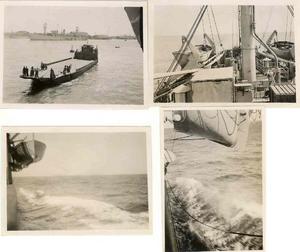
Top left, a 'Z' landing craft in Port Said. Other pictures taken when a passeger on the Empire Battleaxe, a sister ship of the Empire Arquebus.
CHAPTER X111 - Part One - A LIFE ON THE OCEAN WAVE
I was taken down to see the Staff Captain controlling 'organisation'. Imagine my pleasure, when I found he was an old OCTU friend, Paddy 0'Ryan. At first he thought I'd come to see him for old times sake and didn't realise I'd come to join his flock. He posted me to HT Empire Arquebus. He then gave me a requisition to stay at the Grand Hotel in Cairo, 'till I joined her at Port Said on her next trip.
HT stood for hired troopship. These were merchant navy boats, with merchant navy crews, on charter to the Ministry of Defence. These 'liberty ships' were built to an American design. Their hull plates were not rivetted, tthey were welded. This was a much cheaper and quicker way of building replacement boats when so many were being sunk by enemy submarines.
I had never before lived in the centre of a big town like Cairo. I soon decided I would never do it again. The noise was appaulling. I think the trams stopped at three and started again at four. I could not get to sleep. My room was set back from the main highway and six floors above it.
In due course I joined the ship. The first problem was getting aboard. She was moored to some pontoons. We tried to get up a ladder, but it was for crew only, so we were flung off. The next thing was to get a launch. We set off to get round to the companion way. But, as we rounded the bows, we found a 'Z' craft had jammed itself between our bows and those of the next ship, the Donata Castle, which was in the middle of embarkation. So we lay off and eventually got on board.
My quaters were magnificent. I had a cabin the size of a Six berth, fitted out for two, although I had it for myself. The cabin had a couch, two wardrobes, chest of drawers, desk, chair and was complete with both a fan and air conditioning.
My OC was a good man. And, as I soon discovered, left me alone to get on with the job. He liked a drink, even occasionally at sea. Surprisingly, drink was forbidden on a troopship. This applied to the passengers and ships staff, but not the crew.
I asked to be allowed to sail as far as Malta as a passenger. But the CO made me put my arm-hand on there and then, so I was soon busy. I claim I did fairly well, as I knew nothing about the job or the boat. I succeded in referring every decision by saying that the RSM or SQMS dealt with that.
The food was magnificent and we had ar wonderful trip to Malta. The wind would rise a bit in the mornings and evenings, then smooth out to an absolutely flat calm. One day we saw a large shoal of flying fish skating along the surface.
We arrived at Malta, and embarked 300 naval ratings which brought our total to 800, 250 below our capacity. We started embarking as soon as we docked in the afternoon. But we were unable to sail because the Embarkation Staff were slow in getting the men's kit bags alongside. These went into the hold, leaving the troop decks clear of clutter in case we had to get off the boat quickly.
All ships from Port Said were being held in quarentine, so we couldn't go ashore, but we were able to see a lot from the ship. The town itself was vary attractive and there was little bomb damage to be seen. All the wrecks had been moved from the harbour. By comparison,at Toulon we saw a lot of wrecks and salvaged ships.
In the 'Avant Port' or outer harbour of Port Said, I once saw two halves of an oil tanker moored. Both were hale and hearty. Both were inhabitted.
In the morning we laft Malta and passed Cape Bonn in the evening. Then we werked our way Northwards to Toulon.
During the trips we used to run record programmes over the ship's loudspeaker system. At first these were interesting and good fun, but our stock of record was poor and it became boring. To begin with, I was nervous about using the tannoy. All the staff and crew could recognise one's voice. Every mistake came back. Latterly I got used to it and came to enjoy it. It was especially good for dishing out rockets.
There is one amusing story about a mistake on one of the other ships. The 'Adj' announced a certain record.Then the following came over:
'Not that bl---y thing again O'Ryan'.
'Careful Sir, the mike?s on'.
It was a real delight to thread our way through the many cool, green, rocky islands to Toulon. We moored on a jetty beside the French aircraft carrier 'Colossus', recently taken over from the British Navy.
During the dissembarkation, I kept looking across at the hills above Toulon. Soon after the last man had gone down the gang plank, I had my boots on, and was off. I had a wonderful afternoon and evening walking on grass, instead of sand. The sun was lovely. It was warm without being oppressively hot.
France lived on her black market. One could sell a British or Egyptian pound for up to 900 francs. The official rate was 480 and 492 respectively. The British soldier had BAFFS - army of occupation money called pounds. They weren't wanted on the black-market.
If the troops changed their BAFFS to francs, the paymaster only gave the official rate of 480. In other words, we were trying to stabilise the French currency at the expense of the British soldier.
The following morning, we embarked about seven hundred ex leave and drafts. Included were a lot of second/lieuts. Tables were turned. I found they were a standing joke, very keen, an accent, clothing that was new and didn't fit. But, above all, overkeen for work.
Our trip was uneventful. We sailed between Sardinia and Italy. Then we went through the Straits of Messina. Here we got an excellent view of Mount Etna. At 10,036 feet high, it is the largest active volcanoe in Europe. The Island of Crete also lay in our path. A desolate island with no shore, but enormous cliffs. A mass of rock in the sea.
On arrival in Port Said, we found we were to wait there for five days. Also, some high Egyptians came to look at the ship. Rumours began to circulate everywgere. We might be going to carry pilgrims to Mecca. Certainly there was something in the air. Eventually we sailed, still in the dark,
Ships Staff had its disadvantages. We lost our Mediteranean Pay Allowance of four shillings and sixpence a day. We had no batmen. We had to do our own laundry, or risk sailing without it.
One day I went down to the ship's ironing room, or Isolation Hospital, to give it's official name. I had a chat with the RAMC sergeant. I mentioned to him that it felt cold. He looked at the thermometer and I was told it was eighty degrees.
On board ship it was always ten degrees warmer than ashore. One day in Port Said, they wanted to do some work on the main generator. We were without fans or air conditioning. The heat was terrible. Ashore, I was never troubled by prickly heat, but I found it starting on board ship.
On the sixth morning in port, we began to embark another load of seven hundred troops. The OC troops left at ten to visit another ship, and did not return until two thirty, an hour-and-a-half before we sailed.
The embarkation on my own was bad enough but it was complicated by some trouble. Contrary to the Army's requests, Sea Transport had stipulated that kit bags were not to be carried on the troop decks. A senior Sea Transport Officer inspected one of the troop-decks, and immediately decided that the kit bags should go in the hold as before. To get men who've been up early and travelling, to move their kit bags, and part with them in unfamiliar surroundings, is quite a big job.
Enentually we had the final inspection and sailed direct for Toulon, although travelling the Malta route. Still uncertain about out future, it was more or less definite that the ship was to be handed over to the Egyptian Government. Our journey was uneventful, 'till we passed Pantileria and Cape Bonn.
The following morning, I woke, checked the time by my watch, and sneaked behind the sheets for an extra five minutes. Then I suddenly noticed the boat was moving in an unusual manner. Instead of seeing the sky through my porthole, I could see the sea.
I jumped up, dressed, and went out. A real storm was in progress. I sat down in a chair in the orderly room, but was immediately rolling across the deck with the chair clattering along behind me.
My first thought was the troop-decks. They could be in great distress. I started to walk down the forward companionway. But, as the bows sank, down into a trough, I found myself so light, I almost left the steps. Then, suddenly, I felt like a sack of coals with the steps rushing up to hit me, as the bows heaved themselves out of the water in a cloud of spray. Much to my surprise, the passengers were up and there was very little mess about the place.
The next part of the ship I visited was the cafeteria. Here again, I was deceived by the pitching of the vessel. I was walking down the central alleyway between the tables. I was flung forward and started to run, nearly slipping on some porage, and eventually crashed onto the bulkhead, grasping a hot pipe with unpleasant results. The manager said we were only 200 short for meals.
I returned to the orderly room. I announced first sitting saloon breakfast over the speakers. I advised everyone to eat as much as they could, and keep on deck in the fresh air. Boat drill was cancelled, but all fatigue parties would carry on as usual.
At ten o'clock when the daily ships inspection was ready to start, we suddenly found that the SMO - the Doc ? had disappeared. Nobody said anything. We all knew that he had followed the SQMS and the RQMS, to some quiet corner.
The inspection itself was so pathetic, that when we got back, we tried a moral boost and decided to play the gramaphone record requests. Our first record, a life on the ocean wave, was much derided. After two or three goes, we had to stop. The arm of the gramaphone kept slipping, and refused to run properly uphill.
In the afternoon, the RSM and I were left alone to keep things going. The ship's crew was short anyway due to desertions in Port Said. There were not enough regular crew to sail the boat. The skipper moved stewards off the mess deck into the crew.
We sent up to 25 volunteers down to the mess-deck. So the ship sailed on. Messages came in from all sides. Only three men left in the cafeteria. The RSM and I walked round the decks. Any fit person was commandeered. Another message from the chief steward. Two of his stewards were sick, could we get two people to help him out.
My own cabin had a very narrow escape. A small captain in the Gordons told me the canteen had closed early, which it had, and he had no cigarettes. I invited him into my cabin, gave him a tin, and we started to chat. He seemed pleased at having been fit all day, then suddenly tore away but was caught short in the passage. He was the last visitor that day.
By five, things began to look serious. The sea water was rushing down the scuppers past the orderly room. Getting in and out of the orderly room was difficult. The bridge was being swept with spray. The Chief Engineer told the Captain that strains were being set up in the hull. We slowed down further, our speed then was only eight knots, and took the bows five degrees out of the storm.
We later heard that one of our sister ships lost two lifeboats, washed overboard.
Before going to bed, I walked round the decks to ensure no one was too ill to go below decks. As a safety precaution, the open decks had already been placed out of bounds. What a sight of desolation, rain, wind, and spray, with two solitary police crouched miserably in a hatch, ducking behind their sodden overcoats. I opened the door into the canteen square. Miserable lumps of human flesh. Some trying to sleep, others just bored.
I went into the troops recreation room. It was another mass of misery, huddled together for warmth. I asked them why they didn't want to go below. They didn't want to go was the only answer.
I went below decks for a minute or two. Conditions were very little worse than usual. There is always the smell of unwashed feet, but things seemed reasonably clean.
I got to bed, hoping things might quieten. Personally I felt fairly well. But I knew we must get some able fatigue parties. We must get the boat cleaned up before we docked in Toulon.
The morning found us riding on an oily swell. All the vacant places were filled at breakfast. Soon, the fatigue parties were busy cleaning the ship while we prepared the documents in the orderly room, sorted the mail and tied it into bundles.
Little did I think that this was the last time I would throw off my adjutants armband, and spend an afternoon treking over the hills of southern France.
© Copyright of content contributed to this Archive rests with the author. Find out how you can use this.


 Recommended story
 Story with photo