

- Contributed by
- actiondesksheffield
- People in story:
- ARTHUR WARD, Lt Turner, Wally Walton, Chalky White, Sgt. Major Whitby, Sgt "Tiffy" Smith, Gnr Gow, Sgt John Rodbard, Tom Pridmore
- Location of story:
- El Alamein, Tripoli, El Daba
- Background to story:
- Army
- Article ID:
- A4454282
- Contributed on:
- 14 July 2005
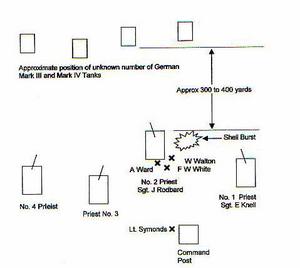
November 02, 19 42 - The Photograph is of a sketch showing how Gunner Arthur Ward survived the Battle of El Alamein.
This story was submitted to the People’s War site by Roger Marsh of the ‘Action Desk — Sheffield’ Team on behalf of Arthur Ward and has been added to the site with his permission. The author fully understands the site's terms and conditions.
Refer to Chapter 1-- A4345544 -for links to other chapters.
LIFE IN THE ARMY
by
ARTHUR WARD
Chapter 12 — The Battle of El Alamein
October 29, 1942
Firing all day and after dark, we came out of action for a rest. We had not travelled very far when a roll of barbed wire became entangled in the tracks of our tank. We were on a track surrounded by mines so we could not wander very far. The remainder of the Regt. carried on so we were left behind on our own. We felt very vulnerable as flares were being dropped and Verey lights were used to light up the area. After 2 hours of frantically trying to remove the wire with a pair of pliers and a hammer, we managed to free it from the tracks.
By now the Regt. was far away and the tanks of the Queens Bays were passing, so we followed them to their leaguer (a leaguer is where most nights in the desert all the units had their own little party and usually in a circle, so that they could defend themselves if attacked. (This was similar to the days of the cowboys in the far west with the wagon trains).
We tried to sleep but Jerry planes dropped bombs very near to us so we moved back another 3 miles and had a peaceful remainder of the night.
Friday, Saturday, Sunday. Resting but had to carry out maintenance. We managed to get the Browning guns to work which we needed when being attacked quite a few times by the dreaded Stukas.
We were near El Alamein station also within walking distance of the sea so we were able to cool ourselves down in the sea.
Then bad news: the advance had faltered and the Battery Commander said the situation was desperate because we had lost a lot of men and tanks.
We learned that we had been fighting for Kidney Ridge and this is where the Germans had concentrated their largest numbers of tanks and here, Lt Turner who was of CO Rifle Brigade had won a VC.
We attacked at night in a similar way to the opening attack on the 23rd, but the shelling, machine gunning and bombing were so fierce, we thought we should not get through the day. It was decided that a rum ration would be issued. This only happened on very rare occasions when the fighting was really bitter.
Wally Walton had to fetch the ration for our substation; 1 tea spoonful each, it was very strong and thick like syrup. Wally thought it was all for him before he was stopped when he had nearly drunk it all. It certainly affected him and he had a real hangover.
This was issued at 02:15 hours in the morning and we were in action at dawn.
November 02, 1942
The battle field was really hectic, shells, bombs, air bursts, machine gun bullets, the constant smell of cordite from the gunpowder and in places smoke shells had been fired so it was just like a thick fog.
Then at 10:30 hours we had to engage 2 Mark IV special tanks which were the best that the Germans had in the desert.
We could just see the tops of them bedded down in the sand dunes. They were better equipped than us for firing at close range. Suddenly shells landed all round our gun and at the time, I was at the back of the priest helping to load up with fresh ammunition, when shells whistled over. We always said that the longer the whine the further away the shell would drop.
Then there was a whoosh and one fell a few yards away just to the side of our priest. I was blown to the side with the blast and when the smoke cleared, I saw 2 lads (whom I had just been talking to) laid on the floor. One was Chalky White (from Reading) whom I had known for a few months. I turned him over and he had a hole in his head, about 4" in diameter. It was obvious that he was dead. I turned to Wally Walton (Barnsley) and he was practically the same, a hole in his head and very little blood, I can see to this day his face was ashen white and the sand which was caked to his face was just falling off him, just like water running off a boulder. I had known Wally nearly 3 years as he had come with me from 70th Field Regt. The situation was utter chaos!!!
We received orders to pull back and our No.1 Sgt. Rodbard shouted over the din for Driver Morton to reverse. The priest would have run over the two lads but I just managed to signal for them to stop. Sgt. Major Whitby came across and told me to get back on board and I just had time to grab Wally's wallet from his pocket before I boarded the Priest and we retreated for 250 yards. It was very much against the grain but we had to leave the lads there, as we could do nothing for them.
The system in battle is that men had to be left where they lay when killed, then the Pioneer Corps came along and buried them where they lay, then later when the battle was over they would be recovered and buried in a military cemetery.
2nd November 1942 is a day I shall never forget, coming so close to death myself and seeing 2 good men lose their lives, which all seemed so unnecessary - What good were we all gaining out of it all?!!!
Lt. Symonds was injured with splinters from the same shell and had to go to hospital.
The photograph above is of a sketch showing how I survived.
I think the German tanks would have been about 400 yards away from us. We took up another position and were firing indirect fire (means we could not see the target but our forward Observation Officer would be able to see them) at 88 mm guns which were the pride of the German army.
The battle carried on. We were firing most of the day and trying to get some sleep at night. Under the circumstances we would have been unable to sleep but we were so tired we were practically unconscious when we laid down.
At this time we heard that the 1st army had landed on the Western end of North Africa, so we hoped it would take some of the pressure off us and the CO said it was to be a race to see who reached Tripoli first.
One night we were in Leaguer and we usually dug slit trenches in the sand to sleep in. These gave us protection from shells and bombs at a distance, but the Germans fired a lot of air bursts from their guns which were shells that were timed to explode about 20 feet above the ground, so if overhead, any shrapnel would fall into slit trenches. Also their planes dropped what we called "Cracker Jack" bombs - these were large containers which opened up before they reached the ground and scattered hundreds of smaller bombs sometimes called Butterfly bombs, and they did the same thing falling into the slit trenches.
To counteract this we dug trenches then drove the priest over the top of them to give us protection from above.
In one area at El Alamein we did this but there was only shallow sand and underneath was hard rock, so we could only dig down about 1 foot before the priests were driven over. One night we were machine gunned and bullets were flying over about 2 feet above the ground. I had my great coat on due to the cold weather, and a bullet must have been lower than the rest and it passed through the broad lapel without touching me.
Whilst I was laid in a shallow slit trench we had Gnr Gow and a gun fitter in our subsection to make up the ammunition numbers but on the second day with us they were both hit by splinters from shrapnel. They looked a sight as they were covered in blood, although their wounds were not serious. Sgt "Tiffy" Smith gave them both ether and they were sent away in a blood wagon (slang for ambulance). We all carried supplies of ether to give for pain. The heavy shelling from enemy 88 mm guns blew off the dial sight on our gun so we were out of action.
I add here part of the description of one day in action at the Battle of El Alamein as told by Ernie Knell in his article "A True Personal Story of the Battle of El Alamein Written at the Time of it Happening".
Note that the priest described in this action, the No.1 is Sgt John Rodbard and I was No.2 on this gun.
John Rodbard died about 1991.
My good mate Sgt "Tiffy" Smith was killed in action later on in Italy. "Tiffy" is short for Articifer and he was a type of mechanic who was responsible for all the guns in the battery being in working order.
This copy of Sgt Ernie Knell's description of El Alamein was typed by a member of Sheffield's Forum of People with Disabilities for A Ward from a HAC Old Comrades ASSN Newsletter.
The Battle of Alamein
November 02, 1942
At last dawn comes and we go into action where we were. Our Infantry is just 200 yards in front, the range being only 2,400 yards. No sooner does it get light than bullets fly all over the place - they seem like rifle shots - God, they are close on each side.
Our infantry keeps up a steady machine gunning, then a breeder opens up on us. I can see Mr Onslow on his way over to me. A breeder bullet explodes right in front of his eyes - God, it's got him! I jump out but only get a couple of yards when I see him get up and go back to 'G' truck.
The question of a brew comes up again - Clive wants to do it but I don't think it's safe - he lets me have a few words back then, to the amusement of the Crew. I take a look round with the glasses. There are three tanks on our right, about 200 yards away but I can't make up my mind whether they are ours or not - they look like M.4. Jerries to me. Walter also takes a look, goes over to ‘G’ truck and then over to Johnny's gun. Good, they are going to take them on open sights.
I watch the first few shots - they begin to move - good! Just then fire orders come through on the wireless - I have to see to my own job though I wish I could have a go at them too. I no sooner get off my series than H.E. begins to fall around us heavily. Johnny is still having a go at those MA's. When the smoke clears, I see two prone figures next to his gun. I send over Clive quickly with the first aid box, as his crew are busy and Walter is loading for them. Clive returns too quick - God, they are done for, Walton and White, a couple of pals of Parker.
The Crew is very quiet and I say "One of you had better go over to ‘D’ Crew. Parker looks at me, I know he doesn't like it so suggest Gow - I say: "Well, ginger did go last time". He gets down and goes over with no comment. Jerry seems to have us well taped. I wish we could move, I don't like these unnecessary risks, it's what we have tracks for, so as to get out easily.
He starts again very heavily and we get orders to retire - thank God. Ossy is in too much of a hurry to go, can easily crash into someone in this blue smoke. I take it easy, get round and forward, find other guns well on their way, and go into action again, some 1,000 yards back. God, Jerry's OP must be watching us as no sooner are we in than down it comes again, and seems even heavier. When it stops I hear Walter shouting for me - Gunner Gow, my chap, had got it - on Johnny's gun again - he is in luck today. I feel sort of responsible for sending him, so go over myself with the first aid kit - a piece of shrapnel has gone through his tin hat - the hat no doubt saved his life - he had a bad scalp wound. Tiffy Smith comes up to help. We get dressings on when more orders come through, so double back to my gun. As I get back aboard more shells fall around ‘D’ Crew. I think of Tiffy and intend to go back, but see Walter making his way there so I take charge of my gun - All are OK here. None hurt. They get Gow away in the ambulance.
We get orders to retire again, this position is as bad as the first, and on the way back we watch Jerry shelling the place where we were. We have a laugh, but too soon, as the Stukas are on to us. We go flat, we did not see them as we were watching the shelling and did not get a round off the A/A - still it only lasted half a minute and they were gone and no damage done. So yet again we go into action, this time behind a nice little crest - let's see if they can spot us now. Its a nice situation to settle down to a spot of firing. The range is 5,000 yards on account of our move back, but who cares? The shells fall, there just the same - it's also good to watch him shell like hell where we were. Every time we fire Clive says, "What about that brew?" and this time I let him. We are thankful for it as we have had a bad day so far. Still we are settled now. The rest of the day goes quietly except for a stray shell that fell near my gun; Parker was on the floor; we heard him yell, then his body flies over the side, saying "I've been hit, I've been hit". We quieten him down - can't find anything wrong with him except a bruise at the back of his ear. I said "Christ, I though you had your head off Ginger". We all laugh. He does not at first, but joins in, saying "I thought I had had it then". I give him a job doing No.2.
I am not sorry when the day comes to an end and I go over to ‘G’ truck for news. We are doing very well in spite of the bad day our troop had. I get a 'wet' from Walter - it tastes good. We dig a Crew sleeping hole and so to bed.
End of excerpt from E Knell's account of the Battle of El Alamein.
November 03, 1942
During the night I was on guard but we had to spend most of the time in slit trenches due to machine gunning.
Most of the night a terrific barrage was carried out by 25 pounder and 4.5 guns, the shells were whistling over our heads and landing with a heavy crunch about a mile in front of our position.
November 04, 1942
We advanced 2 miles and fired 250 rounds during the day. We formed a close leaguer at night and were bombed but no damage caused.
Tom Pridmore (from Oughtibridge ex 70th Field Regt.) came into our subsection.
We fired at 10,000 yards (our maximum). We advanced to a "Wog" (army slang for Arab) village called El Daba where we saw an air field which had many bomb craters and dozens of German and Italian planes smashed up on the runways. Our division captured a whole division of Italian troops, very dishevelled, dirty and miserable, they all looked. The Germans had retreated and left the 'Ities' without transport ("Ities" is slang for Italians).
We advanced by stages passing abandoned enemy airfields, tanks, guns and trucks. We saw many harrowing sights where enemy troops were blown to bits and the most upsetting was where they had been burnt to death. This happened a lot when tanks were hit and the men tried to get out with their clothing on fire, and they had died from their burns as they tried to escape.
The smell was terrible and if only the men who started wars were in the front line like this, I am sure that they would think twice about being involved. Of course we saw men from our own side who had been killed by the enemy before they fled. During this advance we had our photographs taken by newsreel men.
November 05, 1942
The chase was now was becoming a route.
Pr-BR
© Copyright of content contributed to this Archive rests with the author. Find out how you can use this.



 Recommended story
 Story with photo