

- Contributed by
- johnmeg
- People in story:
- Megan Rees (nee Llewellyn)
- Location of story:
- Castle Bromwich,Birmingham
- Background to story:
- Civilian
- Article ID:
- A4093382
- Contributed on:
- 19 May 2005
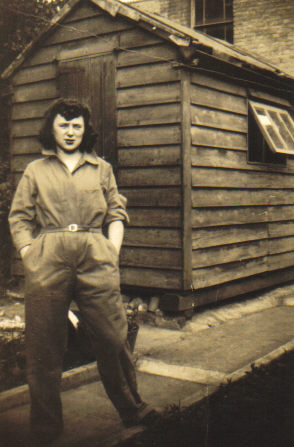
Megan in work clothes
I was born in 1921 in the small town of Ammanford in South Wales. The family moved to Birmingham to find work in 1936 and we lived in the Erdington area.
I remember coming down the stairs on the morning of Sunday, 3 September 1939 hearing the news on the wireless that war had been declared. It was my father’s birthday.
When the war started I was working at the Valor factory. The factory made cookers and heaters. I worked on the hand presses. There were heavy weights on the press and I hurt my wrist. I had to go to the First Aid at the factory and they said I had sprained my wrist. The foreman was not very happy with me. I worked with Joan, a girl from Alum Rock. She was a pretty girl and was a trained hairdresser. We decided to look for work together at another factory.
We walked up the road to Dunlop’s, the tyre factory, and found jobs there. There was no problem in getting jobs. My job at Dunlop’s was examining the skeins of elastic rubber. White cotton stuff covered the rubber. The dust from this cotton covered every surface and worker. The floors were ankle deep in the dust. Everyone inhaled the fibres. I began to have chest trouble and Dr Devlin told me to change my job. It was then that I left Dunlop’s and went to work for Nuffield’s where they produced the Spitfires. There was no particular reason for taking a job there; it was just the next factory along the road.
I worked in C Block at the factory. Later during the war Lancaster bombers were made in Blocks E and F . We worked in a big shop where there were sections for the starboard wings, the port wings, the fuselage and the finishing section. From the finishing section the planes would go across the Chester Road to the aerodrome.
During my time at Nuffield’s I always worked on the same section. I worked on the starboard wings of the Spitfires. The wings of the Spitfires were built vertically in jigs. When I first started, I drilled the holes on the ribs of the wing (the frame of the wing) with a hand held drill. I once drilled through my little finger and went to first aid with the bit of the drill still in my finger and holding the drill steady in my other hand. I then progressed onto marking the position of the holes. You had to be very accurate. When things had to be riveted together you worked in two’s; one person operating the riveting gun and another with an iron block underneath the hole being riveted to take the pressure. A man would have the riveting gun while I held the block of iron . It was very noisy and there was a lot of vibration. Once the ribs had been prepared, the skins (big aluminium sheets) were fitted to the ribs. The skins had also been through a similar process of having holes marked and drilled. I used to machine drill the holes in the skins and then change the tool to punch the holes so that the rivets could lie flush.
Albert, a chap that I worked with on riveting had an ulcer so he did not eat. He smoked instead. He was a chain smoker. We would be offering one another cigarettes all day. We smoked Craven ‘A’ and Senior Service. I was forever putting the cigarette down so that most of it went up in smoke. I used to think that I might die from smoking before he died from his ulcer. There were no restrictions on smoking even though paint spraying was taking place in the area. It seems strange now but smoking was a way of life then.
Mr Carter was one of the inspectors. He checked that the nuts and bolts on the ribs had been locked securely before passing the job as ready to have the skins fitted. Not everyone wanted Mr Carter to check their work because he was so meticulous in his inspection. The lives of pilots depended on the planes being built properly so it was very important that the everyone did their job correctly. We would see planes coming back for repair and they were all shot up, their propellers mangled like the tentacles of an octopus. Mr Carter did not want anyone working on the jig while he was doing his inspection. However, he would allow me to continue to mark the holes on the ribs at one end while he inspected at the other.
When the planes were finished they were taken over the road to the aerodrome. Lord Haw-Haw said that we were waiting for rings (for the guns) to complete the planes and for us not to bother because they would bomb the planes before we received the rings. Now what he said was true, we were waiting for these rings. Someone was supplying him with inside information. They used to say that there was someone by the railway, signalling to the enemy with a torch.
Initially we worked two twelve hour shifts, 6 am to 6 pm and 6 pm to 6 am. We all used to clock in and out. When on the night shift, at 9pm we would put our gas masks and clothes ready at the end of the jigs so that we could grab them when the sirens went off. We would have to run to the air raid shelters. The shelters were underground and huge. There were benches each side for sitting. There were no bunks for sleeping. The men used to play cards down one end of the shelter. There must have been some lighting but there were no facilities for making a drink or anything to eat. We would have eaten any food we had taken to work long before. We would then have to stay there until the all clear was given and we returned to our work.
I remember going to work to start the 6am shift one morning and D Block had been bombed the night before. The clothes, shoes and gas masks of the workers from D Block were piled in heaps between A and C Blocks. They were wet from the water used by the fire brigade to fight the fires. You could see bodies still in the girders of the roof of the factory. It is a sight that you never forget. It was after the bombing of D Block that they altered the working hours to three shifts, 6am to 2pm, 2pm to 10pm and 10pm to 6am.
There were air raids during the day too. The German planes would machine gun the workers running to the shelters. Another time when there was bombing during the day, my mother sent my brother Jack (he was not working because he was ill with TB) to the factory to see if I was okay. While making his way to the factory he had to shelter under a bridge because the German planes were machine-gunning the roads.
We had special buses to take us to Nuffield’s. We had to pay the bus fare out of our own pocket. There used to be one of the workers who had a wonderful singing voice. He was a Welshman who lived in Handsworth. He always sat on the top deck at the back of the bus and sang while the rest of us listened. He was a rather big but shy chap. He would not sing if people turned to look at him.
One day the bus could not come down its usual route along the Number 11 Outer Circle route because a bomb had been dropped on the road by Rookery Park. Instead, the bus went down Wood End Lane. It was only a small lane and there were overhanging trees. The branches of the trees brushed the roof of the bus and we all dived onto the floor of the bus thinking it was machine gun fire.
We wore overalls at work. We had lockers for our personal things. Each block had a restroom and there was a big canteen. In the main canteen there was a stage. The radio programme ‘Workers Playtime’ used to come to the factory.
Alex Henshaw, the chief test pilot, would come around the factory. The King and Queen and Prince Michael of Kent came to visit the factory. I remember we were waiting outside to greet the King and Queen and they were late.
Towards the end of the war I finished working at Nuffield’s. I returned to South Wales for some treatment that was supposed to help cure the psoriasis that I had.
Throughout the war I just remember being so very tired working long hours but you just got on with doing what had to be done. I was too tired to do anything but work and sleep but I will always have a special place in my heart for the Spitfire.
© Copyright of content contributed to this Archive rests with the author. Find out how you can use this.



 Recommended story
 Story with photo